Types of Welding Explained: MIG, TIG, Stick, and Flux Core
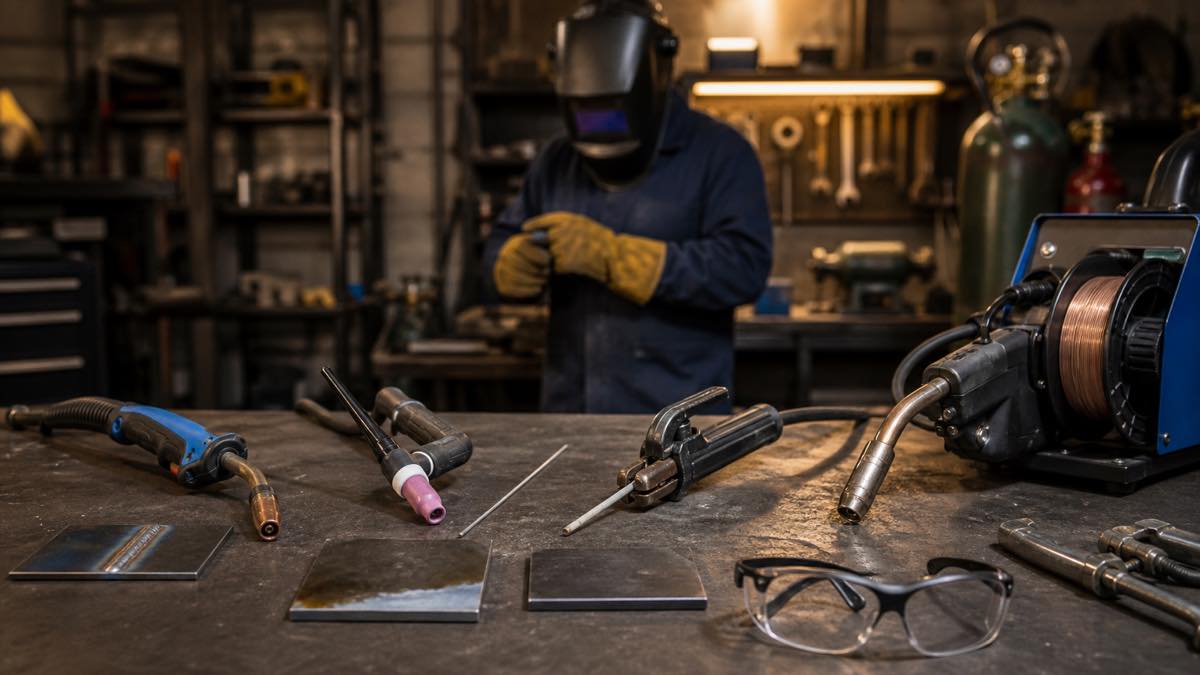
There are many types of welding, but most beginners should start by understanding four common processes: MIG welding, TIG welding, stick welding, and flux core welding. These are the welding types you will see most often in home shops, repair work, fabrication projects, farm repairs, automotive work, and beginner welding guides.
Each process joins metal by creating heat at the joint, but the setup is different. Some use wire feed. Some use welding rods. Some need shielding gas. Some create slag. Some are easier to learn, while others give more control once you build skill.
Mark Dawson’s beginner note: Do not choose a welding process only because someone says it is best. The best welding type depends on your material, workspace, budget, safety setup, and the projects you actually want to build or repair.
Quick Answer: What Are the Main Types of Welding?
The four main types of welding beginners usually compare are MIG welding, TIG welding, stick welding, and flux core welding.
MIG welding is a wire-feed process that usually uses shielding gas. It is often the easiest welding type for beginners to learn.
TIG welding is a precise process that uses a tungsten electrode and often a separate filler rod. It is excellent for clean welds, thin metal, stainless steel, and aluminum, but it is harder to learn.
Stick welding is a rugged process that uses flux-coated welding rods. It works well outdoors and on thicker steel, but it takes practice to control.
Flux core welding is a wire-feed process that uses flux inside the wire. Some flux core wires do not need external shielding gas, which makes them useful for outdoor welding and repair work.
If the terms arc, electrode, filler metal, shielding and weld pool are still new, begin with What Is Welding?. That foundation makes the process comparison below easier to use when you choose a machine or plan your first practice session.
Welding Process Names vs Common Shop Names
Welding can feel confusing because the same process may have a technical name and a common shop name.
- MIG welding is commonly used to describe GMAW, or Gas Metal Arc Welding.
- TIG welding is commonly used to describe GTAW, or Gas Tungsten Arc Welding.
- Stick welding is commonly used to describe SMAW, or Shielded Metal Arc Welding.
- Flux core welding is commonly used to describe FCAW, or Flux Cored Arc Welding.
For beginners, the common names are easier to remember. But knowing the technical names helps when you read manuals, welding charts, safety documents, or training material.
MIG Welding
MIG welding uses a machine-fed wire electrode. The wire comes through the welding gun and melts into the joint. Most MIG welding also uses shielding gas to protect the weld pool from contamination.
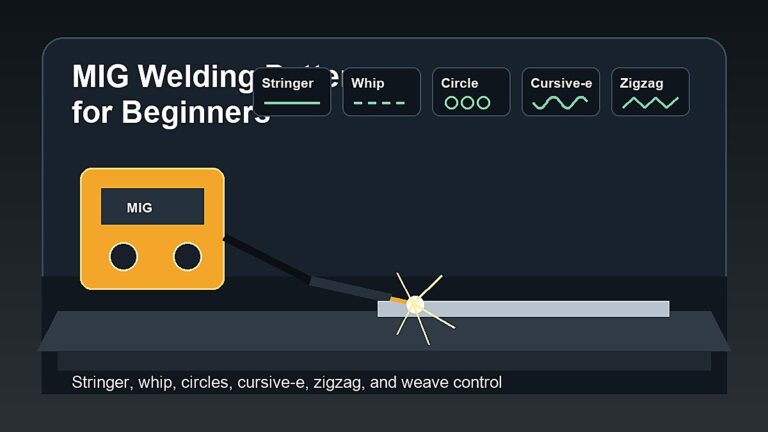
MIG is popular because the machine feeds the wire automatically. That lets beginners focus on torch angle, travel speed, stickout, and watching the weld pool.
Best Uses for MIG Welding
- Garage projects
- Mild steel fabrication
- Auto body and repair work
- Brackets, carts, tables, and frames
- Beginner practice on clean steel
- General home shop welding
MIG is often a good first process for someone working indoors with clean mild steel. Start with the MIG Welding hub when you are ready to learn machine settings, gas, wire, and beginner technique.
MIG Welding Pros and Cons for Beginners
Pros: MIG is easier to learn than TIG or stick for many beginners, makes clean welds when the setup is right, works well for mild steel projects, and needs less slag cleanup than stick or flux core.
Cons: MIG usually needs shielding gas, wind can blow away shielding outdoors, the metal needs to be clean, and the full setup includes wire, gas, polarity, and machine settings.
TIG Welding
TIG welding uses a non-consumable tungsten electrode to create the arc. The tungsten does not melt into the weld like MIG wire or stick rods. The welder may add filler rod by hand while controlling the torch and heat.
TIG gives excellent control, but it requires more coordination. You may need to control the torch, filler rod, and foot pedal or amperage control at the same time.
Best Uses for TIG Welding
- Stainless steel
- Aluminum
- Thin metal
- Clean visible welds
- Precision fabrication
- Projects where appearance matters
- Controlled welds on clean material
TIG is a strong process, but it is not usually the fastest path for a complete beginner. The TIG Welding hub is a better next step after you understand welding basics and safety.
TIG Welding Pros and Cons for Beginners
Pros: TIG can make very clean welds, gives excellent heat and filler control, works well on thin materials, and is common for stainless steel and aluminum.
Cons: TIG is harder to learn, slower than MIG for many jobs, requires clean metal, takes more hand coordination, and can cost more to set up.
Stick Welding
Stick welding uses flux-coated welding rods. The rod acts as both electrode and filler metal. As the rod burns, the flux helps protect the weld pool and leaves slag over the weld.
Rugged repair work is where stick welding is most familiar. It is common on farms, construction sites, outdoor repairs, and thicker steel.
Best Uses for Stick Welding
- Outdoor repair work
- Thicker steel
- Farm equipment
- Field repairs
- Situations where gas cylinders are not practical
- Dirty or less-than-perfect conditions
- Structural practice under proper training
Beginners need patience with stick welding. Starting the arc, holding the correct arc length, and avoiding rod sticking can take practice. For rod selection and related basics, use the Welding Rods & Electrodes hub with the Stick Welding hub.
Stick Welding Pros and Cons for Beginners
Pros: Stick works well outdoors, does not need external shielding gas, handles thicker steel, and uses a simple machine setup for repair and field work.
Cons: Stick can be harder than MIG for many beginners, creates slag, makes more spatter than TIG or clean MIG, and is harder to control on thin metal.
Flux Core Welding
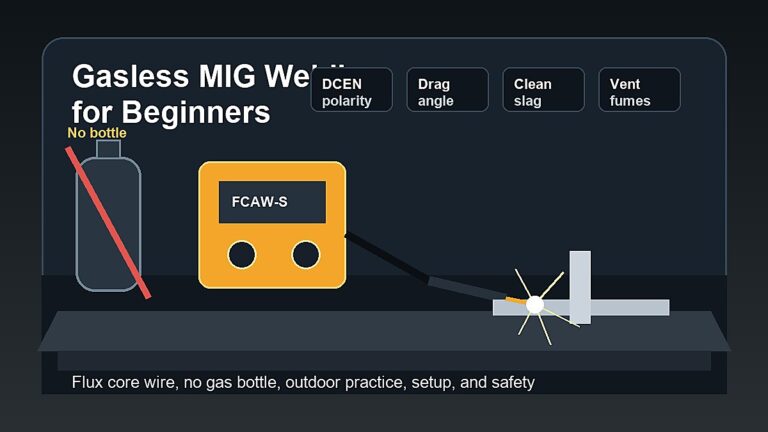
Like MIG, flux core is a wire-feed process, but the wire contains flux inside. Some flux core wires are self-shielded, meaning they do not need external shielding gas. Other flux core wires are gas-shielded and used in more advanced or industrial settings.
For beginners, flux core usually means self-shielded flux core welding with no gas cylinder.
Flux Core vs Gas MIG
Flux core and MIG can look similar because both often use a wire-feed welding gun. The big difference is shielding.
Gas MIG uses solid wire plus shielding gas.
Self-shielded flux core uses flux-filled wire and usually does not need a gas cylinder.
That makes flux core helpful outdoors because wind can disturb MIG shielding gas. The tradeoff is that flux core usually creates more smoke, spatter, and slag.
Flux Core Pros and Cons for Beginners
Pros: Self-shielded flux core does not need a gas cylinder, works better outdoors than gas MIG, can be useful for repairs and thicker material, and keeps the familiar wire-feed feel.
Cons: Flux core creates more smoke and fumes, more spatter, slag cleanup, and may be harder to control on thin metal.
MIG vs TIG vs Stick vs Flux Core
Use this beginner comparison before choosing your first welding process.
MIG welding
Best for: indoor home shop projects, mild steel, fabrication, and beginner practice.
Difficulty: easy to moderate.
Needs gas: usually yes.
Cleanup: low.
Best beginner fit: very good.
TIG welding
Best for: thin metal, stainless steel, aluminum, and clean precise welds.
Difficulty: harder.
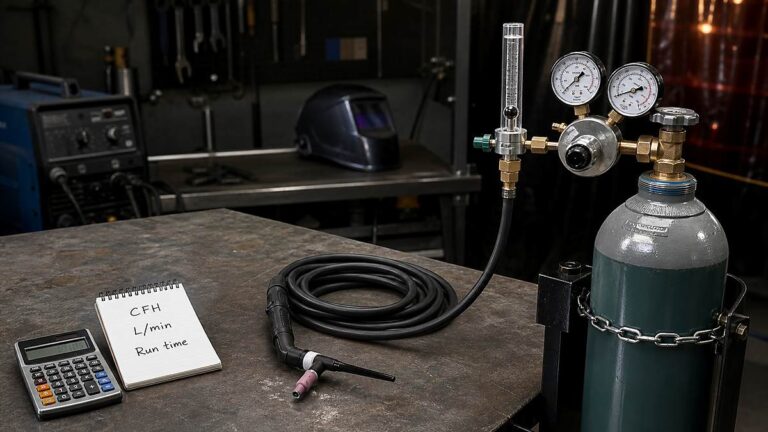
Needs gas: yes.
Cleanup: low.
Best beginner fit: better after learning the basics.
Stick welding
Best for: outdoor repairs, thicker steel, farm work, and field repairs.
Difficulty: moderate.
Needs gas: no.
Cleanup: slag removal required.
Best beginner fit: good if your work is mostly outdoor repair.
Flux core welding
Best for: outdoor welding, repairs, no-gas setups, and thicker steel.
Difficulty: easy to moderate.
Needs gas: not for self-shielded wire.
Cleanup: slag and spatter cleanup.
Best beginner fit: good for budget and outdoor users.
Which Type of Welding Should You Learn First?
For most beginners, MIG welding is the easiest type of welding to learn first if you have an indoor workspace and can use shielding gas.
Choose MIG welding first if you want to build garage projects, learn on mild steel, and practice with a process that is easier to control.
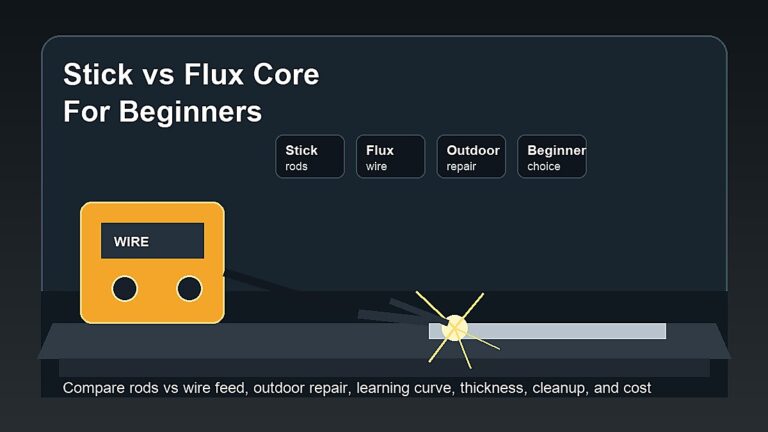
Choose flux core welding first if you need a lower-cost setup, want to weld outdoors, or do not want to deal with a gas cylinder right away.
Choose stick welding first if your main goal is outdoor repair, thicker steel, farm equipment, or rugged field work.
Choose TIG welding first if your main goal is thin metal, stainless steel, aluminum, or high-control welding, and you are ready for a steeper learning curve.
- Learn welding safety first.
- Choose one process based on your real projects.
- Practice on clean mild steel.
- Learn how heat, travel speed, angle, and fit-up affect the weld.
- Study common welding defects so you can fix problems early.
- Move into more difficult materials and joints after you can make consistent practice welds.
Safety Notes for Every Welding Process
Every welding type has safety risks. MIG, TIG, stick, and flux core can all involve hot metal, sparks, electric shock, fire, fumes, ultraviolet radiation, burns, and eye injury.
Before welding, use proper PPE and read your machine manual. A basic safety setup should include a welding helmet with the correct shade, welding gloves, flame-resistant clothing, safety glasses, ventilation or fume control, a fire-safe workspace, secure clamping, and safe handling if you use gas cylinders.
Flux core and stick welding can create more smoke and fumes than clean TIG or gas MIG, so ventilation matters. TIG can look cleaner, but it still creates UV radiation, hot metal, and fume risks depending on the material.
Avoid welding near flammable materials. Do not weld on unknown containers, tanks, or coated metals without proper training. For structural, vehicle, trailer, pressure vessel, or safety-critical welding, get qualified training and professional inspection.
For safety basics, review official resources such as OSHA welding, cutting, and brazing guidance, OSHA’s welding fume fact sheet, and the American Welding Society free resources page.
Common Beginner Mistakes When Choosing a Welding Type
- Choosing TIG because it looks clean: TIG can make beautiful welds, but it is not always the best first process for a beginner.
- Buying a machine before choosing projects: A welder for thin auto body work may not be the right setup for outdoor farm repairs.
- Ignoring shielding gas: Gas MIG works well indoors, but wind can ruin shielding outdoors.
- Thinking flux core and MIG are exactly the same: They both use wire feed, but the shielding method, cleanup, smoke, and weld behavior are different.
- Starting on dirty metal: Rust, paint, oil, and moisture can cause porosity, spatter, and weak welds.
- Skipping safety because it is just practice: Practice welds still create UV radiation, fumes, sparks, and burn risks.
FAQ
What are the 4 main types of welding?
The four main types of welding beginners usually compare are MIG welding, TIG welding, stick welding, and flux core welding. Their technical names are GMAW, GTAW, SMAW, and FCAW.
Which welding type is easiest for beginners?
For many beginners, MIG welding is the easiest process because the machine feeds the wire automatically and the arc is easier to control than TIG or stick. Flux core can also be beginner-friendly, especially for outdoor work.
Is MIG or stick better for beginners?
MIG is usually better for beginners who work indoors on clean mild steel. Stick welding may be better if the beginner needs to weld outdoors, work on thicker steel, or do repair jobs where shielding gas is not practical.
Is flux core the same as MIG?
Flux core is similar to MIG because both use wire feed, but they are not exactly the same. Gas MIG usually uses solid wire and shielding gas. Self-shielded flux core uses flux-filled wire and does not need external gas.
Which welding type is best for aluminum?
For aluminum, TIG welding is commonly used when clean, precise welds are needed. MIG welding can also weld aluminum with the right machine, wire, gas, and setup, often using a spool gun or push-pull system.
Which welding is strongest?
No welding type is always the strongest. Weld strength depends on material, joint design, preparation, filler metal, amperage, polarity, technique, and inspection. MIG, TIG, stick, and flux core can all make strong welds when used correctly.
Can one machine do multiple types of welding?
Yes, some multi-process welders can support MIG, flux core, stick, and sometimes TIG. However, not every multi-process machine performs every process equally well. Beginners should check the machine manual, power requirements, duty cycle, and included accessories before buying.
Next Steps
If you are completely new, start with Welding Basics and Welding Safety before choosing a machine. After that, pick one process based on your real projects.
For garage projects and clean mild steel, start with MIG Welding. For outdoor repair and no-gas welding, compare flux core welding with Stick Welding. For stainless steel, aluminum, and thin metal, learn the basics first, then move into TIG Welding.
The best welding process is the one that matches your material, workspace, safety setup, and practice goals.