Welding Wire Size Chart
A welding wire size chart helps you choose a wire diameter that matches the welding process, material thickness, machine output, contact tip, drive rolls, and the job in front of you. The common beginner mistake is treating wire size like a simple bigger-or-smaller choice. In real welding, a .030 in solid MIG wire, a .035 in self-shielded flux core wire, and a 3/64 in aluminum wire can behave very differently even when the numbers look close.
This guide gives a practical starting point for MIG and flux core wire sizes. Use it to understand what each diameter is usually for, then confirm the final setting with your welder door chart, wire label, contact tip marking, and test welds on scrap metal.
Mark Dawson beginner note: wire size is a setup choice, not a strength guarantee. A larger wire can deposit more metal, but it can also overload a small machine, burn through thin sheet, or feed poorly if the contact tip and drive rolls do not match.
Quick Answer
For many beginners welding mild steel with MIG, .030 in wire is a useful general starting size. For thin sheet metal, .023 or .024 in wire can be easier to control. For heavier home-shop work, .035 in wire is common. For thicker steel and higher-output machines, .045 in wire may be used. Aluminum MIG often uses larger, softer wire such as 3/64 in, especially with a spool gun or push-pull setup.
Self-shielded flux core does not always follow the same feel as solid MIG wire. A .035 in self-shielded flux core wire may be a common starter size, but it creates slag, more smoke, and different heat behavior than solid wire with shielding gas. Read the wire package and machine manual before copying settings from another process.
| Wire Diameter | Common Beginner Use | Main Caution |
|---|---|---|
| .023 or .024 in | Thin mild steel, sheet metal, light repair | Can be too light for thicker parts |
| .030 in | General beginner MIG on mild steel | Needs retuning when material gets thick |
| .035 in | General MIG or flux core practice | Can burn thin sheet if heat is high |
| .045 in | Thicker steel, higher-output machines | Often too much for small 120V welders |
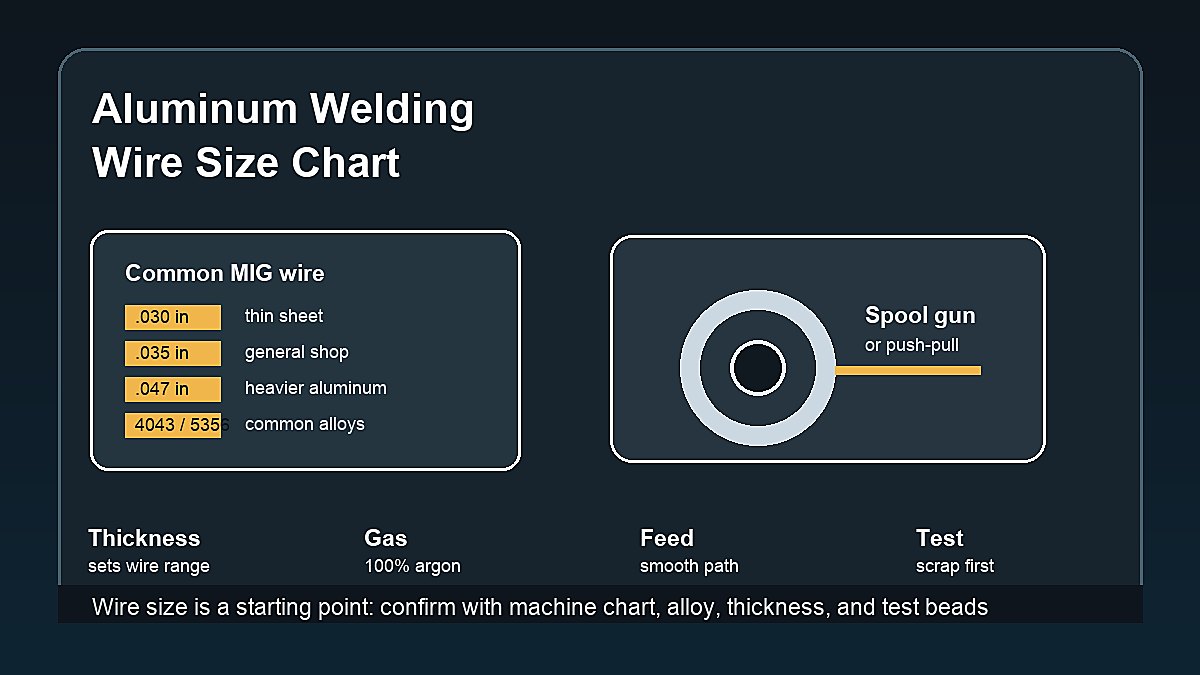
| 3/64 in | Aluminum MIG and spool gun work | Soft wire needs the right feed setup |
Common Welding Wire Size Chart
The chart below is a learning reference, not a replacement for your welder settings chart. Different machines have different output ranges. Wire brand, shielding gas, polarity, transfer mode, material condition, joint type, and welding position all affect the final setup.
| Wire Size | Process Fit | Material Range | Beginner Notes |
|---|---|---|---|
| .023/.024 in | Solid MIG wire | Thin steel and sheet metal | Good when burn-through is a problem. Often used for auto body style practice with short welds and careful heat control. |
| .030 in | Solid MIG and some flux core | Thin to medium mild steel | A common starter size for home MIG. Easy to find, useful for practice beads, brackets, and light fabrication. |
| .035 in | Solid MIG or self-shielded flux core | Medium steel and repair work | Common for flux core beginners and stronger home-shop machines. Needs correct polarity and cleanup if flux core. |
| .045 in | Flux core, MIG, higher-output setup | Medium to thicker steel | Better for machines with enough amperage and feed strength. Not the first choice for thin sheet. |
| 3/64 in | Aluminum MIG wire | Aluminum with spool gun or push-pull | Often easier to feed than very small aluminum wire. Needs argon shielding gas and correct drive setup. |
How Wire Size Affects Welding
Wire size affects how much filler metal reaches the weld pool as the wire feeds through the gun. A larger wire carries more metal per inch of wire. That usually means it can handle more amperage and deposit more metal, but it also needs the machine, contact tip, liner, drive rolls, and settings to support it.
A smaller wire can be easier on thin metal because it takes less heat to melt. That gives the beginner a little more control before the edge burns away. The tradeoff is that small wire may not fill larger joints well and may require more passes on thicker material.
Changing wire size changes wire feed speed behavior too. If you move from .030 to .035, the same wire feed speed number does not mean the same deposited metal. Retune voltage and wire feed speed on scrap before welding the project.
MIG Wire Size for Beginners
For gas-shielded MIG on mild steel, beginners often start with .030 in solid wire because it is easy to find and works across many light home-shop jobs. If your main work is thin sheet metal, .023 or .024 in wire may give better control. If your main work is heavier brackets or frames and the machine has enough output, .035 in wire may be a better match.
Do not choose the wire only by what came with the welder. Many starter machines ship with a small roll because it is convenient, not because it is correct for every project. Check the machine chart for wire diameter, material thickness, gas, voltage, and wire feed speed. For technique basics, read MIG Welding Techniques for Beginners.
Solid MIG wire usually needs shielding gas. Mild steel often uses a mix such as argon and CO2, while other combinations are used for different jobs. If the gas flow, nozzle distance, or wind protection is poor, the weld may become porous even when the wire size is correct.
Flux Core Wire Size for Beginners
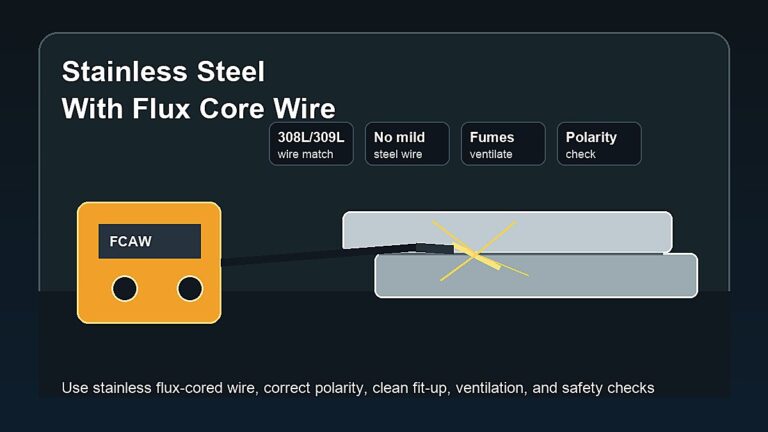
Self-shielded flux core wire is popular because it can run without a gas cylinder. Many small machines use .030 or .035 in self-shielded wire. The flux inside the wire creates shielding and leaves slag on the weld, so cleanup is part of the process.
Many flux core wires feel hotter than beginners expect. This process can work well outdoors and on repair tasks, but it may be harder on thin sheet than gas MIG. Before choosing a wire, confirm whether it is self-shielded or gas-shielded, then set the correct polarity. The wrong polarity can make the arc rough and the weld poor.
For deeper wire differences, see Different Flux Core Welding Wire Types. If you are working outdoors, also compare Can You MIG Weld Outdoors? so you understand when gas shielding becomes a problem.
Aluminum Welding Wire Size
Aluminum wire is softer than steel wire, so feeding is a big part of the setup. Beginners often see 3/64 in aluminum wire used with a spool gun or push-pull system because it feeds more reliably than very small aluminum wire in many home-shop setups.
Aluminum also conducts heat quickly. A wire size that seems close on paper may need very different technique, travel speed, and machine settings. For aluminum-specific chart work, use Aluminum Welding Wire Size Chart, 3/64 Aluminum Welding Wire Settings, and Aluminum MIG Welding Wire Speed and Voltage Chart.
Wire Size by Material Thickness
Material thickness is one of the main reasons wire size matters. Thin material needs enough heat to fuse, but not so much that the edge disappears. Thick material needs enough heat and filler metal to tie into the joint, but a small machine may not have the output for a single heavy pass.
| Material Situation | Likely Starting Wire | Why It Helps |
|---|---|---|
| Thin sheet steel | .023/.024 solid MIG | Less filler and heat makes burn-through easier to control |
| Light general steel | .030 solid MIG | Balanced choice for many beginner practice jobs |
| Medium mild steel | .030 or .035 | Depends on machine output and joint type |
| Outdoor repair steel | .030 or .035 flux core | Self-shielded wire can handle light wind better than gas MIG |
| Thicker steel | .035 or .045 | Needs more output and may need multiple passes |
| Aluminum MIG | 3/64 often used | Softer wire usually needs a spool gun or push-pull feed |
Contact Tips, Drive Rolls, and Liners
The wire must fit the hardware. A .030 wire normally needs a .030 contact tip. A .035 wire normally needs a .035 contact tip. If the tip is too tight, the wire can drag, burn back, or stop feeding. If the tip is too loose or worn, arc starts can become less stable.
Drive rolls matter too. Smooth V-groove rolls are common for solid steel wire. Knurled rolls are often used for flux core. U-groove rolls may be used for soft aluminum wire. The wrong roll can slip, crush the wire, or create shavings that dirty the liner.
If your wire stutters, check the simple parts first: contact tip size, tip wear, drive roll groove, drive tension, liner condition, wire spool drag, and whether the wire is rusty or dirty. A settings chart cannot fix a feeding problem.
Wire Feed Speed and Voltage
Wire feed speed and voltage work together. Wire feed speed affects amperage in many MIG and flux core setups because it controls how much wire is pushed into the arc. Voltage affects arc length and bead shape. When wire size changes, both settings may need adjustment.
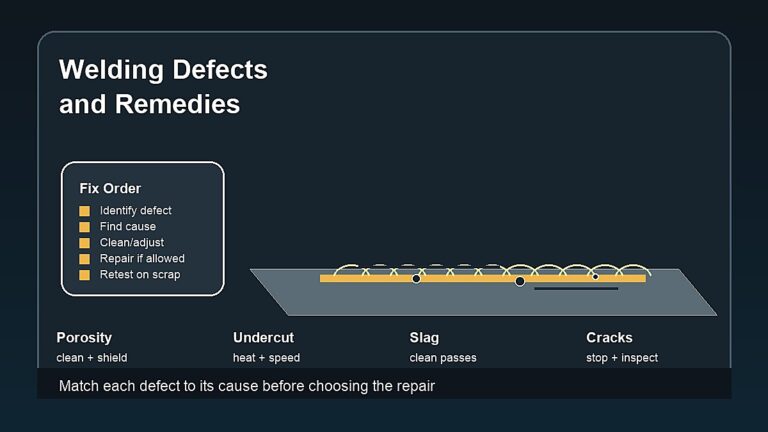
Burnback into the tip can mean the wire feed speed is too low, voltage is too high, stickout is wrong, or feeding is restricted. Stubbing into the plate can mean wire feed is too high, voltage is too low, or the work lead connection is poor.
Start with the machine chart, run a short bead on scrap, and adjust one variable at a time. Write down what worked. This habit builds a personal chart for your machine, wire, gas, and material.
Safety Notes Before Changing Wire
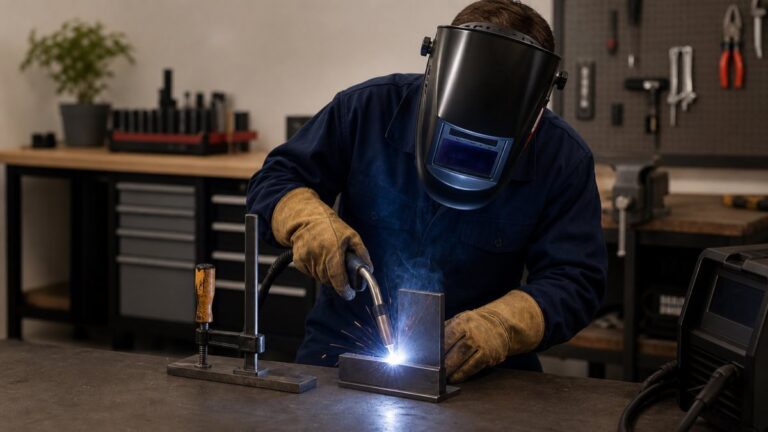
Changing wire size still involves welding hazards. Wear a properly shaded welding helmet, gloves, flame-resistant clothing, and safety glasses for cutting or brushing wire. Keep the workspace clear of flammable materials, clamp the work securely, and use ventilation or fume control that matches the material and wire type.
Flux core and some welding wires can create heavy fumes. Coated, galvanized, painted, or oily metal can produce hazardous fumes and contamination. Do not weld unknown containers, pressure vessels, vehicle safety parts, trailer frames, lifting points, or structural parts without qualified training and inspection.
Wire ends are sharp, drive rolls can pinch fingers, and gas cylinders need proper handling if you use MIG shielding gas. Review your machine manual and official safety guidance such as OSHA welding hazard guidance, OSHA 1910.252 welding, cutting, and brazing rules, and AWS free safety resources.
Common Beginner Mistakes
- Using the wrong contact tip: the wire diameter and tip marking should match.
- Copying solid MIG settings for flux core: self-shielded wire often needs different polarity, voltage, and travel technique.
- Choosing large wire for thin sheet: too much heat and filler can make burn-through worse.
- Ignoring machine limits: a small welder may not run .045 wire well even if the spool fits.
- Skipping test welds: always tune on scrap before welding the project.
- Forgetting drive rolls: wrong grooves or tension can cause feed problems that look like bad settings.
How to Choose Wire Size Step by Step
- Identify the process: solid MIG, self-shielded flux core, gas-shielded flux core, stainless MIG, or aluminum MIG.
- Check the material: mild steel, stainless steel, aluminum, or another alloy.
- Measure the material thickness instead of guessing.
- Read the welder door chart for supported wire sizes.
- Use the wire label to confirm polarity, gas, diameter, and application.
- Install the matching contact tip, drive roll groove, and liner setup.
- Set voltage and wire feed speed from the chart.
- Run test beads on similar scrap metal.
- Adjust one setting at a time until the bead wets into the joint cleanly.
- Stop if the weld is safety-critical and get qualified help.
FAQ
What size welding wire should beginners use?
For mild steel MIG, many beginners start with .030 in wire because it works for a wide range of light practice and home-shop jobs. Thin sheet may be easier with .023 or .024 in wire. Flux core beginners often use .030 or .035 in self-shielded wire depending on the machine.
Is .030 or .035 welding wire better?
Neither size is always better. .030 wire is often easier for light to medium MIG practice. .035 wire can be useful for thicker steel, flux core work, and machines with enough output. Choose by material thickness, process, and machine chart.
Can I use flux core wire in a MIG welder?
Many wire-feed MIG welders can run self-shielded flux core wire, but not all machines support every wire size. Before switching, read the manual for polarity, drive roll type, contact tip size, and wire diameter.
What wire size is best for thin sheet metal?
For thin mild steel sheet, .023 or .024 in solid MIG wire is often easier to control than larger wire. Use short welds, clean metal, correct gas, and test pieces to avoid burn-through.
What wire size is used for aluminum MIG?
Aluminum MIG often uses 3/64 in wire, especially with spool gun or push-pull setups. The best size depends on aluminum thickness, machine output, alloy, gas, and feed system.
Final Advice
Use the welding wire size chart as a starting point, then let your machine chart, wire label, and test beads make the final call. For many mild steel beginners, .030 in solid wire is a practical first choice. Move smaller for thin sheet, larger for heavier work, and switch rules when you move into flux core or aluminum.
The right wire size should feed smoothly, match the contact tip and drive rolls, suit the material thickness, and give you a weld pool you can control. Poor feeding or an ugly test bead should not send you straight into random knob turning. Start with the wire path, polarity, gas or shielding method, and material prep.