How to Weld Cast Iron to Steel
If you want to learn how to weld cast iron to steel, the first thing to know is that the repair is possible in some cases, but it is not a simple beginner weld. Cast iron is brittle, steel is tougher and more ductile, and the joint can crack if heat, filler, preparation, and cooling are handled poorly.
Common examples include attaching a steel tab to a cast iron part, repairing a cast bracket with a steel piece, or joining a cast iron component to mild steel for a non-critical shop repair. The risk level depends on the casting, load, temperature, vibration, and whether failure could hurt someone.
Mark Dawson beginner note: cast iron repairs reward patience. Short beads, clean prep, correct filler, and slow cooling matter more than trying to make one hot pass look impressive.
Quick Answer
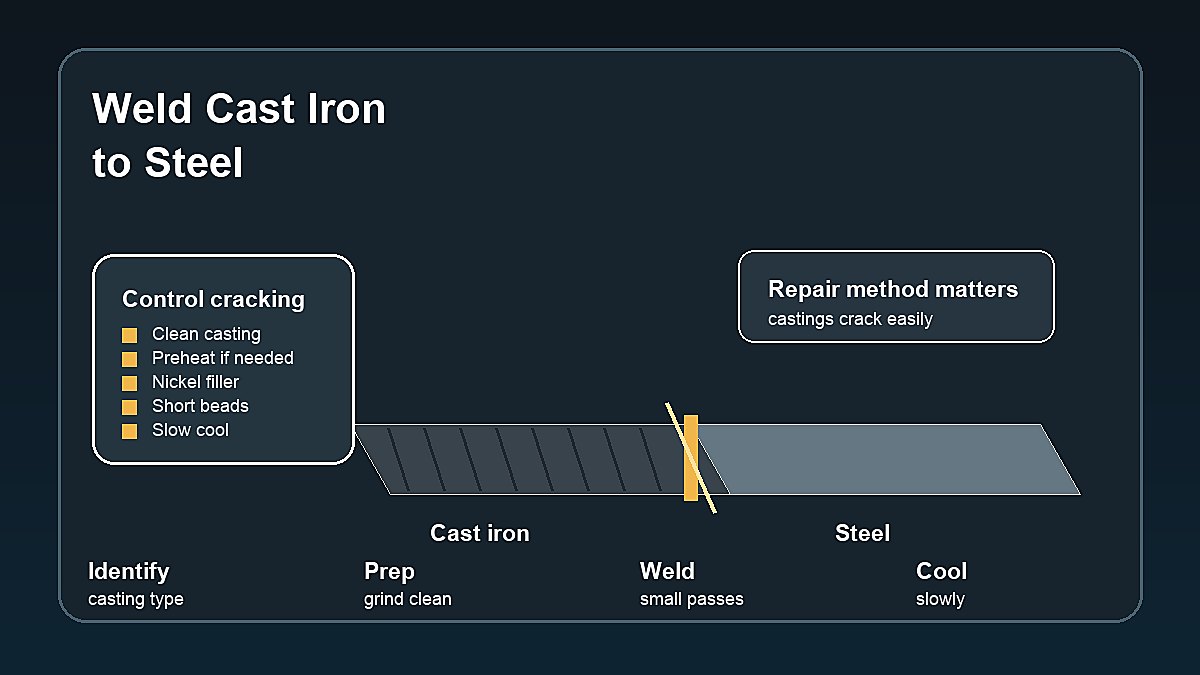
You can weld cast iron to steel in some non-critical situations, usually with nickel-based filler, careful cleaning, short weld beads, controlled heat, and slow cooling. The main risk is cracking because cast iron has high carbon content and low ductility compared with mild steel. Critical cast iron-to-steel repairs should be handled by qualified welders or repair shops, especially on engine parts, machine frames, vehicle parts, pressure parts, or load-bearing components.
| Step | Beginner Focus | Why It Matters |
|---|---|---|
| Identify part | Know if it is critical | Some repairs are not beginner-safe |
| Clean casting | Remove oil, rust, paint | Cast iron traps contamination |
| Choose filler | Often nickel-based | Helps manage dissimilar joint stress |
| Control heat | Short beads or preheat | Reduces cracking risk |
| Cool slowly | Insulate if needed | Limits thermal shock |
Why Cast Iron to Steel Is Difficult
Cast iron contains much more carbon than mild steel. That carbon helps make cast iron hard, wear-resistant, and easy to cast, but it also makes it brittle compared with steel. When a cast iron part is heated and cooled quickly, it can crack beside the weld or through the repair area.
Steel expands, shrinks, and bends differently. A weld bead joining cast iron to steel has to handle stress from both materials. If the bead is too hard, too restrained, or cooled too quickly, the weaker side may crack.
For broader dissimilar-metal context, read Can You Weld Aluminum to Steel? and Can You Weld Cast Iron With Mild Steel Rods?.
Check the Casting Before Welding
Not all cast iron is the same. Gray cast iron, ductile iron, malleable iron, and cast steel can look similar to beginners but weld differently. Old castings may also contain oil, carbon, grease, paint, or unknown repairs that make welding harder.
Before welding, ask what the part does. A decorative bracket is different from an engine block, machine base, vise, pump housing, or suspension component. If the part is expensive, safety-related, or hard to replace, get expert advice before trying a first repair.
Look for Cracks Before You Start
A cast iron part may already have cracks beyond the broken edge you can see. Clean the area and inspect under bright light before grinding. If the crack continues into a corner, bolt hole, rib, or machined surface, the repair becomes more difficult.
Drilling a stop hole, grinding a groove, or using dye penetrant may be part of a proper repair plan, but the right method depends on the part. Do not grind away evidence before you understand where the crack starts and ends.
Best Filler for Cast Iron to Steel
Nickel-based filler is commonly used for cast iron repair because it can be more forgiving than mild steel filler. Nickel electrodes or nickel TIG filler can help manage the cast iron side and reduce cracking risk, though filler choice still depends on the exact job.
Mild steel rods are tempting because they are cheap and easy to find, but they are often a poor choice for cast iron repair. They can create a hard, crack-prone area and may not machine well. For rod basics, review Different Types of Welding Rods and Welding Rod Specifications.
Preheat vs Cold Welding
Two common approaches are controlled preheat and cold welding with very short beads. Preheat warms the whole casting or repair area so temperature changes are less severe. Cold welding uses tiny beads, peening, and cooling pauses to keep heat input low.
Neither method is automatic. Large castings, thick parts, dirty cast iron, and restrained joints can still crack. The best choice depends on casting size, shape, material, filler, and service. Beginners should practice on scrap cast iron before touching the real part.
Peening and Stress Relief
Some cast iron repair methods use light peening after short beads to help counter shrinkage stress. Peening means gently tapping the bead with a small hammer while it is still hot enough for the method being used. It is not heavy pounding.
Too much hammering can damage the bead or casting. If the electrode or repair procedure gives peening instructions, follow those instructions. If you do not know whether peening is appropriate, avoid improvising on an important part.
Basic Welding Steps
- Confirm the repair is non-critical or get qualified help.
- Clean the cast iron and steel to bare sound metal.
- Grind out cracks, paint, oil-soaked metal, and weak edges.
- Fit the steel piece with minimal stress and good access.
- Select suitable nickel-based filler or the specified filler.
- Use preheat or short-bead technique as appropriate.
- Weld small sections instead of one long bead.
- Peen lightly if the method calls for it.
- Let the repair cool slowly and inspect for cracks.
Fit-Up and Joint Design
Fit-up matters because cast iron does not like being forced into position. If the steel part is clamped under stress, the weld may crack as it cools. Shape the steel tab, bracket, or patch so it fits naturally before welding.
Use enough weld area for the load, but avoid huge welds that dump too much heat into the casting. A smaller controlled weld may be better than a large bead that creates shrinkage stress. On many repairs, a bolted steel reinforcement plus a small weld may be smarter than relying only on weld metal.
Stick Welding Cast Iron to Steel
Stick welding is common for cast iron repair because nickel electrodes are available and the equipment is simple. Use the electrode manufacturer’s amperage range and keep beads short. Avoid overheating the casting and do not weave a large bead across the repair.
Clean slag fully before adding another bead. Let the area cool as required by the chosen method. For technique fundamentals, read Stick Welding Basics for Beginners.
TIG Welding Cast Iron to Steel
TIG can give precise heat control, but the repair is still not easy. The casting must be clean, the filler must be suitable, and heat must be managed carefully. TIG is often better for controlled small repairs than for large dirty castings.
If oil keeps boiling out of the casting, the puddle may become dirty and porous. Stop and clean again rather than burying contamination under more filler. For TIG setup basics, read TIG Welding for Beginners.
MIG Welding Cast Iron to Steel
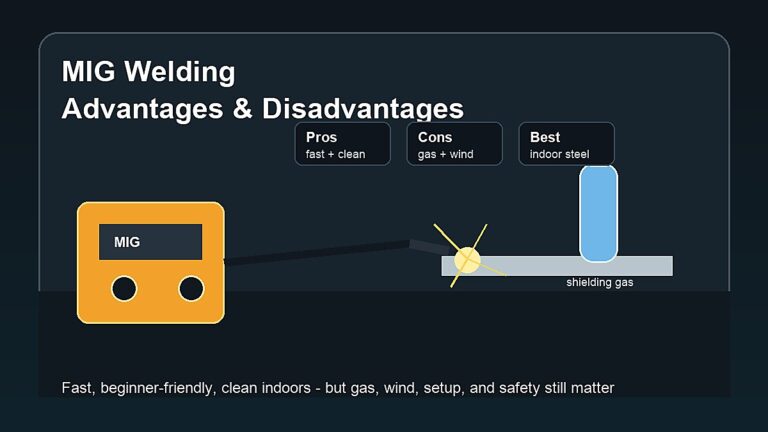
Ordinary mild steel MIG wire is usually not the first choice for cast iron-to-steel repair. It may attach metal, but cracking and hard brittle zones are common risks. Some specialized wires and procedures exist, but they are not the same as casual garage MIG repair.
If the repair needs to last, choose filler and process based on the casting and service, not on whatever wire is already loaded in the machine. For related MIG limits, read MIG Welding Techniques for Beginners.
Brazing or Mechanical Repair Options
Welding is not the only repair path. Brazing can sometimes join or reinforce cast iron with lower base-metal melting than fusion welding. Mechanical repair can use bolts, steel plates, straps, threaded inserts, or stitching methods depending on the part.
These options still need design sense. A bolted steel patch may be strong enough for a guard or bracket but wrong for a pressure housing. Brazing may be useful for a non-critical crack but unsuitable where heat, load, or machining requirements are high.
When the part is rare or expensive, a repair shop may save money by choosing a method that avoids cracking the casting further.
Repair Decision Checklist
- Is the part load-bearing, pressurized, or safety-related?
- Do you know whether it is gray cast iron, ductile iron, cast steel, or another casting?
- Is the casting oil-soaked, cracked in several places, or previously repaired?
- Can the steel piece fit without forcing the casting?
- Do you have suitable nickel filler and a way to control cooling?
- Can the repair be inspected after welding?
- Would replacement, brazing, stitching, or bolting be safer?
If several answers are uncertain, the job is probably beyond beginner practice. That is not failure; it is good repair judgment, especially when replacement parts are available.
Cooling and Crack Control
Cooling is often where cast iron repairs fail. Rapid cooling can create thermal stress and cracking. Depending on the method, the repair may be buried in dry sand, wrapped in insulation, left in a warm area, or cooled in a controlled way.
Do not quench the repair. Do not set a hot casting on a cold concrete floor if thermal shock is a concern. Let it cool slowly enough for the repair method and part size.
Common Beginner Mistakes
- Using mild steel rods because they are already on the bench.
- Running one long hot bead on a brittle casting.
- Skipping cleaning because the surface looks acceptable.
- Welding an oil-soaked casting without preparation.
- Forcing the steel part into position with heavy clamps.
- Cooling the casting too quickly after welding.
- Repairing critical parts without inspection.
- Assuming cast iron and cast steel weld the same way.
When Not to Weld It Yourself
Do not treat every cast iron-to-steel repair as a beginner project. Engine blocks, heads, machine frames, brake parts, steering parts, suspension parts, lifting brackets, pressure parts, and expensive castings need qualified repair guidance.
If failure could injure someone, stop. The correct answer may be brazing, stitching, replacement, machining, a bolted repair, or a professional welding procedure instead of a home weld.
Inspection After Welding
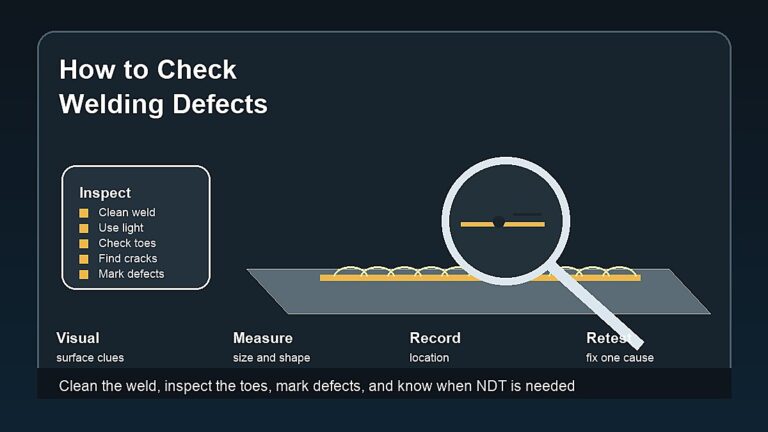
After cooling, clean the repair and inspect it under bright light. Look for new cracks beside the bead, cracks at bead starts and stops, porosity, undercut, poor tie-in, and distortion. A crack may appear after the part cools, not while it is still hot.
Critical repairs may need dye penetrant testing, magnetic particle testing, machining checks, leak testing, load testing, or another qualified inspection method. Visual inspection alone is not enough when the part matters.
Machining After Welding
Some cast iron repairs need grinding, drilling, tapping, or machining after welding. Filler choice affects how easily the repaired area can be machined. A hard repair deposit can ruin tools or make the final fit poor.
If the steel part must sit flat or a bolt hole must line up, plan that before welding. Distortion and weld buildup can move the part enough to make assembly difficult. Tack, check alignment, and keep heat controlled.
Practice and Recordkeeping
Before welding the real part, practice on scrap cast iron and mild steel if you can get similar pieces. Record filler type, amperage, preheat method, bead length, cooling method, and whether cracks appeared after cooling.
Those notes matter because cast iron repairs can fail after you think the weld is done. A repair that looks fine hot may show a crack later. Give practice samples time to cool fully before judging them.
Check the same sample again the next day before trusting the method.
Safety Notes
Cast iron-to-steel welding can involve fumes, UV radiation, hot metal, fire risk, electric shock, grinding dust, old coatings, oil contamination, and cracking parts. Wear proper PPE, use ventilation or fume control, and keep flammable material away.
Old castings may contain oil, paint, grease, or unknown coatings that create extra hazards when heated. Review OSHA welding hazards guidance, OSHA welding, cutting, and brazing requirements, and AWS safety resources.
FAQ
Can cast iron be welded to steel?
Yes, in some situations, but it requires the right filler, cleaning, heat control, and cooling. Critical repairs should be handled by qualified repair professionals.
What rod is best for welding cast iron to steel?
Nickel-based electrodes are commonly used for cast iron repair, but the best rod depends on the casting, steel, process, and service requirements.
Do you need to preheat cast iron before welding to steel?
Sometimes. Some repairs use preheat and slow cooling, while others use cold welding with very short beads. The part size, casting type, and repair method decide the approach.
Can you MIG weld cast iron to steel?
Ordinary mild steel MIG wire is usually not recommended for reliable cast iron repair. Specialized filler and procedures may be needed.
Why does cast iron crack after welding?
Cast iron can crack because it is brittle, high in carbon, sensitive to heat stress, and often contaminated. Fast cooling and long hot beads increase the risk.
Final Advice
Welding cast iron to steel is possible, but the safest beginner mindset is caution. Identify the part, clean it well, choose suitable filler, keep heat controlled, cool slowly, and avoid critical repairs unless qualified help is involved from the start.