Welding Duty Cycle Calculator
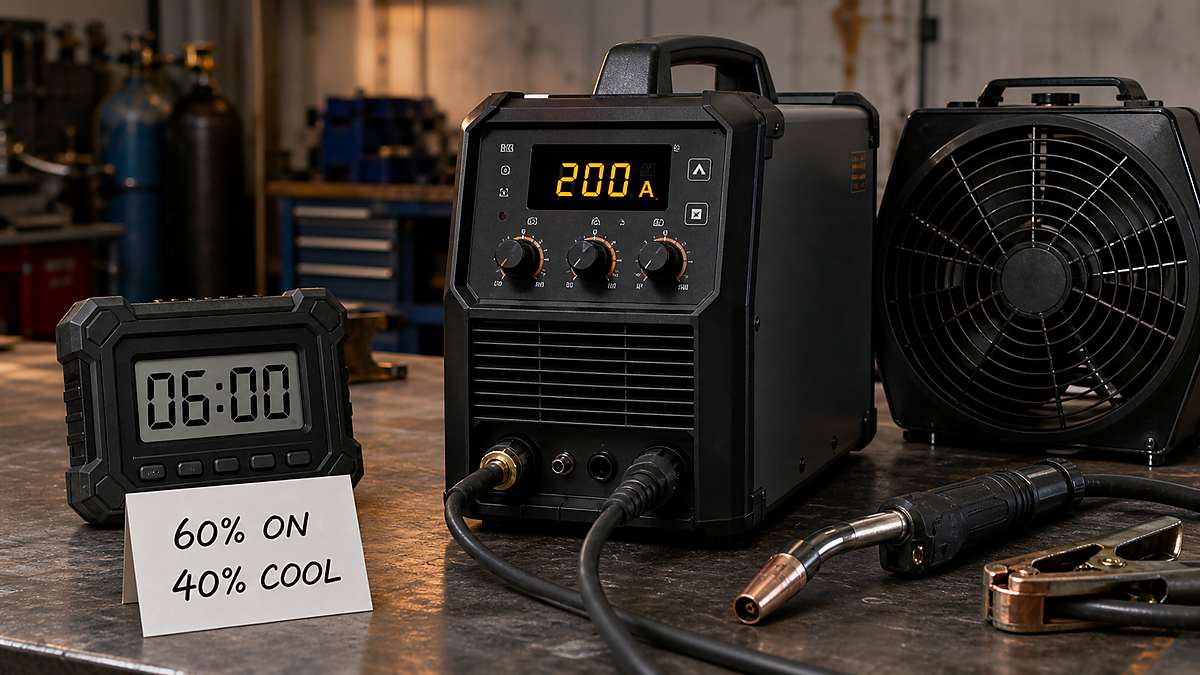
A welding duty cycle calculator converts a machine’s percentage rating into arc-on and cooling time. Most welding power sources express duty cycle over a 10-minute period and pair the percentage with a specific output current. A rating of 60% at 200 amps means six minutes of welding at 200 A followed by four minutes available for cooling within that test cycle.
The percentage cannot be separated from amperage. The same machine may provide 100% duty cycle at a lower current and a much shorter duty cycle near maximum output. Ambient temperature, airflow, input power, cable condition, process, and machine design also affect real operating behavior.
Mark Dawson beginner note: use calculations to understand the nameplate, then follow the operator’s manual and duty-cycle chart. A formula cannot override thermal protection or prove that a machine is safe to run beyond its published rating.
Quick Duty Cycle Calculator
For a standard 10-minute rating period:
- Weld time in minutes = duty cycle percentage ÷ 10
- Cool time in minutes = 10 − weld time
- Duty cycle percentage = arc-on minutes ÷ 10 × 100
| Duty Cycle | Arc-On Time | Cooling Portion |
|---|---|---|
| 20% | 2 minutes | 8 minutes |
| 30% | 3 minutes | 7 minutes |
| 40% | 4 minutes | 6 minutes |
| 60% | 6 minutes | 4 minutes |
| 80% | 8 minutes | 2 minutes |
| 100% | 10 minutes | No scheduled pause in the rated cycle |
At 35%, the machine has 3.5 minutes of arc time and 6.5 minutes for cooling in a 10-minute interval. These numbers apply at the current and test conditions stated by the manufacturer.
What Welding Duty Cycle Means
Duty cycle is a thermal rating. Current flowing through transformers, rectifiers, switching devices, conductors, connections, and other components creates heat. Fans, heat sinks, case ventilation, and internal design remove that heat. The rating describes how long the machine can produce a stated output without exceeding its tested thermal limit.
It is not a quality rating by itself. A 100% duty-cycle industrial unit may suit continuous production, while a 20% unit may be adequate for small repairs where measuring, fitting, and cleaning naturally provide cooling time.
Read the Rating with Amperage
A nameplate or manual may show several pairs:
| Example Rating | Meaning | Calculated Cycle |
|---|---|---|
| 20% at 250 A | Maximum-output short runs | 2 min weld, 8 min cool |
| 60% at 200 A | Longer work at reduced current | 6 min weld, 4 min cool |
| 100% at 150 A | Continuous rating in the stated test | 10 min arc time per cycle |
Do not advertise the machine simply as “60% duty cycle” without the matching amperage and input condition. A rating at 120 V input may differ from the same multi-voltage machine operating on 240 V.
Estimate Duty Cycle at Another Current
A square-law relationship can provide a rough estimate when a manufacturer chart is unavailable:
Estimated DC₂ = DC₁ × (I₁ ÷ I₂)²
- DC₁ = known duty cycle
- I₁ = current at the known rating
- I₂ = new current
- DC₂ = estimated duty cycle at the new current
Example: a machine is rated 60% at 200 A. At 250 A, the estimate is:
60 × (200 ÷ 250)² = 38.4%
That suggests approximately 3.84 minutes of arc time in a 10-minute cycle. It is only an approximation. Fan control, inverter limits, voltage, ambient temperature, thermal mass, and manufacturer protection logic can make the real curve different. Use the published graph whenever available.
Estimate Current for a Required Duty Cycle
The same approximation can be rearranged:
Estimated I₂ = I₁ × √(DC₁ ÷ DC₂)
If a machine is rated 60% at 200 A and you want a rough 100% current estimate:
200 × √(60 ÷ 100) ≈ 155 A
The result is a planning estimate, not permission to relabel the machine. Confirm the actual 100% value in its manual or nameplate data.
Duty Cycle for a Different Time Window
Some documents or limited-duty equipment may use another test period. Use the full formula rather than assuming every percentage refers to 10 minutes:
Arc-on time = duty cycle as a decimal × stated test period
A 40% rating over five minutes gives two minutes of arc time, while 40% over ten minutes gives four minutes. Compare machines only after confirming the same test basis, standard, input voltage, ambient condition, and output current.
IEC Standards and Test Conditions
IEC 60974-1 covers safety and performance requirements for industrial and professional arc-welding power sources. Limited-duty equipment intended mainly for nonprofessional users may fall under IEC 60974-6. The exact standard and edition matter when comparing ratings.
Published test conditions may use a high ambient temperature, often 40°C under relevant IEC testing. A machine can appear to run longer in a cool shop, but that does not change its certified nameplate. Likewise, a hot enclosure, direct sun, dust-blocked vents, or poor airflow can shorten practical runtime.
Power Source vs Gun or Torch Duty Cycle
The welding machine is not the only component with a thermal limit. MIG guns, TIG torches, plasma torches, electrode holders, cables, connectors, and water coolers can have separate current and duty-cycle ratings.
A power source rated for 100% at a given current does not make an undersized air-cooled torch safe at that current. Check the lowest-rated component in the complete circuit. Cooling method, shielding gas, cable length, and connection condition may affect accessory ratings.
Worked Job Example
A fabrication task requires 24 minutes of actual arc time at 200 A. The machine is rated 60% at 200 A. Theoretical cycle count is:
- Arc time per cycle: 6 minutes
- Cycles required: 24 ÷ 6 = 4
- Cooling portion per cycle: 4 minutes
- Minimum rated cycle time: 4 × 10 = 40 minutes
Real job time also includes fit-up, positioning, cleaning, inspection, and consumable changes. Those pauses may overlap the required cooling period, but the operator should still monitor the manual and thermal indicator rather than assuming every non-arc minute provides identical cooling.
Duty Cycle and Production Planning
Combine required arc hours with the machine’s usable cycle to identify whether duty cycle is likely to limit production. A low rating may not matter for tack welding or short stick-electrode runs. It can become a major constraint for long spray-transfer welds, high-deposition flux core, gouging, automated work, or heavy multi-pass joints.
Use the Weld Deposition Rate Calculator to estimate deposited metal per arc hour. Use the Advanced Weld Consumable Calculator to estimate filler quantity. Duty cycle then helps translate arc requirements into a more realistic production schedule.
Why a Welder Trips Early
- Higher current: the actual setting exceeds the current tied to the published duty cycle.
- Blocked airflow: dust, walls, covers, or clutter restrict cooling.
- Hot ambient conditions: the machine begins with less thermal headroom.
- Wrong input supply: voltage drop or an unsuitable circuit increases stress.
- Loose or damaged connections: resistance creates extra heat.
- Fan or sensor problem: cooling or thermal protection may need service.
- Accessory overload: the torch, gun, holder, or cable is the limiting component.
Do not bypass a thermal switch, increase breaker size casually, or point an unsafe improvised cooling source into live equipment. Stop work, follow lockout and manual procedures, and have electrical faults inspected by qualified personnel.
How to Manage Duty Cycle Safely
- Read the rating at the amperage and input voltage you will use.
- Keep cooling inlets and outlets clear.
- Allow the fan to run as the manufacturer instructs.
- Keep leads, connectors, gun, and holder in good condition.
- Plan fitting and cleaning during cooling portions where practical.
- Use a higher-capacity machine when the job repeatedly exceeds the rating.
- Stop if the thermal indicator appears or the manual requires cooling.
Lowering current only to extend runtime is not acceptable if it creates poor fusion or violates the welding procedure. Machine capacity must fit the process requirement, not the other way around. Consult the Welding Wire Size Chart only for wire context; settings still come from the machine, filler, and WPS.
Duty Cycle Is Not Arc-On Factor
Machine duty cycle is a thermal capability at a specified output. Arc-on factor is the portion of a work shift during which the operator actually maintains an arc. A welder may have a 25% arc-on factor while using a machine rated 60%, because the remaining shift includes handling, setup, inspection, and breaks.
Do not use a low average arc-on factor to justify one continuous weld longer than the machine permits. A machine that sat idle earlier can still reach its thermal limit during a long high-current run.
Compare Welders by the Current You Need
Maximum amperage is a poor comparison by itself. Two machines may both advertise 250 A, yet one may provide that output for 20% of a 10-minute cycle while the other provides 60%. Start with the current required by the process and then compare the rating at or near that current.
| Comparison Item | Machine A | Machine B |
|---|---|---|
| Maximum output | 250 A | 250 A |
| Duty cycle at 250 A | 20% | 40% |
| Rating near 200 A | Check manual | Check manual |
| Input used for rating | 120/240 V? | 240 V? |
| Ambient/test standard | Verify | Verify |
| Gun or torch rating | Verify separately | Verify separately |
A heavier machine may offer more thermal headroom, but purchase decisions also include process output, voltage range, generator compatibility, portability, service support, input requirements, accessory capacity, and the actual work schedule. Do not pay for a high maximum-current duty cycle that the planned jobs never use.
Input Voltage and Supply Conditions
Multi-voltage welders can have different output and duty-cycle tables for each input. A machine connected to 120 V may not sustain the same output it provides on 240 V. Extension-cord size, circuit length, plug condition, generator quality, and supply voltage drop can also affect operation.
Use the input circuit, breaker, receptacle, conductor size, grounding, and extension lead specified by the manufacturer and applicable electrical rules. Repeated breaker trips or hot plugs are not normal cooling signals. Stop and have the supply inspected rather than treating them as part of a duty-cycle calculation.
Ambient Temperature, Altitude, and Airflow
Cooling depends on the temperature and density of air moving through the machine. Hot air removes less heat than cool air, while high altitude can reduce cooling performance because air density is lower. Dust, grinding debris, wall clearance, filters, and fan condition further affect heat transfer.
Do not create a homemade correction percentage unless the manual provides one. If the machine is used in unusual heat, altitude, rain, dust, or an enclosure, ask the manufacturer about derating and environmental limits. Keep ventilation openings clear without removing protective covers.
Process Workload Examples
| Work Pattern | Typical Thermal Pattern | Planning Question |
|---|---|---|
| Small stick repairs | Rod changes create pauses | Does high-current arc time stay within rating? |
| Short-circuit MIG fabrication | Many short beads and fit-up pauses | Will long seams exceed the cycle? |
| High-deposition FCAW | Longer arc time at substantial output | Are machine, gun, and cables rated together? |
| TIG bench work | Variable current with post-flow and repositioning | What is the rating at actual peak and average use? |
| Gouging or heavy repair | High sustained thermal load | Is the power source specifically rated for the task? |
Natural pauses help, but they do not make every low-duty-cycle machine suitable for heavy production. Record actual current and arc time during a representative job. That evidence is more useful than guessing from the number of finished parts.
Thermal Trip Diagnostic Sequence
- Stop welding and note the current, voltage, process, and elapsed arc time.
- Observe the thermal indicator and follow the manual’s cooling instructions.
- Confirm the correct duty-cycle curve for input voltage and amperage.
- Check required clearance around air inlets and outlets.
- Inspect accessible leads, plugs, connectors, gun, and holder for heat or damage.
- Verify that the fan operates as the manual describes.
- Let qualified service personnel inspect internal faults or repeated early trips.
A thermal trip after work clearly beyond the published rating may be normal protection. A trip during light operation can point to blocked cooling, supply problems, sensor faults, fan trouble, or damaged components. Repeatedly resetting the machine without finding the cause can turn a manageable fault into expensive damage.
Safety Notes
Overheated equipment can damage insulation, connections, electronics, guns, torches, and cables. Welding also involves electric shock, fire, fumes, UV radiation, burns, compressed gas, and hot work hazards. Keep covers installed, disconnect power before authorized service, and never work inside energized equipment without the required qualification and procedure.
Review Welding Safety Equipment, Miller’s duty-cycle guidance, the current IEC 60974-1 standard page, Lincoln Electric operator guidance, and OSHA welding hazards.
FAQ
What does 60% duty cycle mean on a welder?
At the stated amperage and test condition, it generally means six minutes of arc time and four minutes of cooling within a 10-minute period.
What does 100% duty cycle mean?
It means the equipment can operate through the full rated test cycle at the specified output. It does not remove ambient, maintenance, accessory, input-power, or manual limits.
Does lower amperage increase duty cycle?
Usually yes, because the machine generates less internal heat. Use the manufacturer’s curve for the actual value; the square-law formula is only an estimate.
Can I keep welding until thermal protection trips?
No. Thermal protection is a backup, not an operating timer. Follow the published rating and manual instead of repeatedly forcing a shutdown.
Does duty cycle include time changing rods?
Duty cycle counts arc-on time within the stated period. Rod changes create natural pauses, but the machine still needs the cooling pattern required by its rating and current.
Can a cooling fan increase the rated duty cycle?
Use only the cooling system designed or approved for the machine. External airflow does not change the certified rating and can introduce dust, moisture, or electrical hazards.
Final Advice
A welding duty cycle calculator makes nameplate percentages easier to use: convert the percentage into arc and cooling minutes, always keep the amperage attached, and use current-change formulas only for rough planning.
For real work, the manufacturer’s duty-cycle chart, thermal indicator, input requirements, and lowest-rated accessory control the setup. Choose machine capacity that meets the weld procedure without depending on overload protection.