Welding Tank Size Chart
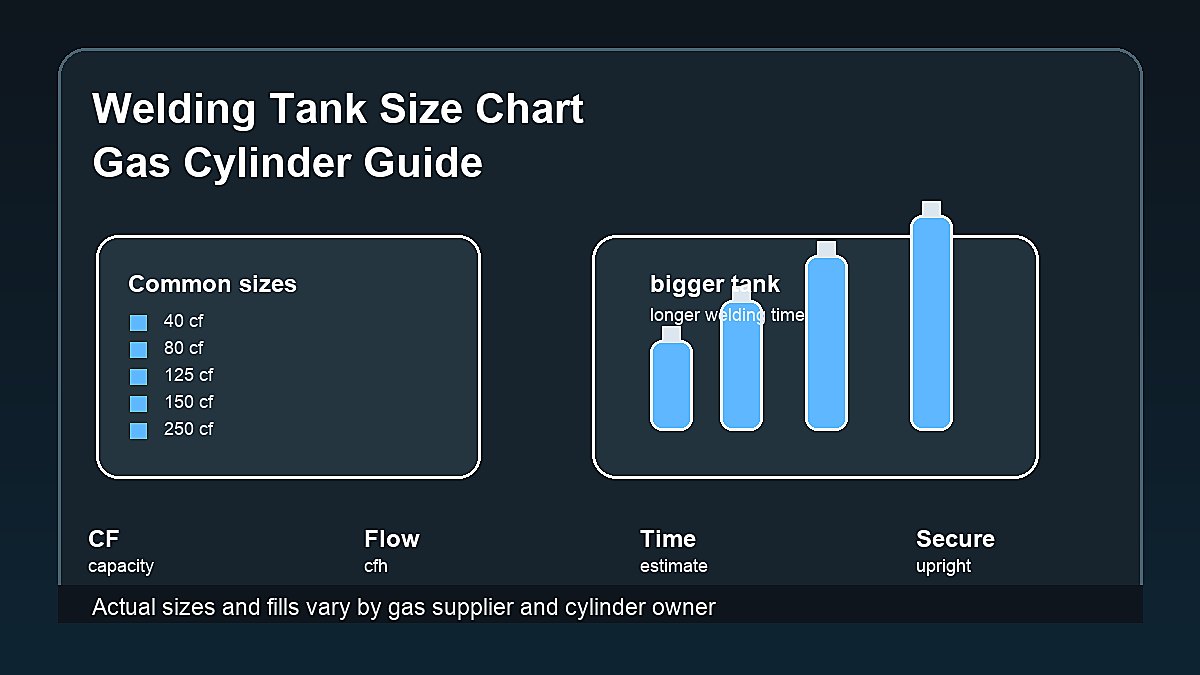
A welding tank size chart helps beginners compare shielding gas cylinders by capacity, portability, refill frequency, and estimated welding time. Tank sizes are often listed in cubic feet, such as 40 cf, 80 cf, 125 cf, 150 cf, and 250 cf.
Gas cylinders matter for MIG and TIG welding because shielding gas protects the weld pool while it cools. A small tank is easy to move but runs out quickly. A large tank lasts longer but costs more, takes more space, and must be secured carefully.
Mark Dawson beginner note: do not choose a cylinder only by price. Choose the size you can store safely, move safely, refill locally, and use without running out halfway through practice.
Quick Answer
For occasional beginner MIG or TIG practice, an 80 cf or 125 cf shielding gas cylinder is often more practical than a tiny bottle. Smaller portable bottles are easy to move but can run out fast. A 150 cf or 250 cf cylinder is better for regular shop use if you have safe storage and transport. Actual cylinder names, dimensions, fill pressure, ownership rules, and exchange options vary by gas supplier, so confirm locally before buying.
| Tank Size | Best Fit | Beginner Tradeoff |
|---|---|---|
| 20 cf | Very light occasional use | Runs out quickly |
| 40 cf | Portable small setup | Good backup, short practice time |
| 80 cf | Home beginner practice | Balanced size for many users |
| 125 cf | Regular garage welding | Longer run time, still manageable |
| 150 cf | More frequent shop use | Heavier, needs better storage |
| 250 cf | High-use shop | Long run time, less portable |
Common Welding Tank Sizes
Welding gas cylinder names are not perfectly standardized across every supplier. One shop may call a bottle by cubic feet, while another may use a letter size or local exchange name. Treat the chart as a beginner guide and ask your supplier what size, pressure, and dimensions they provide.
| Common Capacity | Portability | Refill Frequency | Typical Use |
|---|---|---|---|
| 20 cf | Very easy to move | Very frequent | Emergency or rare short welds |
| 40 cf | Easy to move | Frequent | Portable MIG/TIG practice |
| 80 cf | Moderate | Moderate | Beginner home shop |
| 125 cf | Moderate to heavy | Less frequent | Regular garage welding |
| 150 cf | Heavy | Less frequent | Small shop or frequent practice |
| 250 cf | Very heavy | Infrequent | Stationary shop use |
How Long Will a Welding Tank Last?
A simple estimate is:
Run time in hours = tank capacity in cubic feet ÷ gas flow in cubic feet per hour
For example, an 80 cf cylinder at 20 cfh gives about 4 hours of arc-on gas flow. That does not mean 4 hours of total shop time. Welding includes fitting, cleaning, tacking, brushing, repositioning, and breaks, so the calendar time may be much longer.
| Tank Size | At 15 cfh | At 20 cfh | At 25 cfh |
|---|---|---|---|
| 40 cf | 2.7 hr | 2.0 hr | 1.6 hr |
| 80 cf | 5.3 hr | 4.0 hr | 3.2 hr |
| 125 cf | 8.3 hr | 6.3 hr | 5.0 hr |
| 150 cf | 10.0 hr | 7.5 hr | 6.0 hr |
| 250 cf | 16.7 hr | 12.5 hr | 10.0 hr |
MIG vs TIG Tank Size
MIG welding often uses argon/CO2 blends or CO2 depending on the material and process. TIG welding commonly uses 100% argon for many beginner steel, stainless, and aluminum jobs. The best tank size depends on gas flow, how often you weld, and whether your process uses gas continuously for pre-flow and post-flow.
TIG practice can use gas even when the arc is short because post-flow continues after each weld. Frequent starts and stops can use more gas than beginners expect. For more TIG gas context, read What Gas Do You Use for TIG Welding?.
MIG welding can use gas quickly when practicing many beads. A tiny cylinder may feel cheap at first, but repeated refills waste time. For new-shop planning, read What Beginners Need to Start Welding.
Common Welding Gases
Tank size is only one choice. The gas inside the tank must match the process and material. TIG welding commonly uses 100% argon. MIG welding mild steel often uses an argon/CO2 blend, while some work uses straight CO2. Aluminum MIG usually uses 100% argon.
Do not connect a cylinder just because the fitting seems to match. Read the label and confirm the gas. A cylinder marked C25, argon, CO2, helium mix, oxygen, or acetylene is not interchangeable for every welding process.
If you weld more than one process, you may need more than one cylinder. A TIG argon bottle is useful for TIG and some aluminum MIG work, but it is not the normal choice for MIG welding mild steel with a common short-circuit setup.
Best Tank Size for Beginners
For most home beginners who plan to practice regularly, 80 cf is a sensible minimum and 125 cf is often more comfortable. These sizes give enough practice time without becoming as awkward as a large shop cylinder.
The 40 cf range can work for portable welding, occasional TIG practice, or a backup bottle. It is not ideal if you are learning every weekend. Running out of gas can cause porosity, wasted coupons, and frustrating troubleshooting.
A 150 cf or 250 cf cylinder makes sense when the welder stays in one shop and gas use is frequent. The tradeoff is weight, storage, and transport. Bigger tanks must be secured well and moved with the right cart.
Example Beginner Choices
If you weld once a month and need to carry the bottle by hand, a smaller cylinder can make sense. You will refill more often, but the setup stays portable and easier to store in a small garage.
If you are learning TIG every weekend, a mid-size cylinder is usually more pleasant. TIG practice often uses many short beads, post-flow, and repeated starts. A tiny tank can empty before the practice session feels productive.
If you are building a fixed welding corner with a cart, a larger cylinder can reduce refill trips. Make sure the cart, chain, floor space, and transport plan are ready before choosing a tall bottle.
Ownership, Exchange, and Refill Rules
Before buying a cylinder, call the local gas supplier. Some suppliers refill customer-owned cylinders only up to certain sizes. Others prefer exchange programs. Some large cylinders are leased or rented instead of owned outright.
Check whether the cylinder has current hydrostatic test markings, correct valve type, and a size your supplier will exchange. A cheap used cylinder is not a bargain if no local supplier will fill it.
Storage and Cart Planning
Shielding gas cylinders must be stored upright and secured so they cannot fall. Keep the valve protected, keep cylinders away from heat and sparks, and do not drag a cylinder by the regulator or hose.
If you use a welding cart, make sure the cart is designed for the cylinder size. A tall cylinder on a weak cart can become unstable. For cart setup, read Welding Cart for Beginners.
How to Choose Your Tank Size
- Decide whether you are using MIG, TIG, or both.
- Estimate your normal flow rate in cfh.
- Choose how many arc-on hours you want before refill.
- Check what sizes your local supplier refills or exchanges.
- Confirm storage space and safe transport.
- Buy the regulator or flowmeter that matches the gas and cylinder.
- Secure the cylinder before welding.
For example, if you expect to weld at about 20 cfh and want around 6 hours of arc-on gas time, a 125 cf tank is a better match than a 40 cf tank. If you only practice once in a while and must carry the bottle often, 40 cf or 80 cf may be easier.
Use run-time math as an estimate, not a promise. Leaks, purging, TIG post-flow, test beads, and forgotten open valves can all reduce how long the tank lasts. Close the cylinder when you finish and check connections before each session.
Flow Rate Mistakes
Beginners sometimes turn gas flow up when a weld looks bad. More gas is not always better. Too much flow can create turbulence and pull air into the shielding zone. Too little flow can leave the puddle exposed. Wind, nozzle distance, leaks, and clogged diffusers can also ruin coverage.
Set flow while gas is moving through the gun or torch, not only by looking at cylinder pressure. Cylinder pressure helps estimate what is left in the bottle. Flow rate tells how much shielding gas is reaching the welding area.
Transport and Refill Planning
Before choosing a large cylinder, think about how it will get to the supplier. A tall bottle may not fit safely in a small car, and many suppliers have rules for transport. Keep caps on cylinders when required and secure the bottle so it cannot roll or fall.
Refill planning also affects project timing. If your gas supplier is far away or closed on weekends, a larger bottle or backup cylinder may save frustration. If the supplier is close and exchanges are easy, a mid-size bottle may be enough.
Signs the Tank Is Running Low
A low tank may show falling cylinder pressure, unstable flow, or a weld that suddenly develops porosity near the end of a session. Do not keep welding important parts if you suspect gas flow is failing. Stop, check the gauge, and test on scrap.
For TIG, low or interrupted shielding can discolor tungsten and leave gray, oxidized welds. For MIG, the bead may become porous, sooty, or rough. Gas problems often look like technique problems until you check the cylinder and flow path.
Gas Path Checklist
- Confirm the cylinder label matches the process.
- Secure the cylinder upright before opening it.
- Use the correct regulator or flowmeter.
- Check hose condition and fittings.
- Set flow while gas is moving.
- Keep the nozzle, cup, diffuser, or gas lens clean.
- Close the cylinder valve after welding.
This checklist helps separate gas supply problems from welding technique problems. If the tank size is reasonable but the weld still shows porosity, check the whole gas path instead of buying a larger cylinder.
Small vs Large Tank Cost Tradeoff
Small cylinders often cost less upfront, but the gas cost per cubic foot can be higher after repeated refills. Larger cylinders cost more to buy, rent, or exchange, but they usually reduce trips to the supplier. The best value depends on how often you weld.
Do the math before buying. Compare cylinder purchase or lease cost, refill or exchange price, travel time, and how often you expect to practice. A beginner who welds twice a year and a beginner who practices every weekend should not choose the same bottle for the same reason.
Regulator and Flowmeter Matching
The cylinder size does not matter if the regulator or flowmeter is wrong for the gas. Use equipment rated for the gas and connection type. A flowmeter for argon/CO2 shielding gas is not the same thing as an oxygen regulator for oxy-fuel work in any welding shop.
Common Beginner Mistakes
Buying too small: Tiny bottles run out quickly and can make learning feel interrupted.
Buying too large: A large cylinder may be hard to move, store, or exchange if your shop is small.
Ignoring supplier rules: Local refill and exchange rules matter more than online advice.
Reading pressure as flow: Cylinder pressure is not the same as gas flow at the torch. Use the correct regulator or flowmeter.
Forgetting safety: A shielding gas cylinder may not be flammable, but it is still high-pressure equipment and can displace oxygen in poor ventilation.
Safety Notes
Welding gas cylinders can be heavy, pressurized, and hazardous if dropped, damaged, heated, or used with the wrong regulator. Secure cylinders upright, protect the valve, check for leaks, and close the cylinder valve when finished.
Argon, CO2, and other shielding gases can displace oxygen in enclosed or poorly ventilated spaces. Do not weld in confined spaces without qualified procedures. Review OSHA welding hazards guidance, OSHA oxygen-fuel gas welding and cutting requirements, AWS safety resources, and Compressed Gas Association publications. For PPE, read Welding Safety Equipment.
FAQ
What size welding tank should a beginner get?
An 80 cf or 125 cf cylinder is often practical for home beginners. A smaller portable bottle is easier to carry but runs out faster.
How long does an 80 cf welding tank last?
At 20 cfh, an 80 cf tank gives about 4 hours of arc-on gas flow. Real shop time is longer because you are not welding continuously.
Is a bigger welding tank better?
Bigger tanks last longer between refills, but they are heavier, less portable, and need safer storage. The best size depends on use and supplier rules.
Can I use the same tank for MIG and TIG?
Only if the gas is correct for both processes. 100% argon is common for TIG and some MIG aluminum work, but MIG steel often uses argon/CO2 blends.
What does cf mean on a welding tank?
CF means cubic feet, a common way to describe how much gas a cylinder holds. Supplier labels and naming systems can vary.
Final Advice
Use a welding tank size chart to estimate run time, but choose your cylinder based on local refill options, safe storage, portability, and how often you weld. For most regular beginners, 80 cf or 125 cf is a practical place to start.