Weld Deposition Rate Calculator

A weld deposition rate calculator estimates how much filler metal becomes deposited weld metal during one hour of arc time. For continuous-wire processes, the calculation uses wire diameter, wire feed speed, filler density, and deposition efficiency. The result is normally reported in pounds per hour or kilograms per hour.
Deposition rate helps with production planning, consumable estimates, arc-time calculations, and process comparison. It does not tell you whether a setting will produce an acceptable weld. Voltage, amperage, transfer mode, polarity, shielding, position, travel speed, joint design, and the approved procedure still control how the process must be run.
Mark Dawson beginner note: a high calculated rate is not automatically a better setting. The machine, wire, position, and joint must support that feed rate while maintaining fusion, bead shape, heat input, and required quality.
Quick Deposition Rate Formula
For a round solid wire:
- Find the wire cross-sectional area.
- Multiply area by wire feed speed to get wire volume per minute.
- Multiply by 60 for hourly volume.
- Multiply by filler-metal density to get melt-off weight.
- Multiply by deposition efficiency to estimate metal retained in the weld.
Wire area = π × (diameter ÷ 2)²
Deposition rate = wire area × feed speed × 60 × density × efficiency
Efficiency is entered as a decimal. For example, 95% becomes 0.95. Keep all dimensions and density in compatible units.
Imperial Calculator: lb/hr
Use wire diameter in inches, wire feed speed in inches per minute, and density in pounds per cubic inch:
lb/hr = π × (d ÷ 2)² × WFS × 60 × density × efficiency
For carbon-steel solid wire, a planning density near 0.283 lb/in³ gives a convenient shortcut:
Steel deposition lb/hr ≈ 13.34 × d² × WFS × efficiency
The shortcut is only for the stated units and steel density. Using millimeters, meters per minute, or aluminum wire in the same expression will give the wrong answer.
Worked Imperial Example
Assume 0.045-inch carbon-steel solid wire running at 350 IPM with an estimated deposition efficiency of 95%.
- Wire area = π × (0.045 ÷ 2)² = 0.00159 in²
- Wire length per hour = 350 × 60 = 21,000 inches
- Wire volume = 0.00159 × 21,000 = 33.39 in³/hr
- Melt-off weight = 33.39 × 0.283 = 9.45 lb/hr
- Deposited weight = 9.45 × 0.95 = 8.98 lb/hr
The theoretical deposition rate is about 9.0 lb/hr of arc time. That is not nine pounds in every clock hour of the shift; setup and non-welding time must be handled separately.
Metric Calculator: kg/hr
Use wire diameter in millimeters, feed speed in meters per minute, and density in grams per cubic centimeter:
kg/hr = π × (d ÷ 2)² × WFS × density × 0.06 × efficiency
For steel at approximately 7.85 g/cm³, area × feed speed × 0.471 × efficiency gives kg/hr. The 0.06 factor converts meters to millimeters, minutes to hours, and density units to kilograms.
Worked Metric Example
Use 1.2 mm steel wire at 7.0 m/min and 92% efficiency:
- Wire area = π × (1.2 ÷ 2)² = 1.131 mm²
- Hourly wire length = 7 × 60 = 420 m
- Steel melt-off rate = 1.131 × 7 × 0.471 = 3.73 kg/hr
- Deposition rate = 3.73 × 0.92 = 3.43 kg/hr
The result assumes the displayed feed speed is accurate and the wire is a solid round product with the selected density. Flux-cored wire needs manufacturer data because its metal sheath and flux core do not behave like a solid cylinder of steel.
Common Steel-Wire Examples
The table uses the geometric formula with carbon-steel density of 0.283 lb/in³ and 95% efficiency. It is a math reference, not a machine-setting chart.
| Wire Diameter | 250 IPM | 350 IPM | 450 IPM |
|---|---|---|---|
| 0.030 in | 2.85 lb/hr | 3.99 lb/hr | 5.13 lb/hr |
| 0.035 in | 3.88 lb/hr | 5.43 lb/hr | 6.98 lb/hr |
| 0.045 in | 6.41 lb/hr | 8.98 lb/hr | 11.54 lb/hr |
| 0.052 in | 8.57 lb/hr | 12.00 lb/hr | 15.43 lb/hr |
Do not set a machine from this table. A feed rate must fall within the operating range for the wire, process, power source, transfer mode, contact tip, shielding gas, and joint. Use the Welding Wire Size Chart for broader wire-selection context.
Melt-Off Rate vs Deposition Rate
Melt-off rate is the weight of electrode or wire consumed per unit of arc time. Deposition rate is the weight that remains as weld metal after process losses. They are related but not identical.
| Term | Meaning | Basic Relationship |
|---|---|---|
| Wire consumption rate | Wire delivered by the feeder | Area × feed speed × density |
| Melt-off rate | Electrode melted during arc time | Consumed filler per hour |
| Deposition efficiency | Share retained in the weld | Deposit ÷ filler consumed |
| Deposition rate | Accepted metal added per arc hour | Melt-off × efficiency |
| Production rate | Output over clock time | Deposition × arc-on factor |
Stick electrodes lose weight through stub ends, slag, spatter, and fumes. Solid MIG wire often has higher efficiency, but clipping, spatter, starts, and rejected welds still matter. Flux-cored wire includes nonmetallic ingredients, so use product data rather than treating the full wire cross-section as solid steel.
Deposition Efficiency by Process
Use measured results or manufacturer data when possible. Broad planning ranges can help during an early estimate, but they should not replace procedure-specific information.
| Process | Broad Planning Range | What Changes It |
|---|---|---|
| SMAW / stick | About 55-70% | Stub length, coating, position, spatter |
| GMAW / solid wire | About 85-98% | Transfer mode, spatter, clipping |
| FCAW | About 75-90% | Wire design, slag, spatter |
| GTAW / TIG | Job-dependent | Manual feeding and unused rod ends |
| SAW | Often high | Wire setup, starts, stops, flux practice |
A process may have high deposition efficiency but a low deposition rate, or the reverse. Efficiency describes retained material; rate describes retained weight per arc hour. Keep those two measures separate.
Arc-On Time and Shift Output
Calculated deposition rate applies while the arc is operating. A welder also fits parts, changes position, cleans slag, replaces consumables, moves cables, checks temperature, and waits for inspection.
Arc hours = shift hours × arc-on factor
Deposited weight per shift = deposition rate × arc hours
If the calculated rate is 8.98 lb/hr and an eight-hour shift records a 25% arc-on factor, arc time is two hours. The theoretical shift deposit is 8.98 × 2 = 17.96 lb. This does not include rejected metal that must be removed and replaced.
Measure arc-on factor from the real workflow instead of copying a generic percentage into every quote. Repetitive positioner work, field pipe, structural erection, and repair welding have very different handling time.
Calculate Arc Time from Weld Weight
If the required deposited weld metal is known:
Arc time = required deposited weight ÷ deposition rate
A joint requiring 27 lb of deposited metal at 8.98 lb/hr needs about three arc hours. Total labor time will be longer after fit-up, interpass cleaning, repositioning, preheat, inspection, and breaks are included. Estimate filler weight first with the Advanced Weld Consumable Calculator or the specialized Pipe Welding Consumable Calculator.
Deposition Rate and Travel Speed
Deposition rate describes weight per time; travel speed describes distance per time. Together they affect how much metal is placed along each inch or millimeter of joint.
Deposited weight per inch = deposition lb/hr ÷ travel inches/hr
At 9 lb/hr and 12 IPM travel, the torch covers 720 inches per hour. The deposited weight is 9 ÷ 720 = 0.0125 lb per inch. Slowing travel without changing wire feed places more metal per inch and may increase bead size and heat exposure. Speeding travel places less metal per inch and can create an undersized weld or poor fusion if the procedure is exceeded.
Do not use this relationship to invent a production setting. Weld size, fusion, penetration, heat input, bead contour, and procedure limits must all be checked. For geometry, compare the Fillet Weld Size Calculator.
Material Density Matters
The same diameter and feed speed move the same wire volume, but not the same weight when materials have different densities.
| Filler Material | Approx. Density | Planning Note |
|---|---|---|
| Carbon steel | 0.283 lb/in³ | Common basis for steel shortcuts |
| Stainless steel | Use alloy-specific value | Often slightly denser than carbon steel |
| Aluminum | About 0.098 lb/in³ | Much lower weight for the same volume |
| Nickel alloy | Use product data | Composition changes density |
For purchasing, use the filler manufacturer’s product data where available. The calculator is sensitive to density because weight is the final output.
Reverse the Formula for Target Wire Feed Speed
Estimators may know the required deposited weight and available arc time before they know the theoretical feed rate. First calculate the target deposition rate:
Target deposition rate = required deposited weight ÷ available arc hours
For the imperial solid-wire equation, the mathematical feed speed is:
WFS = target lb/hr ÷ [π × (d ÷ 2)² × 60 × density × efficiency]
Suppose a job needs 18 lb deposited in three arc hours. The target is 6 lb/hr. With 0.045-inch steel wire and 95% efficiency, the formula gives about 234 IPM. That number is only a math check. Confirm that the selected wire, transfer mode, amperage, voltage, gas, joint, and position have an approved operating range near that feed speed.
If the calculated WFS falls outside stable procedure limits, change the production plan rather than forcing the feeder to match the estimate. More arc time, another wire size, a different process, improved joint positioning, or multiple arcs may be the proper engineering answer.
Deposition Cost per Arc Hour
Deposition rate can support a consumable-cost estimate when purchase price and efficiency are kept clear. Deposited pounds are not the same as purchased pounds.
Filler consumed per hour = deposition rate ÷ efficiency
Filler cost per arc hour = filler consumed per hour × purchase cost per pound
At 8.98 lb/hr deposition and 95% efficiency, wire consumption is about 9.45 lb/hr. If wire costs $2.10 per pound, filler cost is approximately $19.85 per arc hour. Labor, shielding gas, electricity, contact tips, flux, grinding, overhead, and repair are separate costs.
Solid Wire vs Flux-Cored Wire Calculations
The area-and-density equation directly describes a uniform solid wire. Flux-cored wire contains a metal sheath and a formulated core. Its total outside diameter does not represent a solid steel cylinder, so multiplying the full cross-section by steel density can overstate metal feed.
For FCAW, use manufacturer deposition-rate tables or a product-specific wire weight per unit length. If the manufacturer gives pounds of wire per 1,000 feet, convert feed speed to feet per hour, multiply by that linear weight, then apply the stated or measured deposition efficiency.
Wire consumed per hour = wire length per hour × product weight per unit length
This method also handles metal-cored and specialty tubular wires more responsibly. Product data reflects the actual construction instead of assuming the core has the density of solid steel.
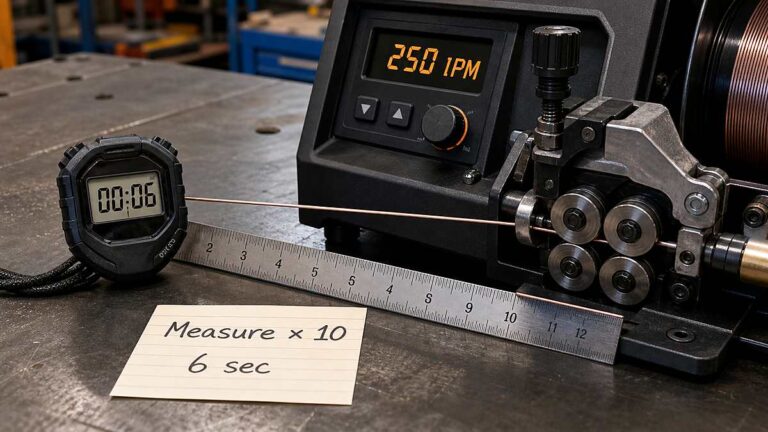
How to Measure Actual Deposition Rate
- Prepare and identify a clean test coupon.
- Weigh it on a suitable calibrated scale.
- Record actual arc time, excluding pauses.
- Weld using the approved settings and technique.
- Remove slag and loose spatter without grinding away sound weld metal.
- Weigh the cooled coupon again.
- Subtract the starting weight to find deposited metal.
- Divide deposited weight by arc time in hours.
A short test magnifies scale and timing error. Use enough arc time and a scale with suitable resolution. Repeat the test when process variation is important, and document wire lot, parameters, position, and operator.
Common Calculator Mistakes
- Using CFM instead of IPM: feed speed and gas-flow units are unrelated.
- Forgetting the squared diameter: wire area grows with diameter squared.
- Entering efficiency as 95: formulas expecting a decimal need 0.95.
- Treating flux-cored wire as solid steel: use manufacturer deposition data.
- Calling arc rate shift output: apply measured arc-on time separately.
- Ignoring material density: aluminum and steel do not deposit the same weight at equal volume.
- Setting the machine from calculator output: use approved operating data and test welds.
Safety and Procedure Limits
Increasing wire feed speed can increase current and deposition, but the power source, gun, feeder, contact tip, cable, duty cycle, gas, and joint must support the operating point. Excessive settings can create overheating, poor fusion, spatter, burn-through, fumes, or an unstable arc.
Welding exposes workers to fumes, UV radiation, hot metal, fire, electric shock, noise, and compressed-gas hazards. Follow the machine manual, filler data sheet, WPS, ventilation plan, PPE requirements, and inspection rules. Review OSHA welding hazard guidance, AWS free resources, the Miller high-deposition MIG data sheet, and Lincoln Electric GMAW guidance.
FAQ
What is weld deposition rate?
It is the weight of filler metal that becomes weld deposit during a unit of arc time, commonly expressed as lb/hr or kg/hr.
How do you calculate MIG deposition rate?
Multiply wire cross-sectional area by wire feed speed, 60 minutes per hour, filler density, and deposition efficiency. Keep all units compatible.
Is deposition rate the same as wire consumption?
No. Wire consumption or melt-off includes filler that may become spatter, fumes, clipped wire, or other process loss. Deposition rate counts the portion retained in the weld.
Does higher wire feed speed always increase deposition?
The geometric feed calculation rises with WFS, but the machine and process must operate stably at that setting. Procedure, current, voltage, transfer mode, position, and fusion requirements limit usable feed speed.
How do I convert lb/hr to kg/hr?
Multiply lb/hr by 0.4536. To convert kg/hr to lb/hr, multiply by 2.2046.
Does shielding gas count as deposited metal?
No. Shielding gas is a separate consumable. Estimate it from flow rate and gas-on time with the Gas Flow Rate Calculator and Formula.
Final Advice
A weld deposition rate calculator is strongest as a transparent planning tool. Use the full area, feed-speed, density, and efficiency equation; then verify the result against manufacturer data or a weighed test coupon.
Keep arc-rate calculations separate from shift productivity and weld quality. The best production setting is one that meets the approved procedure and inspection requirements, not simply the setting with the largest lb/hr result.