Fillet Weld Size Calculator
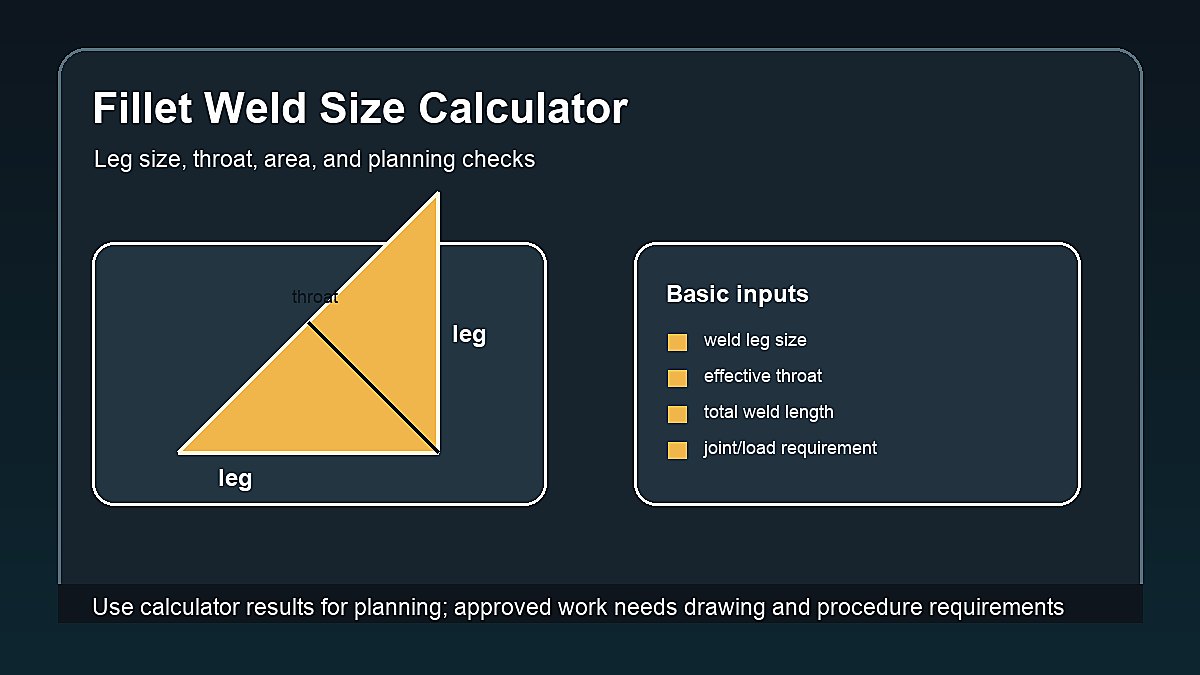
A fillet weld size calculator helps estimate weld leg size, effective throat, weld area, and sometimes rough weld strength or filler use. It can be useful for planning practice projects, checking a drawing, comparing weld sizes, or understanding why a small change in leg size can add a lot of weld metal.
Fillet welds are common on T-joints, lap joints, corner joints, brackets, tabs, frames, and shop fixtures. The shape looks simple, but sizing matters. A weld that is too small may not meet the joint requirement. A weld that is much larger than needed can waste time, filler metal, and heat, and it may distort the part.
Mark Dawson beginner note: use a calculator to understand the numbers, not to approve a critical weld. Structural, trailer, lifting, vehicle, pressure, pipe, or code work needs approved drawings, qualified procedures, and proper inspection.
Quick Answer
For an equal-leg fillet weld, the common planning relationship is:
Effective throat = leg size x 0.707
A 6 mm equal-leg fillet has an effective throat of about 4.24 mm. A 1/4 in equal-leg fillet has an effective throat of about 0.177 in. Many calculators use this throat value, total weld length, and allowable stress or design method to estimate capacity or required weld size.
| Leg Size | Effective Throat | Basic Use |
|---|---|---|
| 3 mm | 2.12 mm | Light sheet or small practice joints |
| 4 mm | 2.83 mm | Light brackets and tabs |
| 6 mm | 4.24 mm | Common medium reference size |
| 8 mm | 5.66 mm | Heavier fabrication planning |
| 10 mm | 7.07 mm | Large weld requiring good control |
What a Fillet Weld Size Calculator Does
A calculator usually starts with the weld geometry. The simplest fillet weld is an equal-leg right triangle. The two legs are measured along the two joined surfaces. In that theoretical triangle, throat is the shortest distance from the root to the weld face.
From there, the calculator may estimate throat, cross-sectional area, weld volume, filler metal, or rough capacity. Some tools work backward: you enter a load and length, then the calculator estimates a required weld size. That backward calculation needs a design method, material assumptions, and safety factors, so it should not be treated as a universal answer.
If you only need a quick size reference, start with Fillet Weld Size Chart in mm. This calculator guide goes deeper into the math behind those chart numbers.
Key Inputs
| Input | Meaning | Common Mistake |
|---|---|---|
| Leg size | Distance along each joined plate surface | Measuring bead width instead of leg |
| Effective throat | Shortest theoretical load path through the weld | Using leg size as throat size |
| Weld length | Total usable length of the weld | Counting starts, gaps, or poor ends as full strength |
| Material | Base metal and filler metal strength | Using one value for every metal |
| Joint type | Lap, T-joint, corner, or bracket layout | Ignoring load direction and fit-up |
| Design requirement | Drawing, procedure, code, or engineer instruction | Letting the calculator replace the requirement |
Basic Fillet Weld Formulas
For a standard equal-leg fillet weld, the most common beginner formulas are:
- Effective throat = leg size x 0.707
- Leg size = effective throat ÷ 0.707
- Approximate triangle area = leg size x leg size ÷ 2
- Weld volume = cross-sectional area x weld length
These are geometry formulas, not permission to weld anything you want. Actual design may use effective throat, allowable stress, load direction, weld group behavior, base metal strength, filler strength, inspection category, and code rules.
For bead shape and visible size, compare Weld Bead Size Chart. A bead that looks wide is not automatically the right fillet size if the leg and throat are wrong.
Leg Size to Throat Chart
| Leg Size | Effective Throat | Approximate Area |
|---|---|---|
| 1/8 in | 0.088 in | 0.0078 in² |
| 3/16 in | 0.133 in | 0.0176 in² |
| 1/4 in | 0.177 in | 0.0313 in² |
| 5/16 in | 0.221 in | 0.0488 in² |
| 3/8 in | 0.265 in | 0.0703 in² |
Notice how area grows faster than the leg number feels. Moving from a 1/4 in fillet to a 3/8 in fillet does not add only a small amount of weld metal. It more than doubles the approximate triangular area. That affects heat input, distortion, filler use, and welding time.
Worked Example
Suppose a drawing calls for a 6 mm equal-leg fillet weld on a non-critical practice bracket. The throat estimate is:
6 mm x 0.707 = 4.24 mm
The approximate triangular area is:
6 mm x 6 mm ÷ 2 = 18 mm²
If the weld length is 200 mm, the rough weld volume is:
18 mm² x 200 mm = 3,600 mm³
This example is only geometry. It does not prove the bracket is strong enough. It simply shows how leg size, area, and length connect. For consumable planning, connect the volume to Advanced Weld Consumable Calculator.
Unequal-Leg Fillet Welds
Not every fillet weld has equal legs. Some joints need an unequal-leg fillet because the plates are different thicknesses, access is limited, or the detail calls for more weld on one side of the joint. In those cases, the simple leg x 0.707 shortcut does not describe the whole weld as cleanly.
An unequal-leg calculator should ask for both leg sizes. Throat depends on the geometry between the root and the weld face. If the tool only accepts one leg size, it is probably assuming an equal-leg weld. Do not use that result for an unequal weld without checking the drawing or engineering requirement.
For beginner practice, unequal legs usually mean the weld should be inspected more carefully. One leg may look large while the other side is too small. A fillet gauge and clear drawing note help avoid guessing.
Intermittent Fillet Welds
Intermittent fillet welds are short weld segments with spaces between them. A calculator needs the actual welded length, not the full length of the joint. If a 1,000 mm joint has five welds that are 100 mm long, the total weld length is 500 mm, not 1,000 mm.
Spacing matters for strength and distortion control, but a basic size calculator may not handle spacing rules. It may only calculate weld metal or throat area for the length you enter. If a drawing calls for intermittent welds, follow the drawing symbols, segment length, pitch, end returns, and inspection notes.
Intermittent welds can save time and reduce heat, but they are not a shortcut for every joint. Some parts need continuous welds for strength, sealing, fatigue resistance, or corrosion reasons.
Minimum and Maximum Fillet Size
Minimum fillet size is often controlled by material thickness, code rules, procedure requirements, or drawing notes. Very small welds can cool fast, lack fusion, or fail to meet the design requirement. Maximum fillet size matters too because overwelding can add distortion, residual stress, cost, and extra heat.
Do not assume a bigger fillet is always safer. Oversized welds can warp thin parts, create stress concentration, hide poor fit-up, or waste filler. If a drawing calls for a size, follow the drawing and procedure instead of freelancing with a larger bead.
For thick-to-thin joints, weld size can also be limited by the thinner member. A large weld on a thin edge can melt away the edge or fail to create the intended connection. The calculator might show a large area, but the base metal still controls what is practical.
Strength Estimate Limits
Some fillet weld calculators include a strength estimate. Treat that number carefully. Strength calculations need more than throat size and length. Load direction, weld group layout, eccentric loading, filler metal, base metal, weld quality, inspection level, and design method can all change the result.
A single straight weld loaded in simple shear is much easier to estimate than a bracket with offset load, multiple welds, bending, vibration, or fatigue. A calculator that does not ask about the load path cannot fully evaluate that bracket. It can only show a simplified planning number.
If the joint failure would hurt someone or damage important equipment, the calculator has reached its limit. Use an engineer, qualified welding procedure, and inspection plan instead of stretching a simplified formula.
Common Calculator Limits
A calculator may assume an equal-leg fillet, good fit-up, clean base metal, full-length usable weld, and a simple load path. Real joints are rarely that neat. Gaps, undercut, overlap, poor tie-in, missed starts, crater cracks, and uneven legs can reduce the usefulness of the calculated number.
Unequal-leg fillets need separate handling because the smaller effective throat may control the joint. Intermittent welds need the actual weld length, spacing, and end returns if required. Weld groups need load direction and eccentricity checks that a basic calculator may not include.
Using Size for Filler and Time Planning
Fillet weld size also affects filler metal and welding time. The approximate area of the fillet grows with the square of the leg size. That means a small increase in specified size can add a large amount of weld metal across a long job.
For example, a 1/4 in fillet has an approximate triangular area of 0.0313 square inches. A 3/8 in fillet has an approximate area of 0.0703 square inches. On a long run of welds, that difference changes wire use, arc time, heat input, and distortion risk.
When estimating a job, calculate each weld size separately. Do not average all fillets together if some are small tabs and others are heavy bracket welds. Separate line items give a cleaner material and time estimate.
Before You Trust the Number
Run a quick reality check before using any calculator result. Confirm the weld symbol, joint type, leg size, total length, base material thickness, and whether the weld is continuous or intermittent. Then compare the calculated size with what your machine, process, and position can actually produce cleanly.
If the result asks for a large fillet on thin material, stop and review the detail. The issue may be the joint design, not your welding skill. A practical weld needs both the math and a joint that can be welded without destroying the base metal.
How to Measure Fillet Weld Size
Use a fillet weld gauge when accuracy matters. The gauge checks leg size or throat depending on the style. Visual guessing is unreliable, especially when the weld face is convex or concave. Grinding, spatter, slag, and paint can also make a weld look larger than it measures.
- Clean slag, spatter, and loose debris.
- Place the gauge against both joined surfaces.
- Check whether the weld meets the required leg size.
- Look for undercut, overlap, porosity, cracks, and lack of fusion.
- Do not count defective or missing sections as full-strength weld length.
For defect checks, use Common Welding Defects before trusting the size alone. Size is only one part of weld quality.
Safety and Quality Warning
Fillet weld sizing can affect strength and safety. Welding also involves fire, electric shock, fumes, UV radiation, hot metal, grinding hazards, and compressed gas where applicable. Use proper PPE, ventilation, fire control, and manufacturer instructions.
For structural, vehicle, trailer, pressure, lifting, pipe, or workplace welds, do not rely on a website calculator. Use approved drawings, qualified procedures, trained welders, and inspection. Review safety references such as OSHA welding hazard guidance, OSHA 1910.252 welding, cutting, and brazing, and AWS free welding resources.
Common Mistakes
- Using leg size as throat size: throat is about 0.707 times the equal leg size.
- Ignoring weld length: size and length both affect capacity and filler use.
- Overwelding everything: bigger welds can add distortion and cost.
- Counting bad weld sections: cracks, porosity, and missed starts may reduce usable length.
- Using calculator output as approval: critical welds need design and inspection.
- Measuring bead width only: fillet weld leg size is measured along the joined surfaces.
FAQ
How do you calculate fillet weld throat size?
For a standard equal-leg fillet weld, effective throat is calculated as leg size x 0.707. For example, a 6 mm leg gives about 4.24 mm effective throat.
Is fillet weld leg size the same as throat size?
No. Leg size is measured along the joined surfaces. Effective throat is the shortest theoretical distance through the weld. For equal-leg fillets, throat is about 70.7% of the leg size.
Can I use a fillet weld size calculator for structural welding?
Use it only for learning or planning. Structural welding needs approved design requirements, qualified procedures, correct materials, trained welders, and inspection.
What happens if a fillet weld is too large?
An oversized fillet can waste filler, add heat, increase distortion, slow the job, and sometimes create quality problems. Follow the drawing or procedure size when one exists.
How do I measure fillet weld size?
Use a fillet weld gauge after cleaning the weld. Check leg size or throat according to the gauge type and the requirement. Do not rely only on visual bead width.
Final Advice
A fillet weld size calculator is useful when you understand what it is calculating. For equal-leg fillets, start with leg size, effective throat, area, and length. Then remember the limits: weld quality, fit-up, material, load direction, and inspection matter just as much as the math.
For practice projects, use the calculator to learn the relationship between weld size and weld metal. For critical work, use the approved design, procedure, and inspection route. That boundary keeps the calculator helpful without making it responsible for decisions it cannot safely make.