Fillet Weld Size Chart in mm
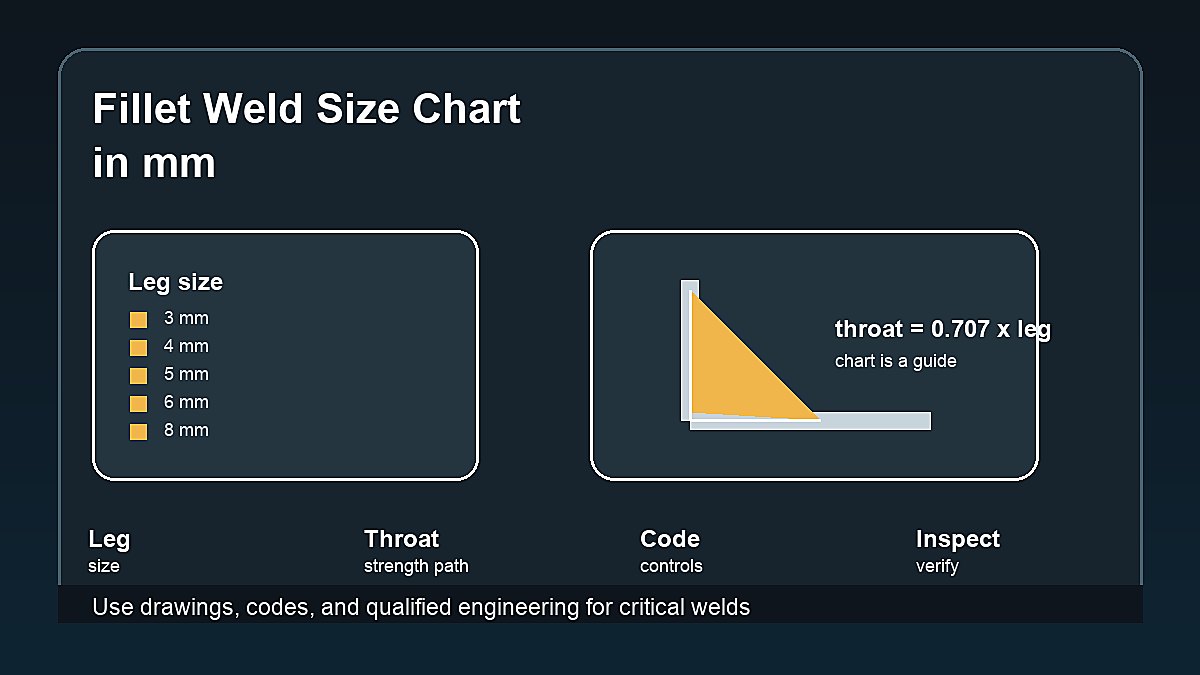
This fillet weld size chart in mm converts a specified equal leg length into ideal theoretical throat and triangular cross-sectional area. It is a geometry reference for a 90° joint, not a table for choosing weld size from plate thickness or load.
Read the drawing first: a throat dimension and a leg dimension are different. In ISO-style notation, z denotes leg length and a denotes throat. Check the drawing standard and notes before interpreting an unprefixed number. TWI explains weld-symbol dimensions.
Fillet Weld Dimensions on a T-Joint
On an equal-leg fillet weld, measure each leg from the theoretical joint root to its toe along the corresponding plate. The theoretical throat runs from the root to the straight line joining the two toes. For an ideal equal-leg 45° profile, a 6 mm leg gives a theoretical throat of 6 ÷ √2 ≈ 4.2 mm.
Use the drawing to identify whether it specifies leg size or throat. A leg measurement on the outside does not establish root fusion or penetration.
Equal-leg fillet weld chart: millimeters
| Specified leg z (mm) | Theoretical throat a (mm) | Triangle area (mm²) |
|---|---|---|
| 2 | 1.41 | 2.0 |
| 3 | 2.12 | 4.5 |
| 4 | 2.83 | 8.0 |
| 5 | 3.54 | 12.5 |
| 6 | 4.24 | 18.0 |
| 7 | 4.95 | 24.5 |
| 8 | 5.66 | 32.0 |
| 9 | 6.36 | 40.5 |
| 10 | 7.07 | 50.0 |
| 12 | 8.49 | 72.0 |
| 14 | 9.90 | 98.0 |
| 16 | 11.31 | 128.0 |
Calculated from a = z / √2 and area = z² / 2. Throat values are rounded to two decimal places; rounding is not an inspection tolerance. The table assumes equal legs, a 90° included joint angle and a straight weld face. It excludes penetration, root gaps and reinforcement.
See the leg and throat relationship
A 6 mm leg is not a 6 mm throat
For z = 6 mm, the theoretical throat is 6 / √2 = 4.24 mm. If the drawing instead specifies a = 6 mm, the ideal equal leg is 6 × √2 = 8.49 mm. These are mathematical conversions, not permission to select or round a production weld size. Follow the specified size and applicable requirements.
The TWI review of fillet joints explains notation and practical throat issues. Concavity and other profile differences mean the real weld need not match the ideal triangle.
Convert throat to leg length
| Specified throat a (mm) | Ideal equal leg z = a√2 (mm) |
|---|---|
| 2 | 2.83 |
| 3 | 4.24 |
| 4 | 5.66 |
| 5 | 7.07 |
| 6 | 8.49 |
| 8 | 11.31 |
Do not use this reverse table as a minimum-fillet-size table. Code minimums, maximums, weld length, load direction, fatigue and member thickness require the actual design and procedure.
Example: compare weld-metal volume
For the same 100 mm length, a 4 mm equal-leg triangle has area 8 mm² and volume 800 mm³. A 6 mm leg has area 18 mm² and volume 1,800 mm³. The second ideal weld uses 2.25 times the volume. This comparison helps explain why a small increase in leg size changes material use; it does not establish joint capacity.
For your own leg and length, use the working fillet geometry calculator. It accepts millimeters or decimal inches and shows its assumptions.
Measure the weld against the right requirement
- Confirm whether the requirement specifies leg or throat, plus side, length and any other notes.
- Put the work in a safe condition and clean the inspection area.
- Use an appropriate gauge according to its instructions and the inspection procedure.
- Check the required locations along the weld, not only the best-looking section.
- Record dimensions and any surface indications separately.
A fillet gauge does not establish internal fusion or rule out subsurface defects. Use the specified acceptance criteria and inspection methods. See how to check welding defects for observation guidance.
Limits of this reference
Unequal legs, non-90° joints, concavity, root gaps and penetration require other considerations. This chart does not recommend a weld size for a bracket, frame or a particular plate thickness. Structural, vehicle, pressure and lifting work needs qualified design, approved procedures and inspection.
For general shop hazards, follow OSHA welding safety guidance and equipment instructions. Do not confuse a correct arithmetic result with an acceptable weld.