Can You Weld Car Sheet Metal With Flux Core Wire?
Can you weld car sheet metal with flux core wire? Yes, it is possible on some thin automotive steel, but it is not the easiest or cleanest method for beginners. Car sheet metal is thin, easy to burn through, and easy to warp. Self-shielded flux core wire runs hotter and messier than solid wire MIG with shielding gas, so body-panel work needs careful heat control.
If you only have a small flux core welder, you can practice on scrap and make small non-structural patches. Do not treat flux core as the best choice for cosmetic bodywork, structural vehicle repairs, suspension mounts, frames, or safety-critical parts. For clean auto body panels, gas MIG with thin solid wire is usually the better process.
Mark Dawson beginner note: the question is not only whether the wire can melt the panel. The real question is whether you can control burn-through, distortion, gaps, cleanup, and corrosion after the repair. Practice on scrap from the same thickness before touching a real car panel.
Quick Answer
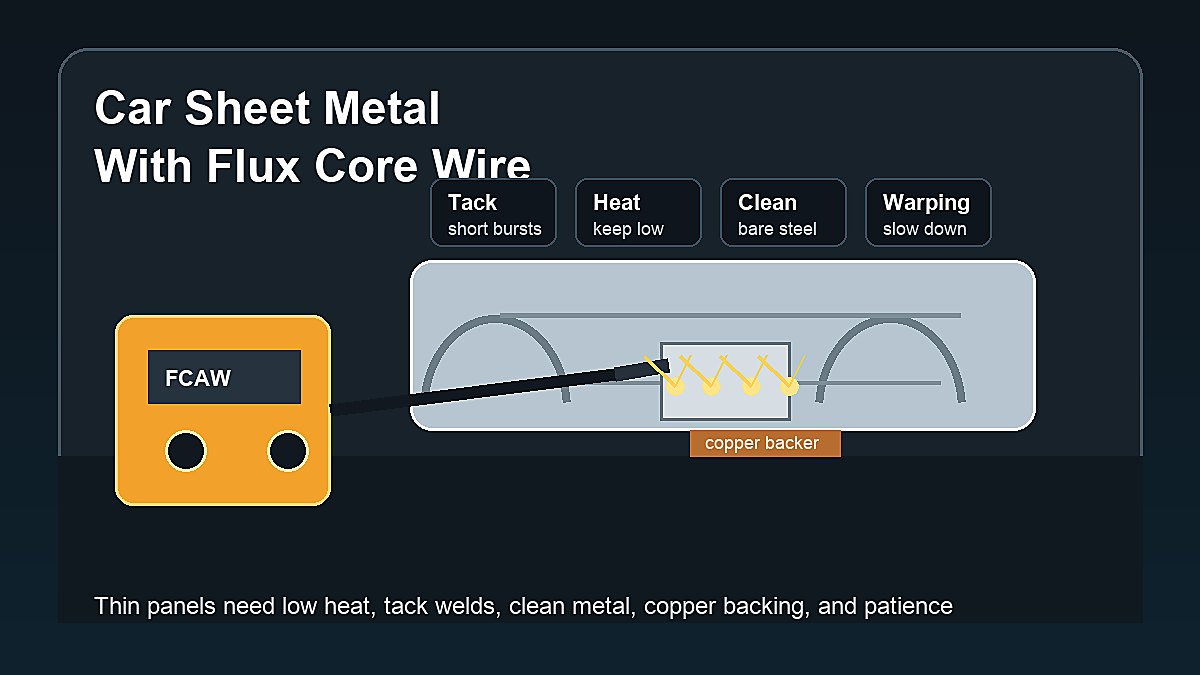
You can weld car sheet metal with flux core wire for small patches and practice work, but it is difficult because automotive panels are thin. Use the smallest self-shielded wire your machine supports, the lowest stable heat setting, short tack welds, clean bare steel, tight fit-up, and cooling time between tacks. Avoid long beads. Avoid critical repairs. Expect more grinding and cleanup than gas MIG.
| Factor | Flux Core on Car Sheet Metal | Beginner Takeaway |
|---|---|---|
| Heat | Easy to burn through | Use short tacks, not long beads |
| Warping | High risk on wide panels | Spread tacks around and let metal cool |
| Appearance | More spatter and slag | Expect cleanup before finishing |
| Best use | Small patches, practice, rough repairs | Not ideal for show-quality bodywork |
| Better process | Gas MIG for thin panels | Use solid wire if appearance matters |
Why Car Sheet Metal Is Hard to Weld
Automotive sheet metal is much thinner than the steel used for brackets, carts, gates, or farm repairs. Thin panels heat up quickly. A setting that feels manageable on 1/8 inch steel can blow a hole in a car panel almost instantly. Once the metal overheats, the panel can shrink, pull, oil-can, or warp.
Body panels also expose every mistake. A small bump in a gate bracket may not matter. A small ripple in a quarter panel can become obvious after sanding and paint. That is why bodywork welds are usually made as a series of spaced tack welds rather than one continuous bead.
Rust repair adds another problem. Rusty car metal often becomes thinner near the edge of the patch. If you weld to weak, pitted steel, the arc may burn the edge away. Cut back to sound metal before welding, and keep the patch fit tight enough that you are not trying to bridge a large gap with flux core wire.
Why Flux Core Makes It Harder
Self-shielded flux core wire is useful because it does not need a gas bottle and can work outdoors. That same process can be aggressive on thin sheet. It produces slag, more smoke, and more spatter than clean gas MIG. It may also need a larger wire size than ideal bodywork wire.
With gas MIG, many bodywork users run thin solid wire and low settings. Flux core beginners are often limited to 0.030 inch self-shielded wire. That can work with skill, but the heat window is narrow. Too cold and the weld piles up. Too hot and the panel opens up.
Before trying automotive panels, understand the basics in Flux Core Welding Settings for Beginners and Self-Shielded vs Gas-Shielded Flux Core Wire.
When Flux Core Is Acceptable
Flux core can be acceptable for small, non-critical patches where appearance is not the main goal. Examples include practice coupons, hidden floor patches, small rust repairs on non-structural panels, temporary shop repairs, or learning exercises on scrap car panels.
It is a poor choice when the repair needs a clean cosmetic finish, very low distortion, or predictable strength. Door skins, hoods, quarter panels, rocker structures, suspension areas, seat-belt mounts, and frame-related parts should not be beginner experiments. Vehicle work can carry real safety consequences.
If your goal is show-quality bodywork, save time and frustration by using gas MIG, spot welding where appropriate, panel adhesive where manufacturer-approved, or professional repair methods. Flux core is a workable backup for some jobs, not the best auto body process.
Best Wire and Machine Setup
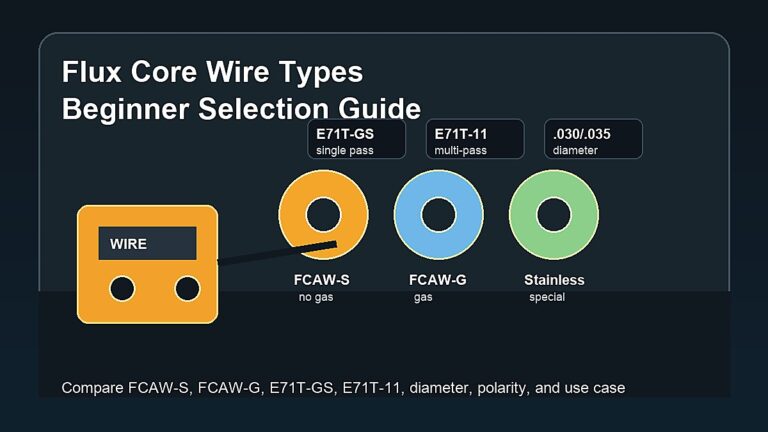
Use the smallest self-shielded flux core wire your machine and contact tips support. For many hobby machines, that means 0.030 inch wire. Some machines may support smaller or larger options, but the machine manual and wire label matter more than guesses.
Check polarity before welding. Many self-shielded flux core wires use DCEN, but you must confirm the wire label. Wrong polarity can make the arc harsher, increase spatter, and make thin-panel welding feel impossible. Match the drive roll and contact tip to the wire size.
Start at the lowest stable voltage or power range. Then adjust wire speed until the arc starts cleanly and does not stub hard into the panel. Practice on similar thickness scrap first. Your real panel should not be the place where you discover the machine is still too hot.
How to Reduce Burn-Through
- Cut out weak rust until you reach solid steel.
- Clean paint, undercoating, seam sealer, oil, and rust from both sides when possible.
- Keep patch gaps tight. Large gaps burn away fast.
- Use tack welds instead of a continuous bead.
- Let each tack cool before adding nearby heat.
- Use a copper backing bar when you can safely fit one behind the joint.
- Aim heat slightly toward the thicker side if one piece is heavier.
- Stop when the panel gets too hot to touch near the weld area.
A copper backing bar can help because weld metal does not easily fuse to copper, and the copper can absorb some heat. It will not fix poor fit-up or excessive settings, but it can reduce blowouts on small gaps. Keep the backing clean and clamp it securely.
Use Tack Welds, Not Long Beads
Long beads are the main beginner mistake on car sheet metal. They build heat too quickly and pull the panel out of shape. Instead, place one tack, move to another area, place another tack, and keep jumping around the patch. The goal is to spread heat, not concentrate it.
After the first round of tacks, inspect the panel. If the metal is staying flat, add more tacks between the first ones. Keep working in short bursts until the seam is filled. Grind carefully and avoid overheating the panel with the grinder too.
This is slower than running a bead, but it is much safer for thin automotive steel. For more beginner technique habits, read How to MIG Weld Flux Core for Beginners and Flux Core Welding Tips for Beginners.
Panel Prep Matters More Than Beginners Think
Flux core can tolerate some dirty steel better than gas MIG, but that does not mean dirty car panels are safe or easy to weld. Paint, primer, undercoating, seam sealer, adhesives, galvanized coating, oil, and rust can create fumes and poor welds. Clean to bare metal around the weld area.
Also check the backside. Automotive panels often have coatings behind them. Welding from the front can heat the back coating enough to smoke or ignite. Keep fire watch, remove nearby flammables, and do not weld near fuel, wiring, insulation, carpet, or unknown materials.
Common Problems and Fixes
| Problem | Likely Cause | Beginner Fix |
|---|---|---|
| Burn-through | Too much heat, gap too large, weak metal | Lower setting, tighten fit-up, use tacks and backing |
| Warping | Too many tacks in one area | Move around the panel and cool between tacks |
| Porosity | Dirty metal, long stickout, contamination | Clean better and check wire setup |
| Heavy spatter | Wrong polarity, poor settings, low-quality wire | Check polarity and tune on scrap |
| Weak patch edge | Welding to rust-thinned steel | Cut back farther to solid metal |
If defects keep showing up, use the Welding Defects hub to diagnose porosity, undercut, slag inclusion, lack of fusion, and spatter before grinding everything flat.
Flux Core vs Gas MIG for Body Panels
Gas MIG is usually better for body panels because thin solid wire can run smoother with less slag and less cleanup. It is easier to make small tacks that grind cleanly. Shielding gas is a hassle outdoors, but most bodywork is better done in a controlled shop anyway.
Flux core wins on simplicity and outdoor convenience. You do not need a gas bottle, and many small machines are inexpensive. The tradeoff is more heat, smoke, slag, and cleanup. If your only welder is flux core, work slowly and accept that the finish may take more effort.
Patch Fit-Up for Thin Car Metal
Fit-up can decide whether a flux core repair succeeds before you strike the first arc. A patch that fits tightly needs less filler metal and less heat. A patch with large gaps forces you to stay in one place longer, which is exactly what thin car steel does not tolerate well.
Trim the patch slowly. Sneak up on the final size instead of cutting it too small. A small, even gap can be easier to manage than a patch jammed in place, but a wide uneven gap is trouble. If the edge of the original panel keeps disappearing when you touch it with the arc, the metal is probably too thin or rusty and should be cut back farther.
Use magnets, clamps, panel clamps, or temporary screws where appropriate to keep the patch flush. A patch that sits high or low will need more grinding and filler later. Keep the surfaces aligned before welding, because welding heat can pull them farther out of position.
Grinding and Finishing Without Ruining the Panel
Grinding can warp a panel too. Beginners often survive the welding step, then overheat the repair with an aggressive grinder. Use light pressure, short passes, and cooling time. Do not grind deep into the surrounding sheet metal just to flatten a high tack.
Remove slag before grinding so you can see what is actually metal. Grind a little, inspect, then continue. If you find pinholes, do not smear over them with filler and hope for the best. Add small tacks only where needed, cool the panel, and grind again gently.
After welding and grinding, protect the repair from corrosion. Bare steel should not sit exposed. Use the correct primer, seam sealer, cavity protection, or coating system for the repair area. Welding is only one part of a body repair; corrosion protection is what keeps the repair from failing later.
When to Stop and Choose Another Method
Stop if the panel keeps burning away, if the patch gap is too large, if smoke is coming from hidden coatings, or if the repair area is near anything safety-critical. More practice beads will not fix a poor repair plan. Sometimes the right answer is a different process, a replacement panel, or help from an experienced body technician.
Also stop if you cannot clean both sides of the weld area or monitor the backside for fire. Cars hide flammable materials in places beginners do not expect. If you cannot see what is behind the panel, slow down and inspect before continuing.
Safety Notes for Car Panels
Welding on a vehicle adds hazards beyond normal shop practice. Remove flammable interior parts near the weld area. Watch for fuel lines, brake lines, wiring, sound deadener, seam sealer, undercoating, and hidden foam. Keep a fire extinguisher nearby and inspect both sides of the panel after welding.
Flux core welding creates fumes, UV radiation, hot slag, sparks, and fire risk. Wear a welding helmet, safety glasses, gloves, flame-resistant clothing, and hearing protection when grinding. Use ventilation or fume extraction. Review OSHA welding hazards guidance, AWS safety resources, and Miller flux-cored welding basics.
Beginner Practice Plan
- Find scrap steel close to the same thickness as the car panel.
- Clean both sides to bare metal.
- Set the welder to the lowest stable range.
- Make single tacks, then let the panel cool.
- Try a tight butt joint and a small patch joint.
- Grind lightly and inspect for pinholes.
- Only move to the real panel after repeatable practice tacks.
Do not practice on a structural vehicle area. If the repair affects crash safety, seat belts, suspension, steering, frame sections, or load-bearing mounts, use a qualified repair process and inspection.
FAQ
Is flux core good for auto body panels?
Flux core can work for small non-critical patches, but it is not the best choice for clean auto body panels. Gas MIG is usually easier to control on thin steel.
What wire size is best for car sheet metal?
Use the smallest wire your machine supports and the wire label allows. Many hobby flux core machines use 0.030 inch wire, but gas MIG with thinner solid wire is often better for bodywork.
Should I push or pull flux core on car sheet metal?
Self-shielded flux core is commonly dragged, but on thin panels your tack sequence and heat control matter more than long travel direction. Avoid continuous beads.
Can flux core weld 22 gauge steel?
It may be possible with the right machine, wire, fit-up, and skill, but 22 gauge steel is very easy to burn through. Practice first and consider gas MIG for cleaner results.
Can I weld a car frame with flux core?
Do not attempt frame or safety-critical vehicle repairs as a beginner flux core project. Structural vehicle repairs need the correct procedure, qualified skill, and inspection.
Final Advice
Flux core wire can weld car sheet metal, but it asks a lot from a beginner. Use it only for practice and small non-critical patches, keep the metal clean, make short tacks, cool often, and expect cleanup. If the repair needs a clean cosmetic finish or safety-critical strength, gas MIG or professional repair is the smarter path.