Different Flux Core Welding Wire Types Explained
Different flux core welding wire types can confuse beginners because several wires look similar on the spool but behave very differently in the weld. Some flux core wires need no external gas. Some require shielding gas. Some are made for single-pass work, some allow multiple passes, and some are made for stainless steel, hardfacing, or industrial fabrication.
The most important beginner rule is simple: do not buy flux core wire by diameter alone. A 0.030 inch spool can still be the wrong wire if it needs gas, has the wrong polarity, is single-pass only, or is made for a material you are not welding.
Mark Dawson beginner note: the wire label is part of the welding setup. Before loading a spool, check shielding type, classification, diameter, polarity, position rating, pass limits, and base metal. Most bad beginner flux core results start before the trigger is pulled.
Quick Answer
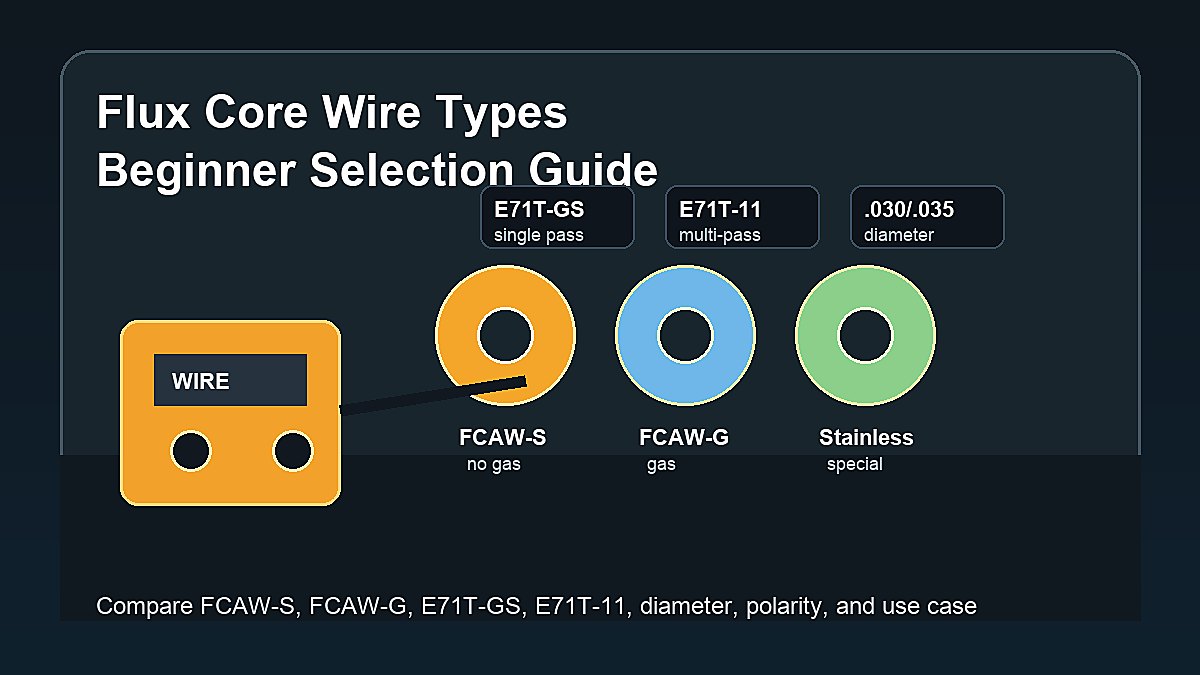
The two main flux core welding wire types are self-shielded flux core wire and gas-shielded flux core wire. Self-shielded wire, also called FCAW-S, creates its own shielding and usually does not need gas. Dual shield wire, also called FCAW-G, uses flux plus external shielding gas. Beginners using small no-gas welders usually need self-shielded mild-steel wire such as E71T-GS or E71T-11, depending on the job.
| Wire Type | Gas Needed? | Common Beginner Use |
|---|---|---|
| Self-shielded flux core | No external gas for most products | Outdoor practice, repairs, no-gas machines |
| Gas-shielded flux core | Yes | Shop fabrication and heavier work |
| E71T-GS | Usually no | Thin material and single-pass hobby work |
| E71T-11 | Usually no | General mild steel, all-position work, some multi-pass use |
| Stainless flux core | Depends on product | Stainless repairs with matching stainless wire |
Self-Shielded Flux Core Wire
Self-shielded flux core wire is the wire most beginners mean when they say “gasless MIG.” It has flux inside the tubular wire that helps shield the weld pool as the wire burns. This lets the welder work without a gas bottle on many mild-steel jobs.
This wire is popular for garage repairs, outdoor work, small farm repairs, brackets, carts, and beginner practice because the setup is simple. It still creates slag, smoke, spatter, fumes, and cleanup. No-gas does not mean no safety risk.
For a deeper comparison, read Self-Shielded vs Gas-Shielded Flux Core Wire.
Gas-Shielded Flux Core Wire
The gas-assisted version also has flux inside, but it is designed to run with external shielding gas. This process is often called dual shield. It is common in heavier shop fabrication because it can be productive when the machine, gas, wire, and procedure are matched correctly.
Beginners should not assume gas-shielded flux core will work in a no-gas machine. If the wire label calls for shielding gas, running it without gas can cause porosity, black soot, unstable arc behavior, and poor weld quality.
E71T-GS Flux Core Wire
E71T-GS is a common self-shielded flux core wire for hobby machines and general light repair. It is often used for thin mild steel, sheet metal practice, small brackets, and single-pass work. Beginners like it because it is easy to find in 0.030 inch and 0.035 inch sizes.
The key caution is pass limit. Many GS wires are intended for single-pass work. If you need multiple passes on thicker material, a different wire may be a better choice. Always read the wire label or product data sheet instead of guessing from the spool name.
E71T-11 Flux Core Wire
E71T-11 is another common self-shielded mild-steel flux core wire. It is often used for all-position welding and can be suitable for general fabrication, repair work, and some multi-pass applications when the manufacturer allows it.
Beginners may choose E71T-11 when they need a more general-purpose wire than a simple single-pass GS wire. It still needs the right polarity, correct stickout, clean enough material, and slag removal between passes. Learn setup basics in Flux Core Welding Settings for Beginners.
Stainless Flux Core Wire
Stainless flux core wire is made for stainless steel applications. It is not the same as common mild-steel flux core wire. If you weld stainless with the wrong filler, the weld may lose corrosion resistance and perform poorly even if it looks attached.
Common stainless filler families include 308L, 309L, and 316L types, but the correct choice depends on the base metal and service conditions. Some stainless flux core wires are self-shielded; others need gas. For more detail, read Can You Weld Stainless Steel With Flux Core?.
Flux Core Wire Diameter
Beginner flux core wires commonly come in 0.030 inch and 0.035 inch diameters. Smaller wire can be easier on thinner material and smaller 120V machines. Larger wire can carry more metal and may suit thicker mild steel, but it also needs enough machine output and good technique.
Do not choose larger wire because it looks stronger. Wire diameter must match the contact tip, drive roll, machine output, material thickness, and settings range. If your machine struggles to run the wire smoothly, the bead will suffer even if the classification is correct.
How to Read Flux Core Wire Labels
A flux core wire label can tell you more than the brand. Look for classification, diameter, shielding requirement, polarity, position rating, tensile strength, recommended material thickness, and whether the wire is single-pass or multi-pass. These details matter more than marketing words such as “easy” or “premium.”
For example, a beginner might see E71T-GS and E71T-11 side by side. Both may be self-shielded mild-steel wires, but they are not identical. One may be intended for light single-pass repairs while the other may allow broader use. The product data sheet should settle the question.
What E71T Means in Plain English
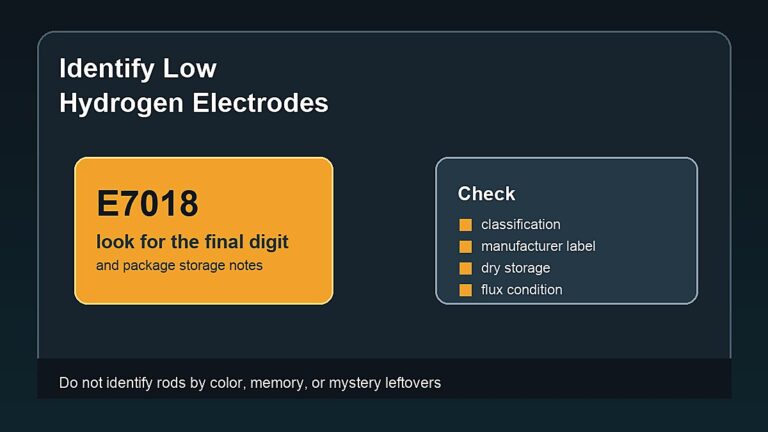
Flux core classifications look technical, but beginners can still learn the useful parts. In a common label such as E71T-11, the “E” means electrode. The “7” points to a 70,000 psi tensile strength class. The “1” commonly indicates all-position use. The “T” means tubular wire, which is the flux-cored construction. The suffix after the T gives more detail about shielding, usability, polarity, and other wire behavior.
Do not use this quick explanation as a replacement for the wire data sheet. It is a reading aid. Two wires can look similar but require different polarity, shielding gas, or pass limits. If a label does not clearly say gasless, self-shielded, or no external gas, verify before welding.
Single-Pass vs Multi-Pass Wire
Single-pass wire is designed for one weld pass. It can be useful for light repairs, thin material, and simple hobby work, but it may not be suitable for building up thick welds. Multi-pass wire can be used for multiple layers when the manufacturer allows it and when the joint, settings, and cleaning are correct.
This matters because beginners often try to solve a thick joint by stacking beads with whatever wire is already in the machine. If the wire is single-pass only, that approach can create a weld that looks filled but does not meet the wire’s intended use. Clean slag between passes and use a wire rated for the job.
Position Ratings Matter
Some flux core wires are rated for all positions. Others are better for flat or horizontal work. Vertical and overhead welding are harder because gravity affects the molten weld pool and slag. If you plan to weld a trailer bracket overhead, a gate hinge in place, or a vertical repair, check the position rating before buying wire.
All-position wire does not remove the need for skill. It only means the wire is designed to support that type of work when used correctly. Beginners should practice flat welds first, then vertical practice on scrap before trying an awkward real repair.
Which Wire Should Beginners Choose?
Most beginners with a small no-gas flux core welder should start with a self-shielded mild-steel wire that their machine manual recommends. For thin mild steel and single-pass practice, E71T-GS may be enough. For more general mild-steel repair and practice, E71T-11 may be a better fit if your machine supports it.
If you are welding car sheet metal, stainless, cast iron, galvanized material, or anything structural, slow down and verify the wire choice. Those jobs have extra concerns. For thin automotive panels, see Can You Weld Car Sheet Metal With Flux Core Wire?.
Choosing Wire by Material
For mild steel, use mild-steel flux core wire that matches the machine and thickness range. This is where E71T-GS and E71T-11 are common beginner choices. For stainless steel, use stainless flux-cored wire that matches the stainless grade and service conditions. For cast iron, aluminum, or specialty alloys, ordinary beginner flux core wire is usually not the answer.
Galvanized or coated material deserves extra caution. Welding zinc coatings can create hazardous fumes, and coatings can also cause porosity and poor weld quality. If you cannot identify the metal or coating, stop and verify the material before welding. Unknown scrap is not a good place to gamble.
Choosing Wire by Machine
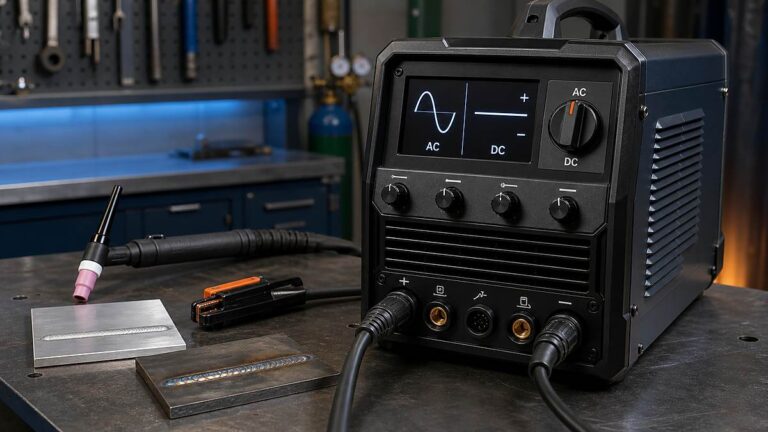
Your welder limits what wire you can use. A small 120V flux core machine may support only certain wire diameters and self-shielded operation. A larger multi-process machine may support self-shielded flux core, gas MIG, stick, and sometimes gas-shielded flux core, but it still needs the right drive roll, contact tip, polarity, and shielding setup.
Check the machine manual before buying a spool. Look for supported wire sizes, polarity change instructions, duty cycle, and recommended material thickness. A wire that works beautifully in a larger machine may feed poorly or run too hot in a small beginner welder.
Beginner Buying Workflow
- Identify the base metal: mild steel, stainless, or something else.
- Check whether the machine supports gas or only no-gas flux core.
- Pick self-shielded wire if you do not have gas.
- Choose diameter based on the machine manual and material thickness.
- Confirm polarity before loading the wire.
- Check whether the wire is single-pass or multi-pass.
- Practice on scrap and adjust settings before welding the real part.
This workflow prevents the most common beginner mistake: buying a spool that fits on the machine but does not fit the job. A wire can physically feed through the gun and still be wrong for the material, shielding method, or weld position.
How Wire Type Changes Weld Appearance
Flux core wire type affects bead shape, slag behavior, spatter, smoke, penetration, and cleanup. Self-shielded wire may look rougher than gas MIG but still make a useful weld when set correctly. Dual shield wire may run smoother in a shop, but it needs proper gas coverage.
If the weld suddenly becomes porous or smoky after a wire change, check the spool before blaming your hand technique. Wrong polarity, missing shielding gas, or a wire that does not match the metal can create ugly results even when travel speed is reasonable.
Wire Storage and Condition
Flux core wire should be stored dry and clean. Moisture, dirt, rust, damaged wire, or a crushed spool can cause feeding problems and poor welds. If a spool has been sitting open in a damp garage, inspect it before blaming the machine.
Keep the wire covered when not in use, and avoid dragging it through shop dust. Smooth feeding matters because flux core already asks the beginner to manage slag, stickout, and smoke. A rusty or dirty wire adds another avoidable problem.
Common Beginner Mistakes
- Buying gas-shielded wire for a no-gas welder.
- Using mild-steel flux core wire on stainless steel.
- Ignoring single-pass limits on a wire label.
- Choosing wire diameter that the machine cannot feed smoothly.
- Forgetting to change polarity after switching wire type.
- Using the wrong contact tip or drive roll.
- Not cleaning slag before adding another pass.
- Expecting flux core to weld every metal well.
Safety Notes
Flux core welding can create fumes, smoke, slag, sparks, UV radiation, hot metal, fire hazards, and electric shock risk. Some wires and base metals create more serious fume hazards than others. Stainless steel, galvanized coatings, painted metal, and unknown scrap need extra caution.
Wear a welding helmet, safety glasses, gloves, flame-resistant clothing, and appropriate respiratory protection when needed. Use ventilation or fume extraction. Read the wire safety data sheet and the welder manual. Review OSHA welding hazards guidance, AWS safety resources, and Miller flux-cored welding basics.
FAQ
What are the main types of flux core wire?
The two main types are self-shielded flux core wire and gas-shielded flux core wire. Self-shielded wire usually needs no external gas, while gas-shielded wire requires shielding gas.
Is E71T-GS or E71T-11 better for beginners?
E71T-GS can be good for thin single-pass hobby work. E71T-11 can be better for more general mild-steel practice if your machine and project match the wire requirements.
Does all flux core wire work without gas?
No. Self-shielded flux core wire usually works without external gas. Gas-shielded flux core wire needs shielding gas and should not be run gasless.
What size flux core wire should I use?
Many beginners use 0.030 inch or 0.035 inch wire. Choose the size your machine supports and match it to material thickness, contact tip, drive roll, and settings range.
Can flux core wire weld stainless steel?
Yes, but only with suitable stainless flux-cored wire. Regular mild-steel flux core wire is not the correct filler for proper stainless welds.
Final Advice
Flux core wire type matters as much as machine settings. For most beginners, start with self-shielded mild-steel wire recommended by the welder manual, then learn what the label means before changing wire. Check gas requirement, polarity, diameter, pass limits, material match, and safety notes every time you load a new spool.