AC vs DC Welding: Differences, Uses, and Polarity
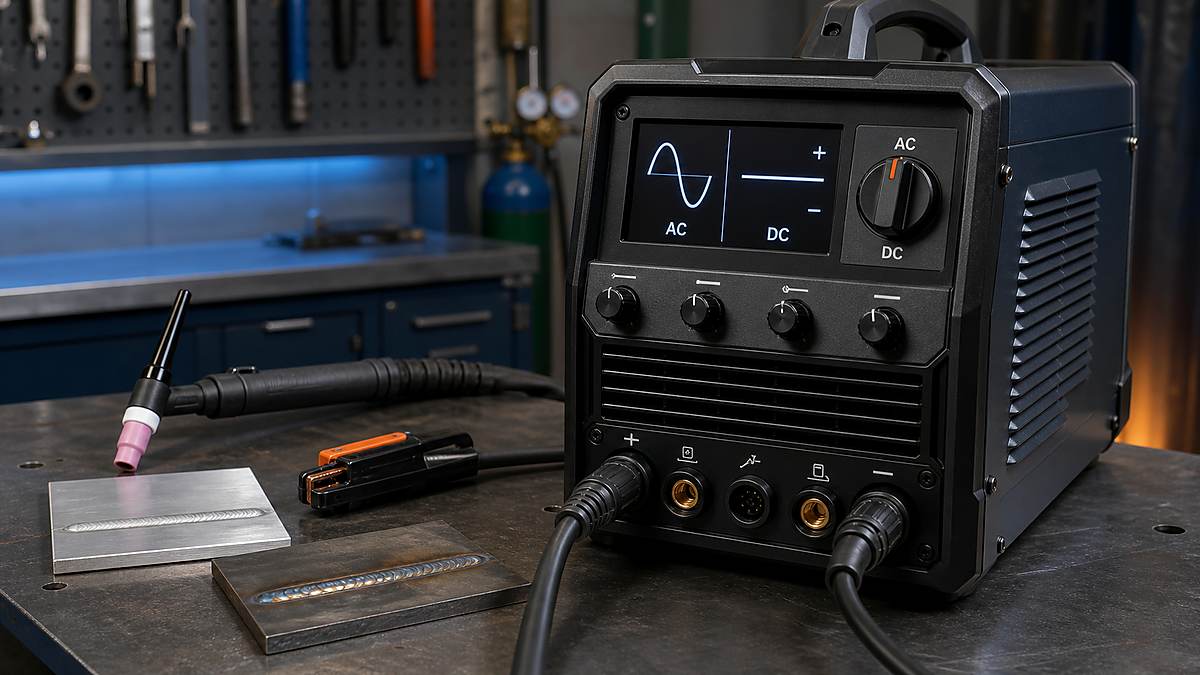
The difference between AC vs DC welding is the direction of welding current at the machine’s output. Direct current flows in one direction and can use electrode-negative or electrode-positive polarity. Alternating current reverses direction repeatedly, switching between electrode negative and electrode positive.
DC is common for most MIG, flux-core, stick, and TIG work because it can provide a smooth, focused arc. AC remains important for TIG welding aluminum and magnesium, for compatible stick electrodes, and for situations where alternating polarity helps reduce magnetic arc blow.
Mark Dawson beginner note: current type is only one part of setup. Always match AC, DCEN, or DCEP to the process, electrode or wire data, torch connection, base metal, and operator’s manual. A machine terminal color is not enough to choose polarity.
Quick Current-Type Comparison
| Feature | AC Welding | DC Welding |
|---|---|---|
| Current direction | Reverses repeatedly | Flows in one direction |
| Polarity options | Alternates EN and EP | DCEN or DCEP |
| Arc behavior | Depends on waveform and arc stabilization | Usually smooth and focused |
| Common TIG use | Aluminum and magnesium | Steel, stainless, titanium, copper alloys |
| Common stick use | Compatible AC electrodes; arc-blow control | Broad electrode choice and stable arc |
| Arc blow | Often reduced | More likely in magnetic conditions |
| Machine complexity | AC/DC TIG adds waveform controls | DC-only machines can be simpler |
This table gives broad patterns. Exact performance depends on power-source design, waveform, frequency, electrode, material, current, and procedure.
AC Input Is Not the Same as AC Welding Output
A welder may plug into an AC wall circuit and still produce DC welding output. Transformers, rectifiers, and inverter electronics convert incoming electrical power into the output current required by the process.
Check the output section of the nameplate and manual, not only the plug. A machine advertised as “DC TIG” accepts AC mains but cannot necessarily create AC TIG output. An “AC/DC TIG” machine includes output controls for both current types.
What Is DC Welding?
Direct current maintains one polarity. The electrode or torch is connected to one output terminal, and the work lead connects to the other. DC can be configured as:
- DCEN: direct current electrode negative, sometimes called straight polarity.
- DCEP: direct current electrode positive, sometimes called reverse polarity.
The effect of polarity is process-specific. Do not rely on one heat-distribution slogan for every arc process. TIG, stick, MIG, and flux-core electrodes have different arc physics, filler behavior, and manufacturer requirements.
What Is AC Welding?
Alternating-current output changes polarity many times per second. Older transformer welders often followed a fixed line-frequency waveform. Modern inverter TIG machines can shape the AC wave and may allow frequency, balance, amplitude, and waveform adjustment.
As polarity crosses through zero, the power source must keep or re-establish the arc. Modern electronics and high-frequency stabilization can make AC TIG highly controlled even though current reverses.
DCEN vs DCEP
| Polarity | Connection | Typical Uses | Main Warning |
|---|---|---|---|
| DCEN | Electrode or torch negative | Most DC TIG; some self-shielded FCAW and stick electrodes | Must match consumable and process |
| DCEP | Electrode or wire positive | Most solid-wire MIG; many stick and gas-shielded flux-core electrodes | Not suitable for every wire or rod |
| AC | Polarity alternates | AC TIG aluminum; compatible stick electrodes | Requires AC-capable equipment and consumables |
Some machines label terminals by torch/work connection rather than telling you the resulting electrode polarity. Trace the leads and read the diagram before welding.
Choosing Current for TIG Welding
Most DC TIG welding uses DCEN. It provides a focused arc and keeps tungsten heat manageable for carbon steel, stainless steel, titanium, nickel, copper alloys, and many other materials.
AC TIG is widely used for aluminum and magnesium. During the electrode-positive part of the AC cycle, cathodic cleaning helps disrupt the oxide film. During electrode-negative time, more useful heating and penetration occur in the work while tungsten load is reduced.
Aluminum oxide melts at a much higher temperature than the aluminum beneath it. AC does not replace mechanical cleaning, solvent cleaning, correct filler, gas, or joint preparation; it provides controlled oxide-cleaning action at the arc.
AC Balance in TIG Welding
AC balance changes the proportion of electrode-negative and electrode-positive time. More EN generally favors penetration and a cooler tungsten. More EP increases cleaning action but adds heat to the tungsten and can widen the etched cleaning zone.
Balance scales differ by manufacturer: one machine may display percent EN while another displays cleaning or EP. Never copy a percentage without checking what the control represents.
AC Frequency and Waveform
Higher AC frequency can produce a narrower, more directional arc and may improve control in tight joints. Lower frequency can create a broader arc. Square, soft-square, sine, and triangular waveforms can change arc feel, noise, puddle response, and tungsten behavior.
Use the machine’s starting chart rather than maximizing frequency or cleaning. Tungsten type and size must also support the selected AC current. See Different Types of Tungsten for TIG Welding and How to Choose the Right Tungsten Electrode Size.
Choosing Current for Stick Welding
DC stick usually provides an easier, smoother arc and gives access to DCEN or DCEP when the electrode permits. AC stick welders remain useful because they are simple, compatible electrodes are widely available, and alternating current can reduce magnetic arc blow.
Electrode classification and manufacturer data control polarity. E6010 is commonly associated with DCEP and often will not run correctly on a basic AC machine. E6011 is designed for AC capability as well as specified DC use. Many E6013 and suitable E7018 products can run on AC or DC, but not every product has identical requirements.
Use Different Types of Welding Rods for classification background, then read the package or data sheet for the exact electrode.
MIG and Flux-Core Output
Conventional solid-wire GMAW normally uses DC output and commonly DCEP. Specialized AC MIG systems exist, but a basic AC stick welder is not a substitute for a MIG power source and wire feeder.
Flux-core polarity depends on the wire. Many self-shielded wires use DCEN, while many gas-shielded wires use DCEP, but there are exceptions. Wrong polarity can cause unstable arc behavior, excessive spatter, poor bead shape, and inadequate penetration.
Use the exact wire data and the Wire Feed Speed Calculator and Formula only after confirming process and polarity.
Arc Blow: Why AC Can Help
Magnetic arc blow occurs when magnetic fields deflect a DC arc. It can appear near corners, joint ends, heavy sections, magnetized material, or poor work-lead placement. The arc wanders, pushes to one side, creates undercut, or makes the puddle hard to control.
Because AC reverses direction, the magnetic field does not remain fixed in the same way, so AC can reduce arc blow when the electrode supports it. Other fixes include changing work-lead location, welding direction, sequence, arc length, or demagnetizing the part.
Arc Stability and Starting
DC tends to offer a steady arc because current does not cross zero. AC arc stability depends on waveform, open-circuit voltage, electrode coating, high-frequency support, and power-source design. Modern inverter AC can be much more stable than an old transformer setup.
Poor starting is not always caused by AC or DC choice. Check work connection, polarity, electrode, tungsten preparation, gas, surface contamination, amperage, and start method.
Choose AC or DC by Process and Material
| Job | Common Starting Choice | Verify |
|---|---|---|
| TIG mild or stainless steel | DCEN | Tungsten, gas, current, procedure |
| TIG aluminum | AC | Balance, frequency, cleaning, tungsten |
| Stick with E6010 | Usually DCEP | Exact electrode data |
| Stick with E6011 | AC or specified DC | Package and machine capability |
| Solid-wire MIG | Usually DCEP | Wire and machine chart |
| Self-shielded flux core | Often DCEN | Exact wire data |
| Magnetic arc blow | Consider compatible AC | Electrode and procedure suitability |
AC-Only, DC-Only, or AC/DC Machine?
A DC-only TIG/stick inverter can cover steel, stainless, and many common shop metals but usually cannot provide conventional AC TIG aluminum capability. An AC/DC TIG machine adds aluminum-focused waveform controls and costs more. A basic AC stick machine can be durable and economical but offers fewer polarity and process options.
Choose by intended process, material, amperage, duty cycle, input power, service support, and accessories. “AC/DC” on a product page should describe welding output, not merely input compatibility.
How to Verify the Cable Connections
Turn the machine off before changing leads. Identify the electrode-side lead: this is the TIG torch, MIG gun, flux-core gun, or stick electrode holder. The other lead connects the workpiece to the power source and is properly called the work lead, even though shops often call it the ground clamp.
Trace each cable to its output receptacle. If the electrode-side lead is attached to the negative terminal, the setup is DCEN. If it is attached to the positive terminal, the setup is DCEP. On machines with internal polarity studs, open only the user-accessible compartment described in the manual and disconnect input power first. Do not remove service covers or touch energized components.
Some multi-process welders change polarity with a short jumper lead. Others use fixed gun wiring or a front-panel selector. After making the connection, compare it with the machine diagram and the consumable label. This two-source check is more reliable than copying a photo from another welder whose terminals may be arranged differently.
Read the Electrode or Wire Label
The package or manufacturer data sheet should state approved current and polarity, such as AC, DC+, DC-, DCEP, or DCEN. Treat the information for the exact product as authoritative. Two consumables in the same broad family may use different flux formulations and have different operating requirements.
For stick electrodes, classification offers useful clues, but it is not a substitute for the maker’s data. For flux-core wire, the spool label is especially important because self-shielded and gas-shielded products often require different polarity. Also confirm wire diameter, shielding gas where applicable, and the recommended parameter range. Polarity cannot correct a mismatched consumable or unsuitable machine.
Run a Controlled Test on Scrap
If the manual and consumable both permit more than one output option, compare them on clean scrap of the same alloy and thickness as the project. Hold joint type, amperage, arc length or contact-tip distance, travel speed, and preparation as constant as practical. Change only the approved current type or polarity.
Record arc starting, stability, sound, spatter, bead shape, slag release, tungsten condition, and visible fusion at the toes. Cut-and-etch or bend testing may reveal differences that surface appearance misses, but these tests require correct preparation and interpretation. A smooth-looking bead alone does not qualify a weld for structural or safety-critical service.
Stop if the arc becomes uncontrollable, the tungsten overheats, wire transfer is abnormal, or the machine displays a fault. Recheck connections rather than repeatedly increasing amperage. Testing is useful for fine adjustment only after the equipment and consumable instructions establish a safe operating range.
AC/DC Welder Buying Checklist
- Output modes: confirm whether the machine provides AC TIG, DC TIG, stick, MIG, or flux core rather than assuming “AC/DC” means every process.
- Useful output: compare amperage range and duty cycle at the current your projects require.
- AC controls: for aluminum TIG, check balance, frequency, waveform, starting method, and independent amplitude only if you will use them.
- Input power: verify circuit voltage, plug, breaker, extension-cord limits, and generator compatibility.
- Complete setup: budget for torch, foot control, regulator, work lead, electrode holder, cooler, gas, and consumables.
- Support: favor a readable manual, available parts, warranty service, and clear parameter charts.
A DC-only machine can be the better value when your work is steel, stainless, or DC stick. Paying for AC TIG makes sense when aluminum or magnesium is a real part of the plan. Buy for verified jobs and available electrical service, not for the longest feature list.
Wrong Polarity Symptoms
- Unstable or harsh arc
- Excessive spatter
- Poor penetration or unexpected bead profile
- Flux-core slag or bead behavior outside product expectations
- MIG wire burning or transferring poorly
- TIG tungsten overheating, eroding, or contaminating
- Stick electrode refusing to run smoothly
These symptoms have other causes too. Verify the connection diagram first, then inspect consumable, settings, gas, work lead, arc length, CTWD, and material cleanliness.
Common AC/DC Mistakes
- Confusing mains input with output: an AC plug does not prove AC welding capability.
- Assuming positive means more penetration: polarity effects depend on process and consumable.
- Using DCEN TIG advice for MIG: conventional solid-wire MIG commonly uses DCEP.
- Running self-shielded wire on the wrong terminal: read the wire label.
- Copying AC balance numbers between brands: displays may use opposite definitions.
- Using AC to avoid cleaning aluminum: oxide, oil, and contamination still need preparation.
- Ignoring arc blow: wandering DC arcs may need lead or sequence changes.
Safety Notes
AC and DC welding can both cause electric shock, burns, fire, fumes, UV exposure, and equipment damage. AC output can present a different shock sensation and some machines use high-frequency arc starting. Keep covers installed, use dry PPE, inspect cables, isolate power before authorized service, and follow the manual.
Review Welding Safety Equipment, Miller AC/DC TIG waveform guidance, Jasic AC vs DC TIG guidance, the Miller AC/DC quick reference, and OSHA welding hazards.
FAQ
Is AC or DC better for welding?
Neither is universally better. DC suits most common arc-welding work. AC is important for TIG aluminum, compatible stick electrodes, and reducing magnetic arc blow.
Do you TIG weld steel on AC or DC?
Most TIG welding of carbon and stainless steel uses DCEN. Follow the procedure and machine guidance for the specific alloy and joint.
Why is AC used for TIG aluminum?
The electrode-positive part supports oxide-cleaning action, while the electrode-negative part supports penetration and reduces tungsten heating.
Is DC welding more stable than AC?
DC often has a smoother continuous arc. Modern AC inverter machines use waveform control and stabilization to provide a controlled AC arc.
What is DCEP?
DCEP means direct current electrode positive. It is common for solid-wire MIG and many stick electrodes, but always verify the consumable.
Can AC reduce arc blow?
Yes, alternating polarity can reduce magnetic arc blow. The process and electrode must still be suitable for AC output.
Final Advice
Choose AC or DC from the process, metal, electrode or wire, and approved procedure. Use DCEN or DCEP only after checking which lead makes the electrode positive or negative.
For TIG aluminum, learn AC balance and frequency as machine-specific controls. For stick, MIG, and flux core, let the exact consumable data decide polarity. Correct output and polarity are setup requirements, not optional fine-tuning.