Flux Core Welding Tips for Beginners
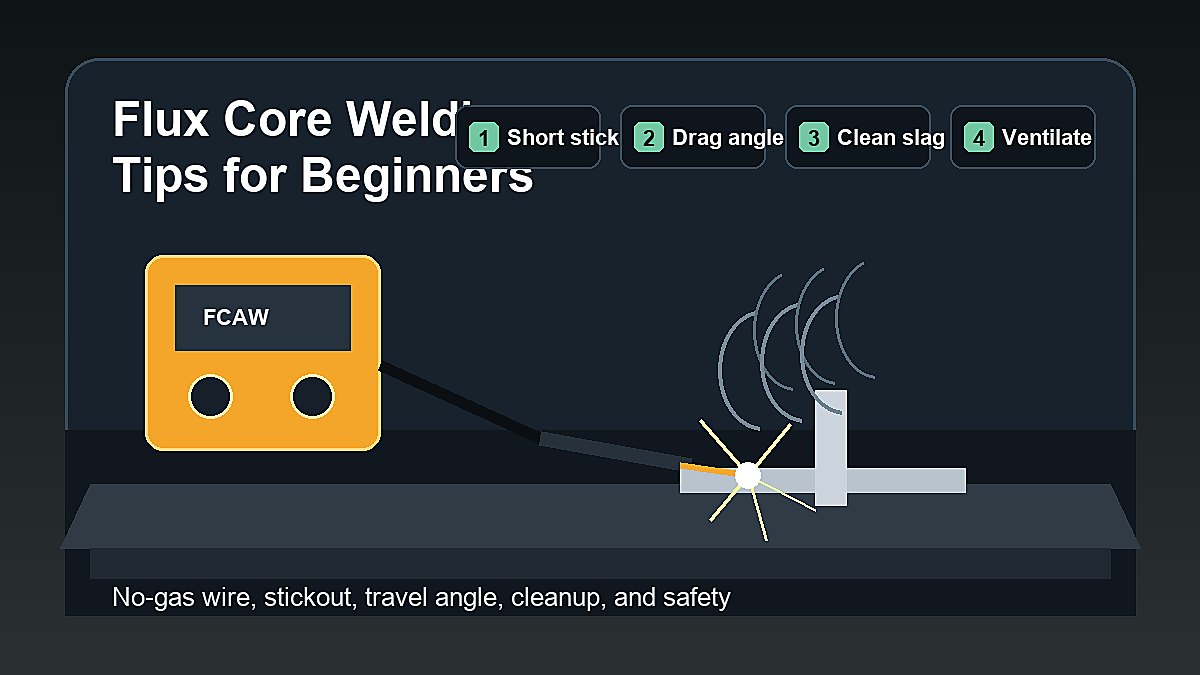
Flux core welding tips for beginners usually start with the basics: use the correct polarity, keep your stickout under control, drag the gun instead of pushing it, clean slag between passes, and practice on clean mild steel before trying real repairs.
Flux core welding is popular because self-shielded flux core wire does not need an external gas cylinder. That makes it useful for outdoor practice, driveway repairs, and simple home-shop welding. The tradeoff is more smoke, spatter, and slag than gas MIG, so beginners need good safety habits and cleanup discipline.
Mark Dawson beginner note: flux core can feel easy because the setup is simple, but it still rewards careful technique. If the weld is smoky, spattery, and full of slag traps, slow down and fix the basics before blaming the machine.
Quick Answer: Best Flux Core Welding Tips for Beginners
- Use the polarity listed on the wire and machine chart.
- Start with clean mild steel practice coupons.
- Use a drag angle instead of pushing the puddle.
- Keep stickout consistent and not too long.
- Adjust wire speed and voltage one change at a time.
- Chip and brush slag before judging the weld.
- Use ventilation because flux core creates more fumes and smoke.
- Do not use beginner practice welds for safety-critical repairs.
1. Check Polarity Before You Weld
Many self-shielded flux core wires require a different polarity than gas MIG with solid wire. If polarity is wrong, the arc may feel harsh, spatter can increase, and the weld may look poor even when your hand movement is decent.
Before welding, read the wire label, welder manual, and setup chart. Do not guess. Polarity is one of the fastest beginner mistakes to fix.
2. Use the Right Flux Core Wire Size
Beginner flux core machines often run common wire sizes such as 0.030 in or 0.035 in. The best size depends on your machine and material thickness. Use wire that your drive rolls, contact tip, and machine chart support.
If the wire feed slips, burns back, or stutters, check the spool tension, drive roll groove, contact tip size, liner condition, and wire speed. A smooth wire feed makes beginner practice much easier.
3. Drag the Gun, Do Not Push
With self-shielded flux core welding, beginners are commonly taught to drag the gun. A simple memory cue is “if there is slag, drag.” Dragging helps keep the slag behind the puddle instead of letting it run ahead into the weld.
Keep the angle modest. Too much angle can make the bead uneven and increase spatter. Watch the weld pool, not just the arc.
4. Keep Stickout Consistent
Stickout is the distance from the contact tip to the workpiece. If stickout is too long or constantly changing, the arc can become unstable and the bead may look inconsistent. Beginners often hold the gun too far away because they are trying to see better.
Use the machine and wire guidance as your starting point, then practice keeping the distance steady. Good lighting and a clean helmet lens make this easier.
5. Set Wire Speed and Voltage Carefully
Start with the chart inside your welder or the manual recommendation for your material thickness. Then make small adjustments on scrap metal. Change one setting at a time so you can see what improved or got worse.
| Problem | Possible Beginner Cause | What to Check |
|---|---|---|
| Lots of spatter | Wrong settings, long stickout, poor polarity, dirty metal | Polarity, wire speed, voltage, stickout, prep |
| Wire stubbing | Wire speed too high or voltage too low | Machine chart and test beads |
| Burn-through | Too much heat or slow travel on thin metal | Voltage, travel speed, material thickness |
| Slag inclusion | Slag trapped by angle, travel, or poor cleanup | Drag angle, bead placement, cleaning |
6. Clean the Metal Even Though Flux Core Is Forgiving
Flux core can tolerate some outdoor and repair conditions better than gas MIG, but that does not mean dirty metal is good practice. Paint, oil, heavy rust, moisture, and coatings can cause porosity, bad fusion, spatter, and hazardous fumes.
For beginner practice, use clean mild steel. Grind or brush the joint area, clamp the work securely, and make practice beads before trying a project.
7. Remove Slag Before Inspecting the Weld
Flux core leaves slag over the weld. Beginners sometimes judge the bead too early or forget to clean between passes. Chip and brush the slag before deciding whether the weld is good. Wear safety glasses while cleaning because slag can fly.
If slag gets trapped in the weld, you may see weak spots, rough bead shape, or inclusions. For more troubleshooting, visit Welding Defects.
8. Practice on the Right Thickness
Very thin sheet metal is difficult for beginners because it burns through easily. Very thick steel may need more output than a small 120V flux core welder can provide. Start with practice pieces that match your welder’s chart and allow you to run short beads without instantly burning through.
If you are still choosing a process, compare what welding is easiest to learn and read Types of Welding Explained.
9. Control Fumes and Fire Risk
Flux core welding can create more smoke and fumes than clean gas MIG. Use ventilation or fume control suitable for the material and workspace. Keep your head out of the plume, remove flammable materials, and keep fire control nearby.
Do not weld on galvanized, painted, oily, unknown, or coated materials without proper training and hazard control. Do not weld sealed containers, tanks, vehicle frames, trailers, lifting points, pressure vessels, or safety-critical parts as beginner practice.
10. Use a Simple Practice Plan
- Read the machine manual and wire label.
- Set polarity correctly.
- Put on PPE and clear the area.
- Clean mild steel scrap and clamp it securely.
- Run straight beads in the flat position.
- Clean the slag and inspect the bead.
- Adjust one setting at a time.
- Practice lap joints and T-joints.
- Review beginner welding mistakes before moving to projects.
Flux Core Bead Checklist
After every practice bead, let the metal cool, chip the slag, brush the weld, and look at the bead before changing settings. A useful flux core bead should show steady width, reasonable tie-in at both toes, and no obvious slag trapped along the edge. If the bead sits high and ropey, the weld may be too cold, travel may be too fast, or stickout may be too long. If the bead is wide, flat, and burning the edges away, the heat may be too high or travel may be too slow.
Take notes while practicing. Write down material thickness, wire size, polarity, voltage or tap setting, wire speed, stickout, travel direction, and what the bead looked like after cleaning. This habit makes practice faster because you stop guessing and start seeing which adjustment changed the weld.
When to Stop and Fix the Setup
Do not keep welding if the wire feed is jerky, the work clamp is loose, the contact tip is damaged, the liner feels clogged, or the machine repeatedly overheats. Beginners sometimes try to solve mechanical setup problems with hand technique. If the machine is not feeding smoothly, even good travel speed and gun angle will not make the bead consistent.
If you want a deeper no-gas setup path, read Gasless MIG Welding for Beginners and How to MIG Weld Without Gas. For buying your first machine, use Welding Tools & Gear before comparing beginner welders.
FAQ
Is flux core welding good for beginners?
Yes. Flux core can be good for beginners because self-shielded wire does not need a gas cylinder and can work outdoors. Beginners still need to manage slag, smoke, spatter, and safety.
Do you push or pull flux core welding?
For self-shielded flux core welding, beginners are commonly taught to pull or drag the gun. This helps keep slag behind the weld pool.
Why is my flux core weld so spattery?
Common causes include wrong polarity, poor settings, long stickout, dirty metal, unstable wire feed, or travel technique. Start with the manual chart and adjust on scrap.
Can flux core weld outside?
Self-shielded flux core wire is often used outdoors because it does not rely on external shielding gas. Wind, material condition, and safety controls still matter.
What metal should beginners flux core weld first?
Clean mild steel scrap is usually the best first practice metal. Avoid coated, unknown, galvanized, oily, or very thin material while learning.
Final Advice
The best flux core welding tips for beginners are simple: set polarity correctly, drag the gun, keep stickout steady, clean slag, use ventilation, and practice on clean mild steel. Flux core is practical and beginner-friendly, but the weld still needs controlled technique and safe working habits.