Gas Welding vs Arc Welding

Gas welding vs arc welding is a comparison between two very different ways to heat and join metal. In gas welding, a fuel-gas and oxygen flame heats the joint. With arc welding, electricity creates an arc hot enough to melt the base metal and filler.
For most modern beginners, an arc process is the more common path because stick, MIG, flux core, and TIG all use an electric arc. Gas welding still matters because oxy-fuel torches are useful for heating, brazing, cutting, bending, and some repair work. The better choice depends on the metal, job, workspace, power access, safety setup, and budget.
Mark Dawson beginner note: do not choose by tradition alone. A torch and an arc can both burn, blind, start fires, and create fumes. Learn the hazards before learning the bead.
Quick Answer
A gas welding torch uses a flame, usually from oxygen and acetylene, to heat metal and filler. An arc welding machine supplies the electrical arc. For structural steel, fabrication, repair, and beginner bead practice, arc processes are usually faster and more common. A torch is slower, but it can be useful for heating, brazing, thin metal work, and oxy-fuel cutting when the right equipment and training are available.
| Feature | Gas Welding | Arc Welding |
|---|---|---|
| Heat source | Fuel gas and oxygen flame | Electric arc |
| Common examples | Oxy-acetylene welding, brazing, heating | Stick, MIG, TIG, flux core |
| Beginner speed | Usually slower | Usually faster |
| Power need | No welding machine power | Needs electrical power |
| Main hazards | Flame, cylinders, fire, fumes | Arc flash, shock, fire, fumes |
How Gas Welding Works
Gas welding uses a torch connected to oxygen and fuel gas cylinders. Acetylene is the classic fuel for oxy-acetylene welding because it can produce a hot flame with oxygen. The welder adjusts the flame, heats the joint, and may add filler rod by hand.
The flame is broader and less concentrated than an electric arc. That means heat spreads through the workpiece more slowly. This can help with some heating and forming jobs, but it can also increase distortion on thin or delicate parts if the welder is not careful.
Oxy-fuel equipment is also used for cutting steel, heating stuck parts, brazing, soldering, and localized heat treatment. Those jobs are related to gas welding, but they are not all the same process. Cutting steel with oxygen is different from fusion welding two pieces together.
How Arc Welding Works
Arc welding uses a power source to create an electric arc between an electrode and the workpiece. The arc creates intense localized heat. Depending on the process, the electrode may melt into the joint, or it may only carry the arc while separate filler is added.
Stick welding, MIG welding, TIG welding, and flux core welding are all arc welding processes. They differ in electrode type, shielding method, filler control, and equipment setup. For a broad overview, read Types of Welding Explained.
This family of processes is common because it can put heat into the joint quickly. It is widely used for steel fabrication, repair, construction, farm work, shop projects, manufacturing, pipe work, and many modern welding jobs.
Gas Welding Equipment
A basic oxy-fuel setup can include oxygen and fuel cylinders, regulators, hoses, flashback arrestors, a torch handle, welding or cutting tips, striker, filler rods, goggles or face protection, gloves, and fire safety tools. Cylinder handling is part of the skill. Regulators, valves, hose condition, and leak checks matter every time.
Beginners sometimes see gas equipment as simple because there is no welding machine. That is misleading. Compressed gas cylinders, oxygen-enriched fire risk, acetylene limits, hose leaks, flashbacks, and open flame all require careful setup and training.
Arc Welding Equipment
Arc welding equipment depends on the process. Stick welding needs a power source, electrode holder, work clamp, and rods. MIG needs a wire-feed machine, gun, wire, shielding gas for gas MIG, and drive parts. TIG needs a torch, tungsten, shielding gas, filler rod, and often foot or amperage control.
For beginners who want a rugged manual arc process, the Stick Welding hub is a natural next step. Stick welding is often used outdoors and on thicker steel because the flux-coated rod supplies shielding and filler.
Speed and Heat Control
For joining steel, an electric arc is usually faster because the heat is concentrated at the joint. A stick or MIG welder can deposit filler quickly once the settings and technique are right. That speed is one reason arc processes replaced gas welding for much industrial steel work.
A torch is slower because the flame spreads heat over a larger area. That can be useful when the job needs gradual heating or flame control. It can be a disadvantage when the goal is quick fusion with less distortion.
Neither process is automatically easier. A slow flame gives time to watch the puddle, but cylinder setup and flame control take practice. An electric arc is powerful and efficient, but it can create defects quickly when angle, amperage, travel speed, or fit-up are wrong.
Best Uses for Gas Welding
- Heating stuck bolts, brackets, and metal assemblies.
- Brazing and soldering with suitable filler and flux.
- Oxy-fuel cutting of carbon steel with the right torch setup.
- Thin repair work where flame control is useful.
- Metal forming, bending, and localized heat work.
- Situations where electrical welding power is not practical.
As a first welding process, torch welding is less common today, but torch skills can still be valuable in a shop. Many welders use oxy-fuel equipment more for heating and cutting than for fusion welding.
Best Uses for Arc Welding
- Steel fabrication and repair.
- Farm and field repair with stick welding.
- Garage projects with MIG or flux core.
- Cleaner precision work with TIG.
- Thicker steel where a strong fusion weld is needed.
- Practice beads, lap joints, T-joints, and common beginner projects.
For new welders comparing process families, MIG Welding vs Stick Welding and Welding Basics are useful supporting pages.
Metal and Material Differences
Mild steel is the common beginner material for both gas and arc practice. For most steel projects, an arc process is usually the practical choice because it is faster and widely supported by modern machines and consumables.
Gas welding can work on some thin steel and repair jobs, but it is not the best fit for every metal. Aluminum, stainless steel, cast iron, and coated metals all need more specific process decisions. Arc welding also changes by material. TIG may be chosen for precision, MIG for production-style welding, and stick for rugged outdoor repair.
Cost and Shop Setup
Cost depends on what you already own. A torch setup needs cylinders, regulators, hoses, torch parts, tips, flashback protection, and safe storage space. Cylinder rental, refills, transport rules, and regulator care are part of the real cost. A cheap used torch kit is not a bargain if the regulators leak or the hoses are cracked.
An arc setup needs a welding machine, leads or gun, consumables, PPE, and enough electrical power. A small flux core welder may run from a household outlet, while larger stick or MIG machines may need a 240V circuit. Shielding gas adds cylinder costs for MIG and TIG, but stick welding can work without a separate gas bottle.
Beginners should compare the whole setup, not just the tool price. If your shop has safe power but no cylinder storage, arc welding may be easier to start. If you already use oxy-fuel for cutting and heating, gas welding practice may make sense as an added skill.
Outdoor and Field Work
Outdoor work changes the decision. Wind can disturb shielding gas in MIG and TIG welding. Stick welding handles outdoor conditions better because the flux coating protects the weld pool and forms slag. Flux core can also work outdoors, depending on the wire type and procedure.
Oxy-fuel torches are often used outdoors for cutting and heating, but flame work brings fire risk. Dry grass, paint, oil, fuel, wood, insulation, and nearby vehicles can catch fire. Wind can also move flame, sparks, and hot scale farther than expected.
For field repair on steel, stick welding is often the more direct welding choice. For heating a seized part or cutting plate, the torch may be the tool that solves the problem. In many shops, the answer is not one process forever; it is the right tool for the part of the job in front of you.
Learning Curve for Beginners
Gas welding teaches puddle watching, filler timing, and flame control. Those skills can make a welder more patient because the process is slower. The downside is that beginners must learn cylinder setup, flame adjustment, tip selection, and torch safety before they even practice a weld bead.
Arc welding teaches electrical setup, amperage or voltage control, electrode angle, travel speed, arc length, and defect recognition. MIG or flux core may feel easier at first because the machine feeds wire. Stick welding takes more practice to strike and hold the arc, but it rewards that practice with a rugged process.
A good beginner path is to learn safety first, pick one process, practice on clean mild steel, and inspect every bead. Jumping between torch welding, stick, MIG, and TIG too early can make troubleshooting harder because each process has its own mistakes.
Weld Quality and Defect Differences
Gas welds can suffer from poor fusion, oxidation, overheating, distortion, and weak filler choice. The slower heat input can make the metal move more than expected. Clean metal and proper flame adjustment matter.
Arc welds can suffer from porosity, undercut, slag inclusion, lack of fusion, excessive spatter, arc strikes, and wrong polarity. Stick welding adds slag removal and electrode storage concerns. MIG adds shielding gas and wire-feed problems. TIG adds tungsten contamination and heat-control challenges.
Quality comes from preparation and control. The process gives you a heat source; it does not guarantee a sound joint. For anything structural, vehicle-related, pressure-related, or safety-critical, use qualified training and inspection.
Safety Comparison
Gas welding hazards include open flame, hot metal, sparks, oxygen and fuel cylinders, regulator failure, hose leaks, flashback, fire, burns, fumes, and eye injury. Oxygen can make materials burn more aggressively, so oily gloves, dirty fittings, and poor cylinder handling are serious concerns.
Arc welding hazards include electric shock, arc flash, UV radiation, fumes, hot metal, fire, burns, flying slag, and grinding injury. Arc welding also needs correct helmet shade and protection for bystanders. A torch flame can hurt your eyes; an electric arc can cause arc eye very quickly.
For either process, use proper PPE, ventilation, fire-safe workspace practices, and training. Review OSHA welding hazards guidance, OSHA welding fume guidance, and AWS safety resources. The Welding Safety hub is the best internal starting point.
Which Should Beginners Learn First?
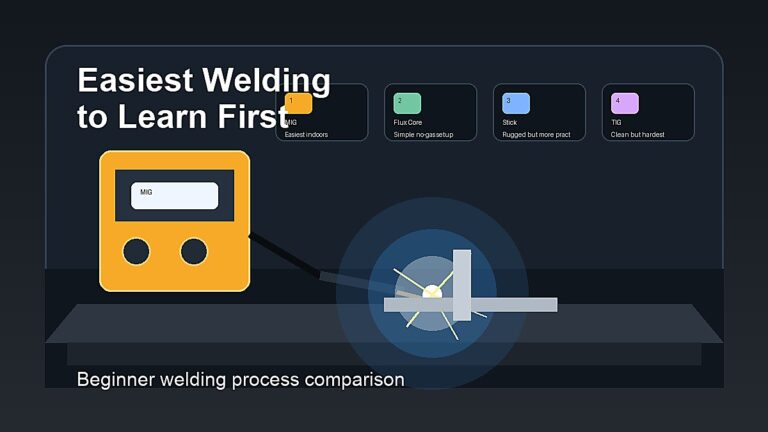
Most beginners should learn an arc welding process first if the goal is common welding projects. MIG is often easier indoors on clean mild steel. Flux core can be practical outdoors without gas. Stick is rugged and useful for thicker steel and repair work. TIG is slower to learn but gives excellent control.
Gas welding may be worth learning if you already have oxy-fuel equipment, need heating and cutting skills, or want to understand flame control. It is a valuable shop skill, but it is not the fastest route for most modern beginner welding projects.
Common Beginner Mistakes
- Calling every torch process gas welding, even when the job is cutting or brazing.
- Thinking gas welding is safer because it has no electric arc.
- Ignoring cylinder storage, regulator condition, and hose leaks.
- Using arc welding without correct helmet shade and skin protection.
- Choosing a process before checking material thickness and joint design.
- Practicing on painted, oily, galvanized, or unknown coated metal.
- Trying critical repairs before learning safety and defect control.
Simple Decision Checklist
- Choose arc welding for most beginner steel joining projects.
- Choose gas equipment when heating, brazing, or oxy-fuel cutting is the real task.
- Check whether you have safe electrical power or safe cylinder storage.
- Match the process to the metal, thickness, and joint design.
- Practice on clean mild steel before repairing anything important.
- Use qualified help for structural, vehicle, pressure, lifting, or code work.
FAQ
Is gas welding the same as arc welding?
No. Gas welding uses a flame from fuel gas and oxygen. Arc welding uses electricity to create an arc between an electrode and the workpiece.
Which is stronger, gas welding or arc welding?
Strength depends on material, joint design, filler, preparation, technique, and inspection. Arc welding is usually preferred for many modern steel fabrication jobs, but a correct procedure matters more than the process name.
Is gas welding easier than arc welding?
Not always. Gas welding gives slower heat control, but torch setup, flame adjustment, and cylinder safety take practice. Many beginners find MIG or flux core arc welding faster to start.
Can gas welding be used without electricity?
Yes, oxy-fuel gas welding does not need a welding power supply. It does need oxygen, fuel gas, regulators, hoses, torch equipment, and safe cylinder handling.
Is stick welding arc welding?
Yes. Stick welding is a type of arc welding. It uses a flux-coated electrode rod and an electric arc to melt the rod and base metal.
Final Advice
For most beginners who want to join steel, arc welding is the better first path. Gas welding is still useful, especially for torch skills, brazing, heating, and cutting, but it brings cylinder and flame hazards that deserve respect. Choose the process based on the job, not the name.