How to Reduce Weld Spatter

If you want to learn how to reduce weld spatter, start by treating spatter as a clue. A few sparks and BBs are normal in many welding processes, but heavy spatter usually points to settings, arc length, stickout, polarity, shielding gas, dirty metal, or technique problems.
Spatter is the small bits of molten metal that pop out of the weld area and stick to the workpiece, nozzle, table, or nearby surfaces. It wastes filler metal, makes cleanup harder, can damage surfaces, and may signal that the arc is not running cleanly.
Mark Dawson beginner note: do not only ask how to clean spatter after welding. Ask why the weld is throwing so much spatter in the first place. Cleaner settings and steadier technique usually save more time than grinding later.
Quick Answer
To reduce weld spatter, clean the metal, match voltage and wire feed or amperage to the material, keep a steady stickout or arc length, use the correct polarity, protect shielding gas from drafts, choose the right wire or rod, and avoid moving too fast or too slow. MIG spatter often comes from poor voltage and wire-feed balance, flux core spatter can come from stickout and polarity mistakes, and stick welding spatter often comes from arc length, amperage, or rod angle.
| Spatter Clue | Likely Cause | First Fix to Try |
|---|---|---|
| Sharp popping arc | Settings mismatch | Adjust voltage and wire feed |
| Lots of BBs near bead | Long stickout or arc length | Shorten and steady the arc |
| Nozzle packed with spatter | Poor setup or dirty nozzle | Clean nozzle and check gas |
| Spatter on rusty steel | Contamination | Clean to bright metal |
| Flux core roughness | Wrong polarity or technique | Check wire label and manual |
What Causes Weld Spatter?
Weld spatter happens when molten metal is expelled from the arc or weld pool. The cause can be electrical, mechanical, chemical, or technique-related. A harsh arc, unstable wire feed, wrong polarity, moisture, rust, paint, oil, or poor shielding can all make spatter worse.
Spatter is common in some processes, especially self-shielded flux core and stick welding. The goal is not always zero spatter. The goal is to reduce excessive spatter and fix the problem that is making the weld messy, inconsistent, or harder to inspect.
For broader troubleshooting, read Common Welding Defects, Welding Defects and Remedies, and How to Check Welding Defects.
Clean the Metal First
Dirty metal is one of the easiest spatter causes to fix. Rust, mill scale, paint, oil, moisture, zinc coating, cutting fluid, and grinding dust can make the arc unstable and contaminate the weld pool. Clean the joint and the area around it before blaming the machine.
For practice, compare two beads on the same steel: one on dirty material and one on cleaned bright metal. Keep the settings the same. The difference in arc sound, spatter, bead shape, and cleanup time can be obvious.
Match Settings to the Job
Settings mismatch is a major spatter driver. In MIG and flux core welding, voltage and wire feed speed need to work together. Too little voltage for the wire speed can make the wire stub into the puddle and pop. Too much voltage can make the arc harsh and wide.
For stick welding, amperage must match the rod type, rod size, position, and material thickness. Too low can make the rod stick and sputter. Too high can create excessive spatter, undercut, and a hard-to-control puddle.
Start with the machine chart, rod package, wire label, or procedure. Then test on scrap and change one variable at a time. Random knob turning makes troubleshooting slower.
Use a Step-by-Step Settings Workflow
When spatter is heavy, do not change every dial at once. First confirm the wire, rod, or process is correct for the material. Then check polarity. After that, use the chart setting as a baseline and make one small adjustment at a time.
For wire-feed welding, note both voltage and wire feed speed. If the wire feels like it is driving into the plate, voltage may be too low for the feed speed. If the arc is broad, harsh, and messy, voltage may be too high or stickout may be wrong.
For stick welding, move within the rod manufacturer’s amperage range. A small change can improve arc stability. If a rod runs badly at both ends of its range, check rod condition, polarity, material prep, and your arc length.
Control Stickout and Arc Length
In MIG and flux core welding, stickout is the distance from the contact tip to the work. Too much stickout can reduce heat at the weld and make the arc less stable. Too little can overheat the tip, crowd the puddle, and make the gun harder to control.
In stick welding, arc length matters. A long arc usually creates more spatter and a rougher bead. Keep the arc controlled and close enough for the rod type. Beginners often improve spatter quickly by shortening and steadying the arc.
Check Polarity
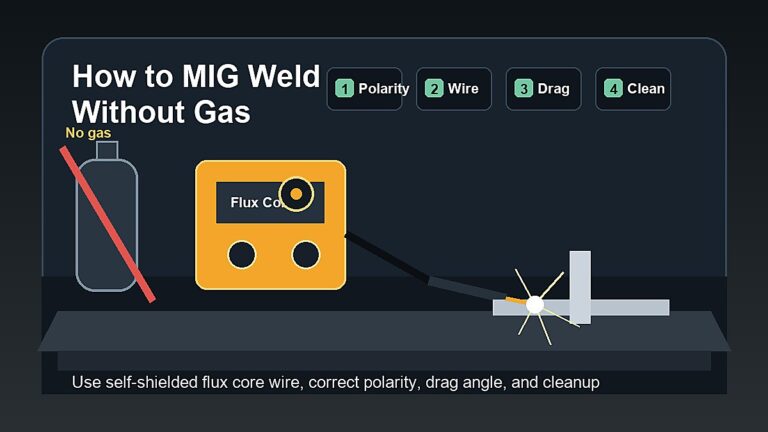
Wrong polarity can cause poor arc behavior, extra spatter, lack of penetration, and ugly beads. This is especially common when switching between solid MIG wire and self-shielded flux core wire because they often use different polarity setups.
Check the machine manual and the wire or electrode label. Do not assume the last person left the machine set correctly. If the arc suddenly becomes harsh after changing wire or rods, polarity deserves an early check.
Shielding Gas Problems
For gas MIG and TIG, poor shielding can make the arc dirty and the weld surface rough. Drafts, low gas flow, damaged nozzles, leaks, bad hose connections, or a clogged gas diffuser can all reduce gas coverage. Too much flow can also create turbulence and pull air into the weld zone.
Check the regulator, hose, gun connection, nozzle, and workspace. Shield the weld from fans or wind. If you are welding outside, gas MIG may struggle because wind can push shielding gas away. In that case, flux core or stick may be more practical.
Gas problems can also create welding porosity. If you see both spatter and small holes in the bead, gas coverage and contamination should move higher on the troubleshooting list.
Reduce MIG Welding Spatter
MIG spatter often comes from voltage and wire-feed imbalance, dirty metal, bad ground contact, too much stickout, poor gas coverage, worn contact tips, or an inconsistent wire feed. Listen to the arc. A smooth short-circuit MIG arc often sounds steadier than a popping, erratic arc.
Check the contact tip, liner, drive roll tension, wire spool, and work clamp. If wire feeding is jerky, the arc will not stay stable. For more process help, read MIG Welding Techniques for Beginners and MIG Welding Tips and Tricks for Beginners.
Wire Feed Problems
MIG and flux core depend on steady wire feeding. If the wire slips, surges, or burns back, the arc can pop and throw spatter. Common causes include wrong drive roll type, too much or too little drive tension, a worn contact tip, a kinked liner, rusty wire, or a spool that does not unwind smoothly.
Watch the wire as you test. It should feed evenly without shaving, birdnesting, or stuttering. If the machine sounds inconsistent before the wire even reaches the weld, fix the feed path before chasing voltage settings.
Reduce Flux Core Spatter
Flux core welding normally creates more spatter than clean gas MIG, especially with self-shielded wire. Still, excessive spatter can point to wrong polarity, too much stickout, poor travel angle, settings mismatch, damp wire, or dirty steel.
Use the polarity listed on the wire label. Keep stickout in the recommended range. Drag angle is common with many self-shielded flux core wires, but the exact technique depends on the wire. For more detail, read Flux Core Welding Tips for Beginners.
Reduce Stick Welding Spatter
Stick welding spatter can come from arc length, amperage, rod angle, rod condition, base metal contamination, or using the wrong electrode for the job. A long arc is one of the most common beginner causes because it makes the arc flare and throw metal.
Use a suitable amperage range, keep the arc tight, and store rods properly. If the rod is damp or damaged, arc behavior can suffer. For stick basics, read Stick Welding Basics for Beginners and Different Types of Welding Rods.
Use Anti-Spatter the Right Way
Anti-spatter spray or gel can make cleanup easier, but it does not fix bad settings. Use it as a cleanup aid, not a replacement for correct voltage, wire feed, arc length, gas coverage, and clean metal. Keep it away from areas where it could contaminate the weld joint.
Too much product near the joint can create contamination problems. Apply it carefully to the nozzle or surrounding surfaces as directed by the manufacturer. Clean the finished part before painting or coating.
Cleanup Without Hiding Problems
Spatter can be removed with a chipping hammer, scraper, wire brush, flap disc, grinder, or dedicated cleanup tool depending on the material and finish. Wear eye protection because small metal BBs can break loose during cleanup.
Clean the weld enough to inspect it before deciding the job is done. Heavy spatter can distract from other defects such as undercut, overlap, or lack of fusion. Do not grind away evidence on a critical weld before the required inspection is complete.
Nozzle and Tip Maintenance
A nozzle packed with spatter can disturb shielding gas and make the next weld worse. A worn contact tip can cause poor electrical contact and unstable wire feeding. These small parts are easy to overlook, but they affect arc stability.
Clean the nozzle, check the tip size, replace worn tips, and make sure the wire feeds smoothly. If spatter suddenly gets worse after several beads, inspect the gun before changing every setting on the machine.
Spatter by Welding Position
Flat welds are usually easier to control. Vertical, overhead, and awkward-position welds can make the puddle harder to manage, which may increase spatter. Beginners often travel inconsistently in these positions because they are fighting gravity, visibility, and body position at the same time.
Use shorter practice beads when changing position. Keep your body steady, support your gun or stinger hand when possible, and focus on arc length before trying to move fast. A stable body position often fixes more spatter than a dial change.
Practice Drill
Run three short beads on matching scrap. Keep the metal clean. For the first bead, use the chart setting. For the second, adjust one setting slightly. For the third, keep settings stable and focus only on stickout or arc length. Clean each bead and compare spatter patterns.
Write down the setting, process, wire or rod, stickout or arc length, and what the spatter looked like. Good notes help you find the cause instead of guessing next time.
What to Record
Record material thickness, process, wire or rod type, polarity, gas flow, voltage, wire feed or amperage, stickout, position, and cleaning method. Add a quick note about the arc sound. A steady buzz, harsh pop, or sputtering arc can point you back to the cause later.
Beginner Checklist
- Clean rust, oil, paint, and moisture from the weld area.
- Check voltage and wire feed or amperage range.
- Confirm polarity after changing wire or rods.
- Keep stickout or arc length steady.
- Protect shielding gas from drafts.
- Clean nozzle and replace worn contact tips.
- Check wire feed path and work clamp contact.
- Use anti-spatter only as a cleanup aid.
- Practice on scrap before the real weld.
Safety Notes
Weld spatter is hot metal. It can burn skin, damage clothing, ignite flammables, and start fires in cluttered work areas. Wear proper PPE, use safety glasses during cleanup, keep flammable materials away, and watch where sparks and spatter can travel.
Cleaning and grinding spatter also create eye, hand, and dust hazards. Use ventilation or fume control, follow the machine manual, and avoid welding unknown coated metals or containers. Review OSHA welding hazards guidance, OSHA welding, cutting, and brazing requirements, and AWS safety resources.
FAQ
What causes excessive weld spatter?
Common causes include wrong settings, long stickout or arc length, dirty metal, wrong polarity, poor shielding gas, worn tips, unstable wire feed, damp rods, and poor technique.
How do you reduce MIG spatter?
Clean the metal, balance voltage and wire feed, keep stickout steady, check gas coverage, clean the nozzle, replace worn tips, and make sure the wire feeds smoothly.
Why does flux core make so much spatter?
Self-shielded flux core usually creates more spatter than gas MIG. Wrong polarity, long stickout, poor settings, dirty steel, and bad travel angle can make it worse.
Does anti-spatter spray fix welding spatter?
No. Anti-spatter helps cleanup, but it does not fix the cause. Settings, technique, gas, polarity, and metal prep still need to be right.
Is weld spatter dangerous?
Yes. Spatter is hot metal and can burn skin, damage eyes during cleanup, melt clothing, and ignite flammable materials near the welding area.
Final Advice
To reduce weld spatter, clean the joint, stabilize the arc, use the right settings, check polarity, and control stickout or arc length. Cleanup products help, but the cleanest progress comes from fixing the cause before the next bead on real practice scrap.