Flux Core vs Stick Welding

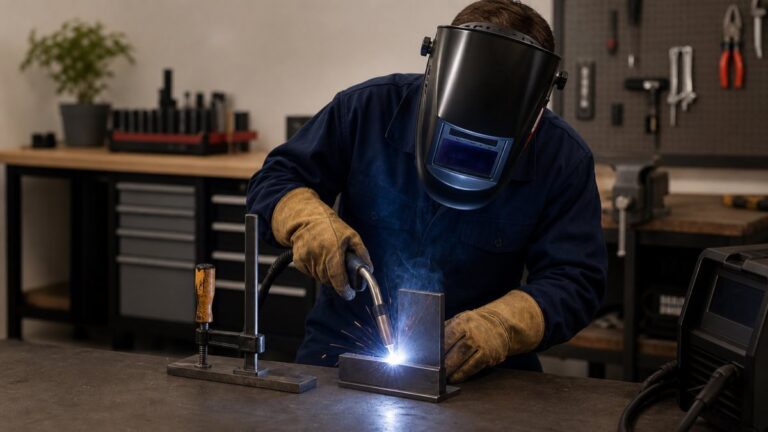
Flux core vs stick welding is a common beginner comparison because both processes can work outdoors, both use flux, and both can weld mild steel without a separate shielding gas bottle in many setups. The difference is how they feed filler metal and how they feel in your hands.
Flux core welding uses a continuously fed tubular wire. Stick welding uses individual flux-coated rods. Many new welders find the wire-feed gun easier to control at first because the filler keeps coming through the contact tip. With stick, the rod keeps getting shorter, so your hand position and arc length need constant attention.
Mark Dawson beginner note: do not choose by process popularity. Choose by the steel thickness, workspace, power supply, wind, repair type, cleanup tolerance, and how much practice you are willing to do.
This comparison is written for beginners choosing a first process for home shop practice, outdoor repair, fence work, brackets, carts, farm-style repairs, and mild steel projects. It does not replace qualified training for structural, trailer, vehicle, pressure, lifting, or workplace welding.
Quick Answer
For most beginners, flux core welding is easier to start because it uses a wire-feed gun and continuous wire. For rugged outdoor repair, thicker steel, and simple portable equipment, stick welding often has the advantage. Choose flux core for beginner-friendly wire-feed practice and light to medium steel repair. Choose stick welding when you want rod versatility, field repair ability, and a process that handles tougher outdoor conditions.
| Feature | Flux Core | Stick Welding |
|---|---|---|
| Filler | Flux-filled wire | Flux-coated rods |
| Learning curve | Usually easier | More manual skill |
| Outdoor use | Good with self-shielded wire | Very good |
| Cleanup | Slag and spatter | Slag and spatter |
| Best beginner fit | Home repair and practice | Rugged repair and thicker steel |
How Flux Core Welding Works
Flux core welding uses a wire-feed machine. The wire is hollow and contains flux ingredients. In self-shielded flux core welding, the flux creates shielding gas and slag, so no external gas bottle is needed. Gas-shielded flux core also exists, but beginners usually mean self-shielded wire when they say flux core.
The machine feeds wire as you pull the trigger. This lets beginners focus on gun angle, travel speed, stickout, and watching the weld pool. It still takes practice, but the continuous wire feed removes the rod-starting challenge that stick welding has.
The common beginner setup is a compact machine running self-shielded E71T-11 wire on mild steel. The wire usually needs the correct drive roll, contact tip, polarity, and tension. If the feed slips or the wire burns back into the tip, the arc can feel jumpy even when the rest of the setup is close.
Flux core also teaches useful habits for later MIG welding. You still learn to keep a steady stickout, angle the gun, tack parts before welding, clean the joint, and adjust travel speed when the bead looks too tall, too narrow, or too hot.
For more process basics, read How to MIG Weld Flux Core for Beginners and Flux Core Welding.
How Stick Welding Works
Stick welding uses an electrode holder and flux-coated rods. The rod creates the arc, adds filler metal, and produces shielding and slag as the flux burns. The rod gets shorter as it melts, so the welder must maintain arc length by hand.
Stick welding has a steeper beginner curve because arc starts, rod sticking, arc length, travel angle, and slag control all happen manually. The reward is a rugged process that works well in field repair and many outdoor steel jobs.
Common beginner rods include 6011, 6013, and 7018, but each rod behaves differently. A 6011 rod digs aggressively and can tolerate less-than-perfect steel better than some rods. A 6013 rod often feels smoother for light practice. A 7018 rod can produce strong welds when handled correctly, but low-hydrogen storage and technique matter.
Stick also makes you pay attention to amperage range. Too cold, and the rod sticks or piles metal on top of the joint. Too hot, and the puddle becomes hard to control, undercut appears, or thin steel burns through. That feedback can be frustrating, but it builds process awareness.
For stick-specific help, use Stick Welding and Arc Welding Rod Size Chart.
Which Is Easier for Beginners?
In the first few practice sessions, flux core usually gives quicker progress. The wire feed is continuous, and the gun is easier to hold steady than a rod that keeps getting shorter. Many beginners can run recognizable beads faster with a small wire-feed machine than with stick.
Stick welding teaches strong fundamentals, but the first hours can be frustrating. Rods stick, arcs go out, slag hides the bead, and the travel angle matters. A patient beginner can learn it, but it is less forgiving at the start.
The easiest process also depends on your work area. In a small garage with thin practice coupons, flux core may feel more approachable. On outdoor scrap plate with more room, stick can be a good teacher because the machine setup is simple and rods are cheap to practice with.
Outdoor Welding Comparison
Both processes can work outdoors. Compared with gas MIG, self-shielded wire handles wind better because it does not rely on an external shielding gas cloud. Stick welding also works well outdoors because the rod flux provides shielding and slag.
Stick welding often wins for rough outdoor repair because rods are compact, the machine can be simple, and wind is less of a problem. Wire-feed flux core still has a place outdoors, especially for lighter repairs, fences, brackets, and home projects where steady filler speed helps.
Weather still matters. Welding in rain, on wet ground, or with wet gloves raises electric shock risk. Wind can carry fumes back into your breathing zone, scatter sparks, and make fire watch harder. Outdoor welding should still happen on dry footing with safe cable routing and clear space around the work.
120V Beginner Machines vs Larger Welders
A lot of beginners compare these processes through small 120V machines. That can be useful, but it can also distort the answer. A compact 120V flux core machine is convenient for practice and light repair, yet it may not have enough output for thicker steel in one pass.
Stick welding machines vary widely. Some small inverter stick welders are easy to carry and run from common outlets, while larger units need a 240V circuit and can handle bigger rods. Before choosing either process, check the machine manual, input power, duty cycle, electrode or wire range, and recommended material thickness.
Do not assume a process is weak because a small machine struggles. A bigger flux core setup can do serious work, and a capable stick welder can handle heavy repair. Beginners should judge the whole setup, not just the process name.
Metal Thickness and Penetration
Stick welding is often preferred for thicker steel and heavy repair because rod selection and amperage can be matched to the job. A 1/8 inch or 5/32 inch rod on a capable machine can handle work that a small 120V flux core welder may struggle with.
Flux core can have good penetration, especially compared with small gas MIG setups, but machine size matters. A small wire-feed welder has limits. Thin sheet can also be tricky because self-shielded flux core can run hot and create burn-through.
For thin sheet metal, neither process is automatically easy. A self-shielded wire setup can burn through quickly if the wire, voltage, and travel speed are too hot for the panel. Stick welding thin material is even harder for many beginners because the arc is intense and the rod is less precise on delicate edges.
For light plate, brackets, and general mild steel practice, either process can work if the welder has enough output. For thick repair, stick often gives beginners more practical options because rod size and type can be changed quickly. Still, joint design, beveling, multiple passes, and inspection matter more than a simple process label.
Cleanup, Slag, and Spatter
Both processes create slag when using self-shielded flux systems. That slag must be chipped and brushed away before judging the bead or making another pass. Both can also create spatter, smoke, and cleanup work.
Flux core may feel faster because wire feed is continuous, but cleanup can still take time. Stick welding stops more often because rods burn down and need replacing. In both cases, welding over slag can create defects.
Slag also changes how you read the weld. A bead can look rough before cleanup and better after chipping, or it can hide undercut and poor tie-in until you brush it. Beginners should clean each bead, inspect both toes of the weld, and look for trapped slag before adding another pass.
Common Defects in Both Processes
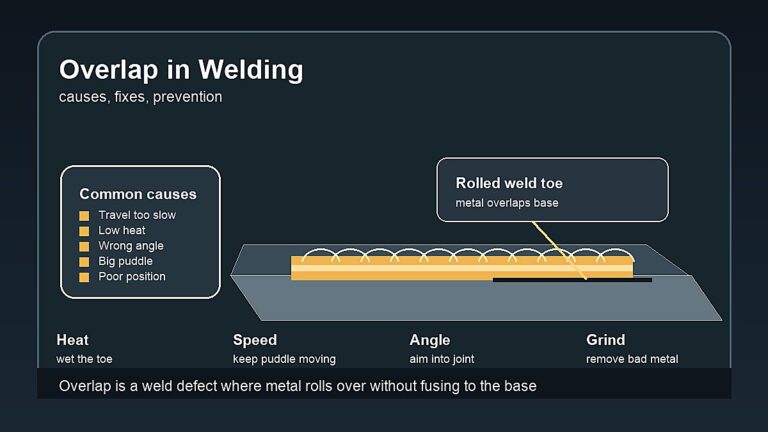
Flux core and stick can both produce porosity, slag inclusion, undercut, overlap, lack of fusion, and excessive spatter. The causes overlap: dirty steel, wrong settings, poor angle, long arc length, moisture, bad travel speed, or welding over slag.
Porosity often points to contamination, moisture, wind, or shielding problems. Slag inclusion usually means the previous bead was not cleaned or the angle trapped slag ahead of the puddle. Undercut may come from too much heat, too long an arc, or moving in a way that washes metal away from the edge without filling it.
If your practice beads keep failing the same way, pause and change one variable at a time. Clean the steel, confirm polarity, shorten the arc or stickout, adjust travel speed, and compare the result. Our Welding Defects hub is the right next stop when you want to diagnose those problems.
Equipment and Cost
A beginner flux core setup usually includes a wire-feed machine, gun, work clamp, drive rolls, contact tips, wire, and PPE. Many small machines run on household power, but they have output and duty-cycle limits.
A beginner stick setup can be simple: power source, electrode holder, work clamp, leads, rods, and PPE. Stick machines can be compact and portable. Rods are easy to store, but some types need dry storage, especially low-hydrogen rods such as 7018.
Flux core consumables include wire spools, contact tips, nozzles, liners, and drive rolls. Stick consumables are mostly rods, but rod condition matters. Damp rods can run poorly and may affect weld quality. Wire can also rust if stored badly, especially in humid shops.
Cost is not just the price of the machine. Add PPE, clamps, grinder discs, chipping tools, wire brush, extension-cord requirements, spare tips, rods or wire, and practice steel. A cheaper welder can become expensive if it is hard to tune or does not match your projects.
Which Process Fits Common Beginner Jobs?
For a small cart, welding table accessory, or bracket project inside a garage, flux core is often comfortable because tacking and short welds feel natural with a trigger gun. You can make repeated practice beads without stopping to replace rods.
For a gate hinge repair, farm bracket, or thicker outdoor steel, stick may be the better learning path. Rods are easy to carry, and the process is less bothered by wind than gas processes. If the steel is thick enough and the machine is capable, stick can be practical for rough repair practice.
For very thin auto body sheet, neither self-shielded flux core nor stick is ideal for a beginner. Thin panels need careful heat control, tight fit-up, short welds, and often a cleaner process. Practice on scrap of the same thickness before touching a real panel.
Best Uses for Flux Core
- Beginner wire-feed practice.
- Outdoor home repair with self-shielded wire.
- Light to medium mild steel projects.
- Fences, brackets, carts, and small repairs.
- Users who want no gas bottle but easier starts than stick.
Best Uses for Stick Welding
- Rugged outdoor repair.
- Thicker mild steel.
- Farm and field work.
- Repair where portability matters.
- Jobs needing different rods for different conditions.
Decision Checklist
- Choose flux core if you want easier starts and wire-feed practice.
- Choose stick if your main work is thicker steel and rugged repair.
- Choose flux core if you prefer trigger control and continuous wire.
- Choose stick if you want rod versatility and compact consumables.
- Check your machine output before assuming either process can weld thick steel.
- Practice on clean scrap before repairing anything important.
If you are still unsure, choose based on the first 20 hours of practice, not the dream project you may build someday. A process you can practice safely and often will teach you more than a powerful machine that sits unused because setup feels intimidating.
Common Beginner Mistakes
- Thinking flux core and stick are the same because both use flux.
- Buying a small machine for steel that is too thick.
- Welding over slag instead of cleaning between passes.
- Ignoring fumes because there is no gas bottle.
- Using flux core on thin sheet without expecting burn-through.
- Using stick rods without checking amperage and polarity.
- Trying safety-critical repairs too early.
Safety Notes
Flux core and stick welding both create arc flash, UV radiation, electric shock risk, hot slag, sparks, fumes, burns, fire risk, and grinding hazards. Flux core wire and stick rods can produce heavy smoke depending on the consumable and material. Ventilation matters.
Use a proper welding helmet, dry gloves, flame-resistant clothing, safety glasses, ventilation, and fire-safe workspace. Review OSHA welding hazards guidance, OSHA welding fume guidance, and AWS safety resources. For more basics, read Arc Welding Safety.
FAQ
Is flux core better than stick welding?
It depends on the job. Flux core is often easier for beginners and faster for light to medium projects. Stick is often better for rugged repair and thicker steel.
Is flux core easier than stick?
Usually yes. Flux core uses continuous wire feed, while stick requires manual arc starts and rod control.
Can flux core weld outdoors?
Outdoor flux core usually performs better than gas MIG because it does not rely on external shielding gas. Wind and fire safety still matter.
Which is stronger, flux core or stick?
Neither is automatically stronger. Strength depends on material, filler, settings, joint design, preparation, technique, and inspection.
Should beginners learn flux core or stick first?
Most beginners find flux core easier first. Stick is worth learning if you want outdoor repair, thicker steel, and rod-based arc welding skills.
Final Advice
For many beginners, flux core is the easier wire-feed path. Stick welding is the more rugged rod-based process for repair and thicker steel. Pick the process that fits your projects, then practice enough to recognize slag, spatter, poor fusion, and unsafe setup before doing real repairs.