Advantages and Disadvantages of Stick Welding
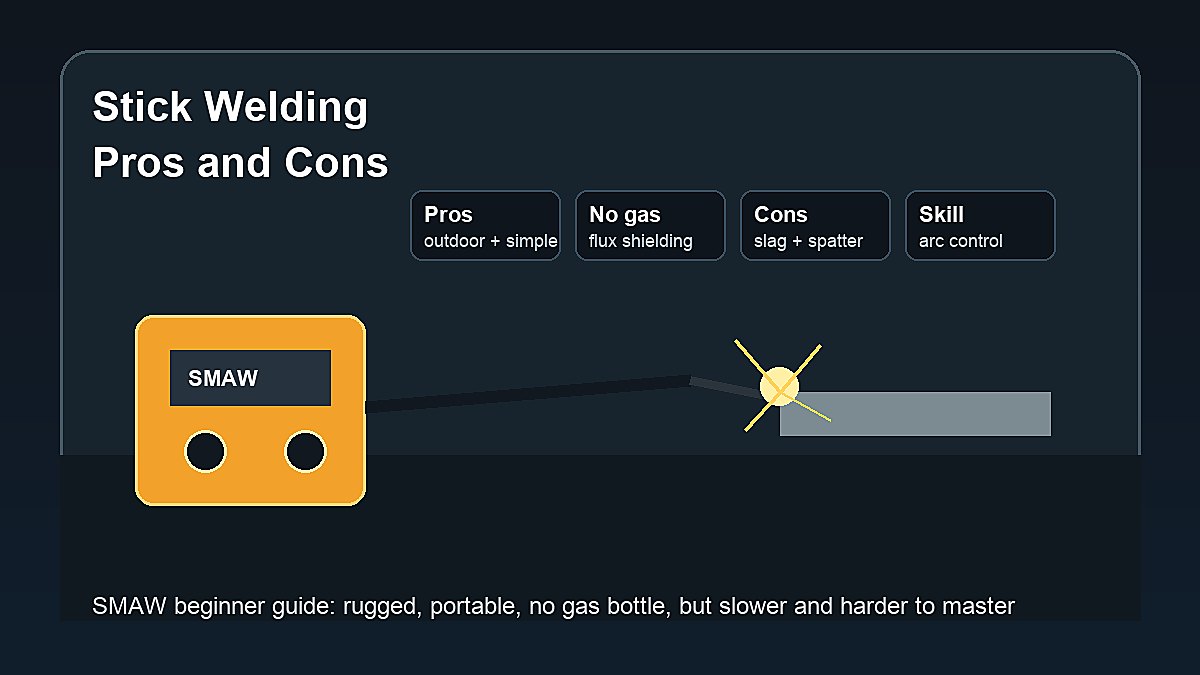
The advantages and disadvantages of stick welding matter because stick welding is one of the most useful welding processes, but it is not the easiest process for every beginner. Stick welding, also called SMAW or shielded metal arc welding, uses a flux-coated electrode rod to create the arc, add filler metal, and protect the weld pool.
The process is popular because the equipment can be simple, portable, and useful outdoors. It can weld thicker steel, handle repair work, and does not require a separate shielding gas cylinder. The tradeoff is that beginners must learn arc starts, arc length, rod angle, slag removal, amperage choice, and defect control.
Mark Dawson beginner note: stick welding is rugged, but rugged does not mean careless. A strong stick weld still needs clean-enough metal, the right rod, correct amperage, safe setup, and practice.
Quick Answer
The main advantages of stick welding are low equipment cost, portability, outdoor usefulness, no separate shielding gas, good performance on thicker steel, and strong repair value. The main disadvantages are more slag, more spatter, slower work, harder arc control, frequent rod changes, difficulty on thin metal, and more cleanup than MIG or TIG.
| Stick Welding Pros | Stick Welding Cons |
|---|---|
| Works well outdoors | Slag must be chipped and cleaned |
| No gas cylinder for basic SMAW | Harder starts for beginners |
| Good for thicker steel | More spatter and smoke |
| Portable equipment | Slower than MIG for many jobs |
| Useful for repair work | Not ideal for very thin sheet metal |
Advantage: Simple and Portable Equipment
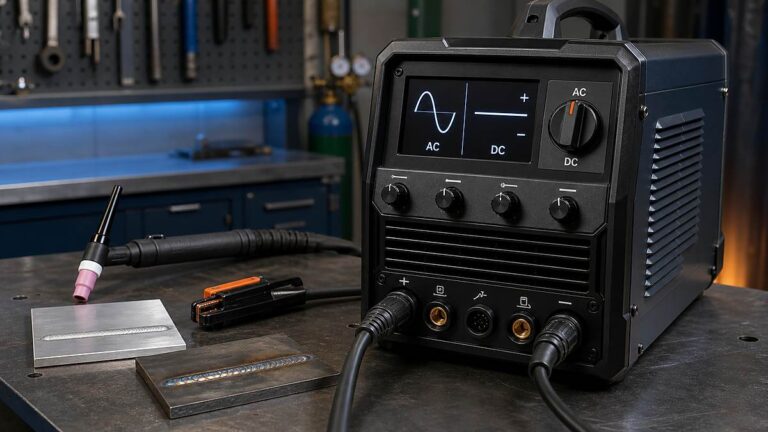
A basic stick welding setup can be simpler than many MIG or TIG setups. You need a suitable power source, electrode holder, work clamp, welding leads, rods, and PPE. There is no wire feeder, no drive rolls, no shielding gas regulator, and no gas bottle for ordinary stick welding.
This simplicity is useful for home shops, field repairs, farms, and small businesses. A compact inverter stick welder can be easy to carry compared with a larger MIG setup. The welder still needs safe electrical power, but the equipment list is shorter.
Advantage: Good for Outdoor Welding
For outdoor work, SMAW is one of the better arc welding processes. The electrode flux creates shielding gas and slag around the weld pool, so wind is less of a problem than it is with gas-shielded MIG or TIG. That is why stick welding is common in field repair, farm work, construction, and outdoor maintenance.
Outdoor usefulness does not remove safety rules. Wind can spread sparks, dust, and fumes. Dry grass, fuel, paint, wood, insulation, and nearby equipment can catch fire. The work clamp and leads still need good connections, and wet conditions raise electric shock risk.
Advantage: No Separate Shielding Gas
Stick welding rods have a flux coating. When the arc burns, the flux helps shield the weld pool and forms slag over the bead. That means basic stick welding does not need a separate shielding gas cylinder. For beginners who do not want to manage gas bottles, this is a major advantage.
The flux system also means rod choice matters. A 6011 rod, 6013 rod, and 7018 rod do not behave the same way. Each rod has different arc feel, penetration, position capability, storage needs, and weld characteristics. For rod basics, use Welding Rods & Electrodes.
Advantage: Strong Repair and Thick Steel Use
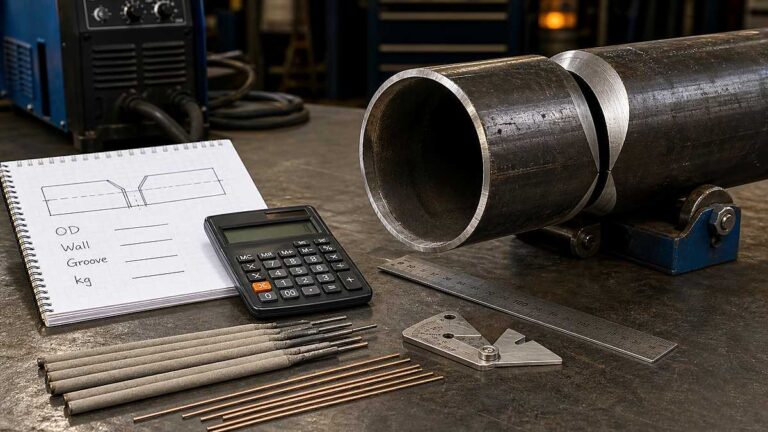
For thicker mild steel, repair brackets, farm equipment, gates, frames, and rugged shop work, this process can be a strong choice. With the right electrode and joint preparation, it can make solid welds in conditions where a small MIG machine may struggle.
Many rods are designed for specific repair situations. Some dig deeper into less-than-perfect steel. Some run smoother on clean material. Some are low-hydrogen rods used where cracking risk matters. Beginners should not choose rods randomly; they should match the rod to the metal, joint, position, and machine.
Disadvantage: Stick Welding Is Harder to Start
Many beginners struggle with starting the arc. The rod can stick to the workpiece, the arc can go out, or the arc length can become too long. A long arc creates spatter and instability. A short arc may stick or make the puddle hard to control.
This is why practice matters. Stick welding teaches hand control because the electrode gets shorter as it burns. The welder must keep the arc length steady while also holding the correct travel angle and speed. For beginner technique, read Stick Welding.
Disadvantage: Slag Cleanup Takes Time
Slag protects the weld while it cools, but it must be removed after welding. Chipping and brushing take time. If slag is trapped between passes, it can become slag inclusion, which weakens the weld. Multi-pass stick welding requires cleaning between passes, not just at the end.
Slag is also one reason stick welding is slower than MIG for many shop projects. MIG can often make cleaner beads with less post-weld cleanup when the material is clean and shielding gas is stable.
Disadvantage: More Spatter, Smoke, and Cleanup
Stick welding often creates more spatter and smoke than clean gas MIG or TIG. The flux coating burns, the slag forms, and the arc can throw small droplets of metal. Spatter can stick to the workpiece and nearby surfaces, adding cleanup time.
Fumes matter too. Depending on rod type, base metal, coatings, ventilation, and amperage, the process can produce significant welding fumes. Galvanized, painted, oily, or unknown coated metal is especially risky and should not be treated as ordinary practice material.
Disadvantage: Slower for Repeated Production Work
Stick welding rods are short compared with a continuous MIG wire spool. When the rod burns down, the welder stops, removes the stub, loads another rod, and restarts. Then the slag must be cleaned. On repeated parts, those pauses add up.
That does not make stick welding bad. It means the process fits repair and field work better than high-speed production in many cases. For many indoor shop projects, MIG may be faster once the machine is set up correctly. For process comparison, see MIG Welding vs Stick Welding.
Disadvantage: Not Ideal for Thin Sheet Metal
Stick welding can burn through thin sheet metal quickly. The rods and amperage ranges that work well on thicker steel may be too aggressive for body panels, thin tubing, and delicate sheet work. A skilled welder can do more than a beginner, but that does not make stick the easiest process for thin metal.
For thin steel, MIG or TIG is often easier to control. A beginner who mainly wants to repair auto body panels or thin sheet should compare processes before buying a stick-only machine.
Best Jobs for Stick Welding
- Outdoor steel repair.
- Farm equipment repair.
- Thicker mild steel practice.
- Gates, brackets, frames, and heavy shop projects.
- Field work where shielding gas is impractical.
- Repair jobs where portability matters.
Stick welding is not only a beginner process. It remains useful because the equipment is rugged and the process works in places where other processes are less convenient.
When Stick Welding Is the Wrong First Choice
Choose another process if your main work is thin sheet metal, cosmetic stainless work, aluminum, fast production, or very clean indoor fabrication. Stick welding can handle many jobs, but it is not the cleanest or fastest process for every project.
A beginner also should not use stick welding as a shortcut for structural, vehicle, trailer, pressure, or lifting repairs without training and inspection. A rough-looking bead may be weak, but a good-looking bead can also hide defects if the joint was not prepared correctly.
Rod Choice Can Change the Pros and Cons
Stick welding does not behave the same with every electrode. A 6011 rod is known for digging action and can be useful on less-than-perfect steel, but it can be rougher and more spattery. A 6013 rod can feel smoother for light practice, but it may not be the best repair rod for every job. A 7018 rod can make strong low-hydrogen welds, but it needs better storage and more careful technique.
This flexibility is an advantage because one machine can run different rods for different jobs. It is also a disadvantage for beginners because the wrong rod can make practice confusing. If the rod is too large, the amperage too low, or the polarity wrong, the bead may look cold, ropey, or full of slag traps.
Before judging stick welding as easy or hard, try the right rod on the right thickness of clean steel. A beginner trying to learn with damp rods, dirty scrap, and random amperage is fighting three problems at once.
Polarity and Power Source Limits
Another hidden disadvantage is that not every stick welder runs every rod well. Some rods run on AC, some run best on DCEP, and some machines struggle with certain electrodes. A small inverter may be portable, but it still has duty cycle, amperage, input power, and rod-size limits.
Polarity affects arc feel, penetration, and rod behavior. Beginners should check the rod package and machine manual before assuming a setting. If the arc keeps going out, the rod sticks constantly, or the bead looks wrong, the issue may be setup rather than hand skill.
Power source limits matter on thicker steel too. Stick welding can handle thick material, but only when the machine, rod size, joint preparation, and multiple-pass technique are suitable. A tiny machine cannot ignore physics just because the process is rugged.
Field Repair Strengths
Stick welding shines when the job is away from a clean bench. A gate hinge, farm bracket, trailer accessory, fence repair, or heavy outdoor fixture may be easier with rods than with gas MIG. The machine can be carried to the work, rods are compact, and wind is less likely to ruin shielding.
That field strength is also why beginners must be careful. Outdoor repairs often happen on rusty, painted, stressed, or awkwardly positioned metal. Those conditions increase the chance of poor fusion, undercut, slag inclusion, and cracking. A repair that looks acceptable from the outside can still be weak.
For non-critical shop practice, field-style stick welding is a great skill. For a trailer frame, vehicle mount, lifting point, pressure part, or public-use structure, get qualified help. The process is capable, but the operator and procedure still matter.
When MIG or TIG May Be Better
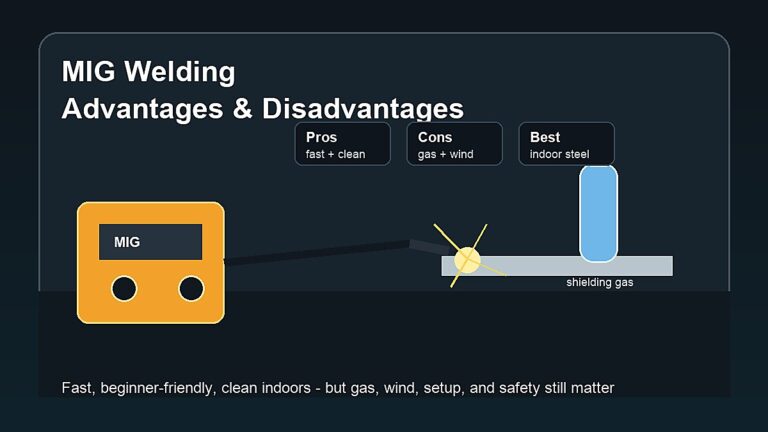
MIG may be better when the work is indoors, the steel is clean, and the goal is repeated joints with less slag cleanup. A beginner building carts, tables, brackets, and light fabrication projects may learn faster with MIG because the machine feeds the wire and the bead is easier to see.
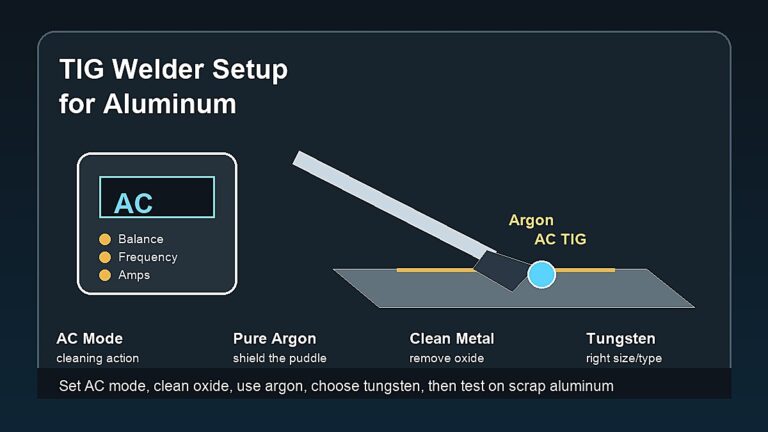
TIG may be better when control and appearance matter more than speed. Thin stainless, aluminum, small precision parts, and visible welds often suit TIG better than stick. TIG has its own learning curve, but it gives fine heat and filler control.
The right process depends on the project. Stick welding is not worse because MIG or TIG is better for some jobs. It is simply strongest in a different part of the welding map: outdoor repair, thicker steel, simple equipment, and rugged conditions.
Beginner Setup Checklist
- Choose clean mild steel for first practice.
- Match the rod to the metal, position, and machine.
- Set amperage from the rod chart, then test on scrap.
- Clamp the work securely and attach the ground close to the weld.
- Practice arc starts and straight beads before joints.
- Chip and brush slag before judging the bead.
- Study defects such as porosity, undercut, slag inclusion, and lack of fusion.
Common Beginner Mistakes
- Using the wrong rod for the material or position.
- Running amperage too high and creating spatter or undercut.
- Holding too long of an arc.
- Not cleaning slag between passes.
- Trying thin sheet metal too early.
- Welding painted, oily, galvanized, or unknown coated metal.
- Ignoring rod storage, especially for low-hydrogen rods.
Safety Notes
Stick welding has serious hazards: electric shock, arc flash, UV radiation, burns, hot slag, sparks, fumes, fire, grinding debris, and falling hot metal. Outdoor work can add wind, wet ground, unstable workpieces, and fire spread. Low-hydrogen rod storage and coated metal hazards also matter.
Use a proper welding helmet, gloves, flame-resistant clothing, safety glasses, ventilation, and fire-safe workspace. Keep bystanders protected from arc flash and sparks. Review OSHA welding hazards guidance, OSHA welding fume guidance, and AWS safety resources. For site basics, use the Welding Safety hub.
FAQ
What is the biggest advantage of stick welding?
The biggest advantage is that stick welding works well outdoors and does not need a separate shielding gas cylinder. It is also portable and useful for repair work.
What is the biggest disadvantage of stick welding?
The biggest disadvantage for beginners is the learning curve. Starting and holding the arc takes practice, and slag cleanup slows the process.
Is stick welding stronger than MIG?
Not automatically. Weld strength depends on material, joint design, filler, settings, preparation, technique, and inspection. Stick and MIG can both make strong welds when used correctly.
Is stick welding good for beginners?
Yes, if the beginner wants to learn outdoor repair, thicker steel, and rod control. MIG or flux core may feel easier for some beginners, especially for indoor practice.
Why does stick welding make slag?
The rod flux melts and forms slag to protect the weld as it cools. After welding, the slag must be chipped and brushed away.
Final Advice
Stick welding is a strong choice for outdoor repair, thicker steel, and portable welding. Its disadvantages are real: slag, spatter, slower work, and a tougher learning curve. Learn it if your projects match its strengths, and practice on simple steel before trusting it on important repairs.