Slag Inclusion
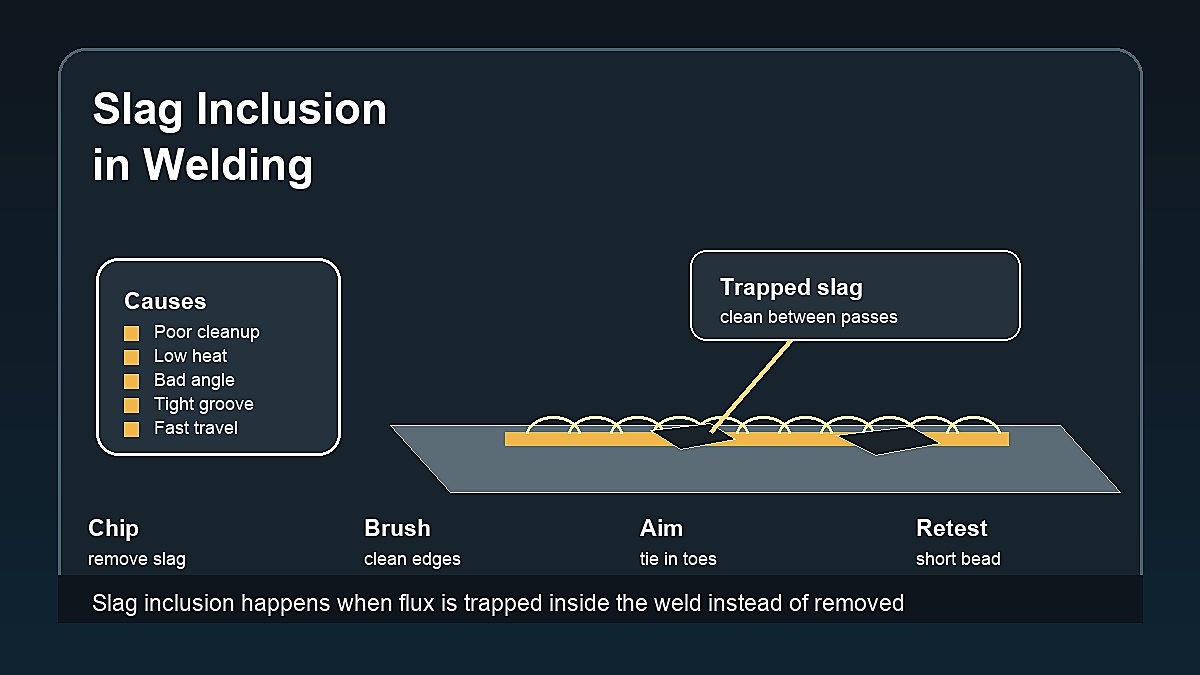
Slag inclusion is a welding defect where slag or flux gets trapped inside the weld instead of floating to the surface or being removed between passes. It is most common in stick welding and flux core welding because those processes create slag as part of the weld.
For beginners, slag inclusion usually means the weld was not cleaned well enough, the bead placement trapped slag at the edge, the heat was too low, or the travel angle made slag run ahead of the puddle. The fix starts with cleanup and technique, not just turning the machine up.
Mark Dawson beginner note: slag is supposed to protect the weld while it cools, but it must not stay inside the finished weld. Clean between passes like it is part of welding, not an optional cleanup chore.
Quick Answer
Slag inclusion happens when flux-based slag becomes trapped in the weld metal. Common causes include poor slag removal, low heat, wrong travel angle, fast travel, narrow grooves, poor bead placement, and welding over slag from a previous pass. To fix it, stop, clean the weld thoroughly, remove trapped slag, correct heat and angle, improve access to the joint, and retest on scrap before welding critical work.
| Slag Inclusion Clue | Likely Cause | Beginner Fix |
|---|---|---|
| Dark line at bead edge | Slag trapped at toe | Chip, brush, and adjust angle |
| Defect between passes | Poor interpass cleaning | Clean before next pass |
| Shows after grinding | Internal trapped slag | Remove and repair if allowed |
| Repeated in groove | Joint too tight or poor access | Improve prep and bead sequence |
| Flux core slag lines | Technique or travel issue | Use correct drag angle and speed |
What Slag Inclusion Looks Like
Slag inclusion may look like a dark line, pocket, or irregular streak in the weld after cleaning or grinding. Sometimes it sits along the edge of a bead. Other times it hides between passes and only appears after the weld is cut, ground, or inspected.
On stick welds, slag can hide under the protective crust until it is chipped away. On flux core welds, slag may sit along the sides of the bead if travel angle, travel speed, or bead placement is wrong.
If you are still learning defect names, read Common Welding Defects and How to Check Welding Defects.
Why Slag Inclusion Matters
Slag inclusion matters because trapped nonmetallic material interrupts the weld metal. Instead of a clean fused weld, the joint may contain weak spots where slag is locked inside. That can reduce strength and make the weld unacceptable for inspected work.
On practice coupons, slag inclusion is useful feedback. On structural, vehicle, trailer, pressure, lifting, or workplace welds, it is a serious inspection concern. Do not assume a covered defect is fixed just because another bead hides it.
Where Slag Gets Trapped
Slag often gets trapped at the toes of a weld, in narrow grooves, at the edge of a previous bead, or where the puddle could not reach cleanly. It can also sit in starts, stops, craters, and restarts if those areas are not cleaned and blended before the next pass.
On fillet welds, check the corner and both legs of the weld. On groove welds, check the sidewalls and root area. On multi-pass welds, look closely where one pass overlaps the previous pass. Those small valleys are easy places for slag to hide.
If the same area traps slag repeatedly, the problem may be joint access rather than only welder movement. A joint that cannot be cleaned properly may need better preparation.
What Causes Slag Inclusion?
- Not chipping or brushing slag before the next pass.
- Low heat that prevents slag from floating out.
- Travel speed too fast for the puddle to cleanly fill.
- Wrong electrode or gun angle that pushes slag ahead of the puddle.
- Grooves, corners, or bead shapes that trap slag.
- Poor bead sequence in multi-pass welds.
- Trying to weld over slag, rust, mill scale, or dirt.
- Using a weave pattern that leaves slag at the toes.
Stick Welding Slag Inclusion
Stick welding is a common place to see slag inclusion because the flux coating creates slag with every rod. The slag protects the weld as it cools, but it must be removed before another pass or before judging the finished weld.
Common stick causes include long arc length, low amperage, poor rod angle, fast travel, and failing to clean the edges of the bead. Some rods also produce slag that peels easily only when the bead is run correctly.
For stick fundamentals, read Stick Welding Basics for Beginners and Drag or Push Stick Welding?.
Flux Core Slag Inclusion
Flux core welding also creates slag. Self-shielded flux core needs correct polarity, stickout, travel angle, and travel speed. If slag runs ahead of the puddle or sits along the bead edges, it can get trapped under the next pass.
Beginners often run flux core too fast or fail to clean between passes because the bead looks acceptable at first glance. Chip and brush before deciding the weld is ready for another pass.
For related setup and technique, use Flux Core Welding Tips for Beginners.
Slag Inclusion in Multi-Pass Welds
Multi-pass welds make slag inclusion more likely because each pass creates edges and valleys where slag can hide. A small slag line left in the first pass can become buried by the second pass.
Clean each pass before adding another. Pay special attention to the toes of the weld and any narrow groove. If the joint is too tight to clean, improve joint preparation instead of forcing weld metal into a dirty space.
Bead sequence matters too. Place passes so each new bead ties in cleanly and does not trap slag at the edge of the previous bead.
Heat and Travel Speed Clues
Low heat can leave the puddle sluggish, which makes it harder for slag to rise and move away. A bead that looks cold, tall, rough, or poorly tied in may also be more likely to trap slag.
Travel speed that is too fast can outrun the puddle and leave slag behind at the edges. Travel that is too slow can pile up metal and create shapes that trap slag in the next pass. The goal is a puddle that stays open long enough to tie in but does not become hard to control.
Use the rod or wire manufacturer’s range, the machine chart, and a short scrap test. Do not jump straight from a bad bead to a major setting change without first checking cleanup and angle.
How to Fix Slag Inclusion
- Stop welding and let the part cool safely.
- Chip, brush, and inspect the area.
- Grind or remove trapped slag if repair is allowed.
- Clean to sound metal before rewelding.
- Correct heat, travel speed, and angle.
- Improve joint access or bead sequence.
- Run a short test bead on matching scrap.
- Inspect again before continuing.
On practice pieces, grinding out slag inclusion can help you see where it was trapped. On real parts, repair depends on material, code, service requirement, and inspection rules. Do not guess on critical welds.
Repair or Reweld?
For practice, grinding out a slag pocket and rewelding can teach you how the defect formed. For real work, the decision is more serious. The repair may need to remove all trapped slag, restore joint shape, and follow a qualified procedure.
Do not simply run another bead over a suspected slag inclusion. Covering it can make the surface look better while the inclusion remains inside. If the weld has a service requirement, get the repair method approved before continuing.
When the defect appears in a practice coupon, cut across the bead if safe and look at the cross-section. Seeing the trapped slag makes the lesson easier to remember.
How to Prevent Slag Inclusion
Prevention starts with clean work habits. Remove slag completely before the next pass. Use enough heat for the process and rod or wire. Keep the arc directed into the joint, and move at a speed that allows the puddle to wash into both sides without outrunning itself.
Use the correct travel angle for the process. Stick and self-shielded flux core commonly use a drag angle. Pushing slag-producing processes can encourage slag to move where you do not want it.
Joint prep matters. Narrow grooves, poor fit-up, and rough starts can trap slag even when the machine settings are close. Make the joint accessible enough to clean and inspect.
Cleaning Between Passes
Interpass cleaning is one of the simplest ways to prevent slag inclusion. Chip the slag, wire brush the bead, and inspect the toes before the next pass. If slag is stuck in a tight line, use a grinder or file where appropriate.
Cleaning should expose the actual weld surface. A shiny top with dark lines at the edge is not clean enough. Pay attention to starts and stops, because slag often sticks there.
Do not rush multi-pass work. The time saved by skipping cleanup often returns as grinding, repair, and failed inspection later.
Slag Inclusion vs Other Defects
Slag inclusion is sometimes confused with porosity, lack of fusion, or cracks. Porosity is usually rounded gas holes. Slag inclusion often looks more irregular, dark, or stretched along a bead edge or between passes.
Lack of fusion can appear beside slag inclusion because both can happen when heat, angle, and bead placement are poor. A weld can also have trapped slag and poor tie-in at the same time, especially in a groove that was not cleaned between passes.
If you are unsure what you are seeing, clean the weld, photograph it, and compare it with the defect patterns in Welding Defects and Remedies.
Practice Drill to Reduce Slag Inclusion
Use clean scrap steel and run a short stick or flux core bead. Let it cool, chip the slag, brush the bead, and inspect both toes. Then run a second pass only after the first pass is completely clean.
For the next coupon, change only one thing: travel speed, angle, amperage, or cleanup quality. Compare the cleaned bead edges. This drill makes it easier to see whether the problem came from slag removal, heat, or puddle control.
Keep the failed coupon. A visible slag line beside an improved bead is a better teacher than a note that only says the weld was bad.
What to Record
Write down the process, electrode or wire, amperage or voltage, polarity, travel direction, material thickness, joint type, and cleaning method. Also note where the slag inclusion appeared: toe, root, restart, crater, or between passes.
Patterns matter. If slag inclusion appears only in restarts, work on restart cleaning and tie-in. If it appears in every second pass, interpass cleaning or bead placement may be the main problem.
Those notes also help you avoid changing the wrong setting during practice and repair work.
Slag Inclusion Checklist
- Did you remove all slag before the next pass?
- Are the weld toes clean and visible?
- Is the amperage high enough for the rod or wire?
- Is travel speed too fast?
- Is the rod or gun angle pushing slag into the joint?
- Is the groove too narrow to clean properly?
- Are you placing beads in an order that traps slag?
- Did you inspect after chipping, not before?
Common Beginner Mistakes
- Welding over slag because the bead still looks hot and ready.
- Only brushing the top and leaving slag at the toes.
- Running low amperage and making a cold, slaggy bead.
- Using the wrong travel angle for flux core or stick.
- Making a groove weld too tight to clean between passes.
- Covering a slag line with another bead.
- Ignoring slag inclusion on parts that need inspection.
Safety Notes
Slag removal and repair can involve hot slag, flying chips, wire brushing, grinding dust, sparks, fumes, sharp edges, UV radiation from rewelding, and fire risk. Wear safety glasses, gloves, hearing protection when grinding, flame-resistant clothing, and respiratory protection when dust or fumes require it.
Never repair critical welds by guesswork. Review OSHA welding hazards guidance, OSHA welding, cutting, and brazing requirements, and AWS safety resources.
FAQ
What is slag inclusion in welding?
Slag inclusion is a defect where slag or flux becomes trapped inside the weld metal instead of being removed or floating to the surface.
What causes slag inclusion?
Common causes include poor cleaning between passes, low heat, wrong travel angle, fast travel, tight grooves, poor bead placement, and welding over slag.
How do you prevent slag inclusion?
Clean slag completely, use correct heat, keep proper travel angle, avoid outrunning the puddle, and place beads so slag is not trapped at the edges.
Can you weld over slag inclusion?
No. Do not simply cover trapped slag. Remove the defect as required, clean to sound metal, correct the cause, and repair only when the procedure allows it.
Is slag inclusion dangerous?
It can be, especially in load-bearing or inspected welds. Trapped slag interrupts the weld metal and can reduce weld quality. Critical welds need proper inspection.
Final Advice
Slag inclusion is usually a cleanup, heat, angle, or bead placement problem. Chip and brush every pass, make the joint easy to clean, and inspect before covering the weld with another bead. Clean habits prevent a lot of trapped slag.