Advantages and Disadvantages of MIG Welding
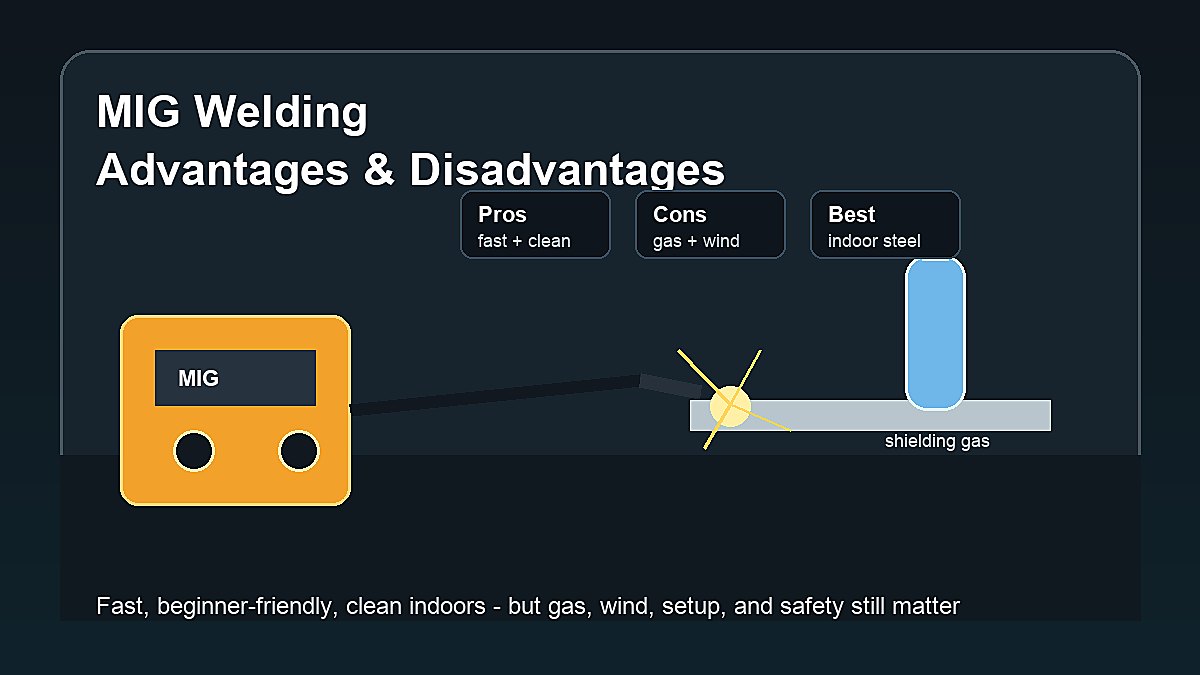
Advantages and disadvantages of MIG welding matter because MIG is often recommended as the easiest welding process for beginners. It can be fast, clean, and simple to learn on mild steel, but it is not the best process for every job. Shielding gas, wind, metal thickness, material type, cost, and safety all affect whether MIG is the right choice.
MIG welding, also called GMAW, uses a continuously fed wire electrode and shielding gas to protect the weld pool. Because the machine feeds wire automatically, beginners can focus on gun angle, travel speed, stickout, and watching the puddle. That is a big advantage, but it can also hide bad technique if the welder only judges the bead by appearance.
Mark Dawson beginner note: MIG is beginner-friendly, not mistake-proof. A nice-looking bead can still have poor penetration, porosity, or weak tie-in if the settings, gas, material prep, or travel speed are wrong.
Quick Answer
The main advantages of MIG welding are speed, easier learning curve, clean welds, continuous wire feed, and strong performance on mild steel in a shop setting. The main disadvantages are shielding gas cost, poor wind tolerance, setup complexity, burn-through risk on thin metal, limited outdoor convenience, and the need for clean material and correct settings.
| Side | MIG Welding Point | Beginner Meaning |
|---|---|---|
| Advantage | Easy to learn | Wire feed helps beginners focus on puddle control |
| Advantage | Fast process | Good for fabrication, brackets, carts, and shop projects |
| Advantage | Clean welds | Less slag cleanup than stick or flux core |
| Disadvantage | Needs shielding gas | Gas adds cost and wind problems |
| Disadvantage | Can hide weak welds | Pretty beads still need correct heat and tie-in |
Advantage: MIG Is Easier to Learn
MIG is easier for many beginners because the machine feeds the wire. You do not have to keep shortening a stick electrode or coordinate a separate TIG filler rod. Once the machine is set correctly, you can practice steady gun movement and focus on the weld pool.
This makes MIG a strong first process for home shop users. Straight beads, lap joints, T-joints, small brackets, shelves, carts, and mild steel practice pieces are good learning projects. For technique detail, connect this article with MIG Welding Techniques for Beginners.
Advantage: MIG Welding Is Fast
MIG can deposit filler metal quickly because the wire feeds continuously. That speed is useful when you are making repeated welds on clean mild steel. A beginner building a cart or table frame can spend less time changing electrodes and more time welding.
Speed does not mean rushing. A fast process still needs correct travel speed, gun angle, and settings. Moving too fast can create poor tie-in, narrow beads, and lack of fusion. Beginners should learn control before trying to weld faster.
Advantage: Clean Welds With Less Slag
Gas MIG with solid wire does not leave the same slag layer that stick or self-shielded flux core leaves. That makes cleanup easier and helps beginners see the weld bead more clearly. It is also one reason MIG is popular for shop fabrication and projects that need a cleaner finish.
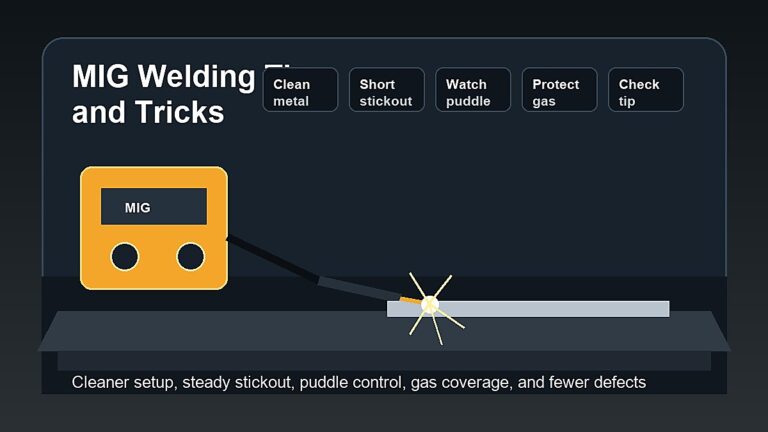
There can still be spatter, soot, or porosity if settings or gas coverage are wrong. Clean welds come from a clean setup, not from the process name alone. If spatter is a problem, pair this guide with MIG Welding Tips and Tricks for Beginners.
Advantage: Good for Mild Steel Projects
MIG is excellent for many mild steel projects: shop fixtures, brackets, tables, carts, frames, gates, repairs, and general fabrication. With the right machine and settings, it can handle a wide range of material thicknesses. This is where MIG gives beginners a practical path from simple practice to useful projects.
MIG can also weld stainless steel and aluminum with the right wire, gas, and setup, but those materials add complexity. Mild steel is the best place for most beginners to start. Learn the basics first, then move into special materials.
Disadvantage: Shielding Gas Adds Cost and Setup
Traditional MIG welding needs shielding gas. That means a gas cylinder, regulator, hose, correct flow setting, and safe cylinder handling. Gas improves weld quality when used correctly, but it adds cost and another system that can go wrong.
Beginners must learn what gas to use, how much flow is reasonable, and how to check for leaks. Too little gas can cause porosity. Too much flow can create turbulence and waste gas. If you want no-gas welding, you are usually talking about flux core rather than true gas MIG. See Gasless MIG Welding for Beginners.
Disadvantage: MIG Does Not Like Wind
Wind can blow away the shielding gas around the arc. Once the weld pool loses gas coverage, air can contaminate the weld and cause porosity. That is why gas MIG is usually better indoors or in a protected shop area.
Outdoor MIG can work with wind screens and careful setup, but self-shielded flux core or stick welding is often more practical outside. If your work is mostly field repair, farm repair, or windy driveway welding, MIG may not be the best first process.
Disadvantage: MIG Costs More to Set Up
A basic MIG setup usually costs more than a simple stick welder or small flux-core-only machine. You may need a welder, gas cylinder, regulator, hose, contact tips, nozzles, wire, gloves, helmet, clamps, and cleaning tools. Gas cylinders also need refills or exchanges.
This does not make MIG a bad investment. It means beginners should budget for the full setup, not only the machine price. A cheap machine with poor wire feed, limited output, or no gas support can make learning harder than expected.
Disadvantage: More Parts Can Go Wrong
MIG depends on smooth wire feeding and good gas coverage. Drive roll tension, liner condition, contact tip size, wire quality, spool tension, gun cable position, gas flow, and ground clamp contact can all affect the arc. A beginner may think they have a technique problem when the real issue is setup.
If the arc pops, wire burns back, or the bead turns porous, do a quick setup check before changing every setting. Confirm wire diameter, contact tip, polarity, gas flow, ground connection, and clean metal.
Disadvantage: Thin Metal Can Burn Through
MIG can weld thin metal, but beginners can burn through sheet metal quickly if the settings are too hot or travel speed is too slow. Auto body panels, thin tubing, and light sheet require short tacks, clean fit-up, lower heat, and patience.
The advantage is that MIG can be cleaner than flux core on thin steel when set correctly. The disadvantage is that the setup still needs care. For thin work, wire diameter, voltage, wire feed speed, and tack sequence matter a lot.
Material Limits Beginners Should Know
MIG is strongest as a beginner process on clean mild steel. Stainless steel needs the right stainless wire and shielding gas. Aluminum usually needs the right aluminum wire, gas, feeding setup, and often a spool gun or push-pull system. Galvanized steel and painted metal create fume and contamination concerns.
Cast iron, hardened steel, unknown alloys, pressure parts, and vehicle structural components are not good beginner MIG experiments. The machine may create an arc, but that does not mean the repair is suitable. Match the process to the material and the consequence of failure.
Disadvantage: MIG Can Make Bad Welds Look Good
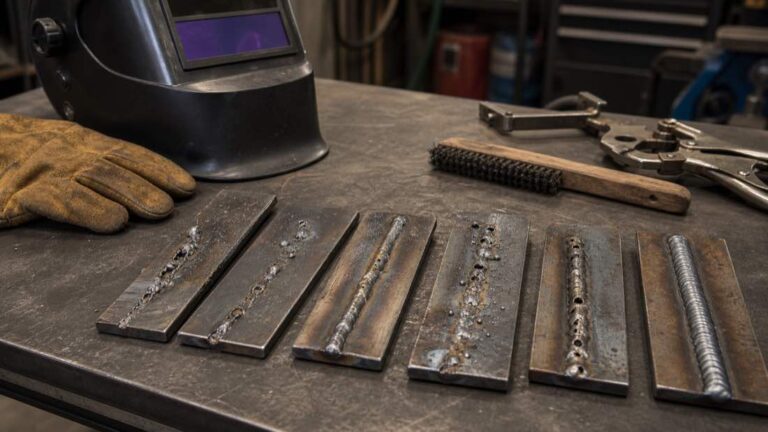
MIG is sometimes called easy because the bead can look smooth quickly. That can be misleading. A smooth bead may still lack penetration, fail to tie into both sides of the joint, or sit on top of dirty metal. Beginners should learn to inspect more than appearance.
Cut and bend practice welds when safe to do so. Watch for fusion at the root, bead shape, heat marks, and defects such as porosity or undercut. Use the Welding Defects hub when a bead looks wrong or breaks easily.
MIG vs Flux Core, Stick, and TIG
Compared with flux core, gas MIG is cleaner and often easier indoors, but flux core is more convenient outdoors and does not need a gas bottle. Compared with stick welding, MIG is usually easier to learn and cleaner, but stick is rugged for outdoor and thicker repair work. Compared with TIG, MIG is faster and easier, while TIG offers more precise control on thin metal, stainless, and aluminum.
That means MIG is not automatically best. It is best when the work is clean, the environment is protected from wind, and the material matches the setup. For broader process comparison, read Types of Welding Explained.
How Shielding Gas Affects the Pros and Cons
Shielding gas is one reason MIG can make clean welds. Common mild-steel blends such as argon and CO2 mixtures can give a stable arc and good bead appearance. Straight CO2 can be cheaper and give deeper penetration in some setups, but it may create more spatter.
The gas advantage becomes a disadvantage when the gas is wrong, the cylinder is empty, the flow is poor, or wind reaches the arc. If the weld suddenly shows pinholes after everything seemed fine, check gas coverage before blaming your hands.
Best Uses for MIG Welding
- Indoor mild steel fabrication.
- Garage and home shop projects.
- Brackets, carts, tables, and frames.
- Clean repair work on suitable steel.
- Learning basic arc control and puddle control.
- Projects where slag cleanup should be minimal.
When MIG Is Not the Best Choice
- Windy outdoor welding without protection.
- Dirty, rusty, painted, or coated metal that cannot be cleaned.
- Very thick field repairs where stick may be more practical.
- Very precise stainless or aluminum work where TIG is better.
- Jobs where gas cylinders are not convenient.
- Safety-critical welds without training and inspection.
Beginner Decision Checklist
- Are you welding indoors or protected from wind?
- Is the metal clean mild steel?
- Do you have the right shielding gas and wire?
- Can your machine handle the material thickness?
- Can you practice on scrap before the real job?
- Is the weld non-critical, or does it need qualified inspection?
If most answers are yes, MIG is probably a good beginner choice. If the work is outdoors, dirty, very thick, or safety-critical, compare flux core, stick, TIG, or professional help before committing.
Beginner Practice Plan
Start with clean mild steel coupons. Run straight beads first, then lap joints and T-joints. Change only one setting at a time so you can see how voltage, wire speed, stickout, and travel speed affect the weld. Keep notes if the machine settings are not obvious.
After a few practice welds, cut or bend scrap pieces when safe. This helps you learn whether the weld is tying in or only sitting on top. MIG rewards steady practice, but beginners improve faster when they inspect the weld instead of only admiring the bead.
Common MIG Problems Beginners See
Porosity usually points to gas coverage, dirty metal, wind, or contamination. Tall ropey beads may point to low heat, slow travel, or wire speed mismatch. Excess spatter can come from settings, stickout, gas choice, or dirty material. Burn-back can come from poor contact tip condition, wire feed trouble, or holding the gun too close.
The advantage of MIG is that many problems are repeatable and fixable. The disadvantage is that beginners can chase settings without checking basics first. Clean the metal, check gas, confirm wire feed, set stickout, and practice on scrap before changing several controls at once. That habit saves time, prevents frustration, and makes each practice weld more useful for the next adjustment. It also builds safer shop discipline over time for beginners.
Safety Notes
MIG welding can involve electric shock, hot metal, sparks, fire, shielding gas, compressed gas cylinders, UV radiation, fumes, burns, and eye injury. Shielding gas can also displace oxygen in poorly ventilated areas. Welding coated, galvanized, stainless, or unknown metal can increase fume hazards.
Use proper PPE, ventilation or fume extraction, a fire-safe workspace, and safe cylinder handling. Review OSHA welding hazards guidance, OSHA welding fume guidance, and AWS safety resources.
FAQ
What is the biggest advantage of MIG welding?
The biggest advantage is that MIG is easier to learn than many other processes while still being fast and useful for clean mild steel projects.
What is the biggest disadvantage of MIG welding?
The biggest disadvantage is reliance on shielding gas. Gas adds cost, setup steps, and wind sensitivity.
Is MIG welding good for beginners?
Yes, MIG is often good for beginners working indoors on clean mild steel. Beginners still need safety training, correct settings, and practice.
Is MIG stronger than stick welding?
Neither process is always stronger. Strength depends on material, joint design, filler, settings, technique, and inspection. MIG and stick can both make strong welds when used correctly.
Can MIG welding be done outside?
Gas MIG can be done outside only if shielding gas is protected from wind. In many outdoor situations, self-shielded flux core or stick welding is more practical.
Final Advice
MIG welding is one of the best beginner processes for clean indoor mild steel. Its advantages are speed, ease of learning, and cleaner welds. Its disadvantages are gas cost, wind sensitivity, setup details, and the risk of trusting a nice-looking bead too quickly. Learn the process, practice on scrap, and choose MIG when the job actually fits its strengths.