What Beginners Need to Start Welding: Complete Setup Guide
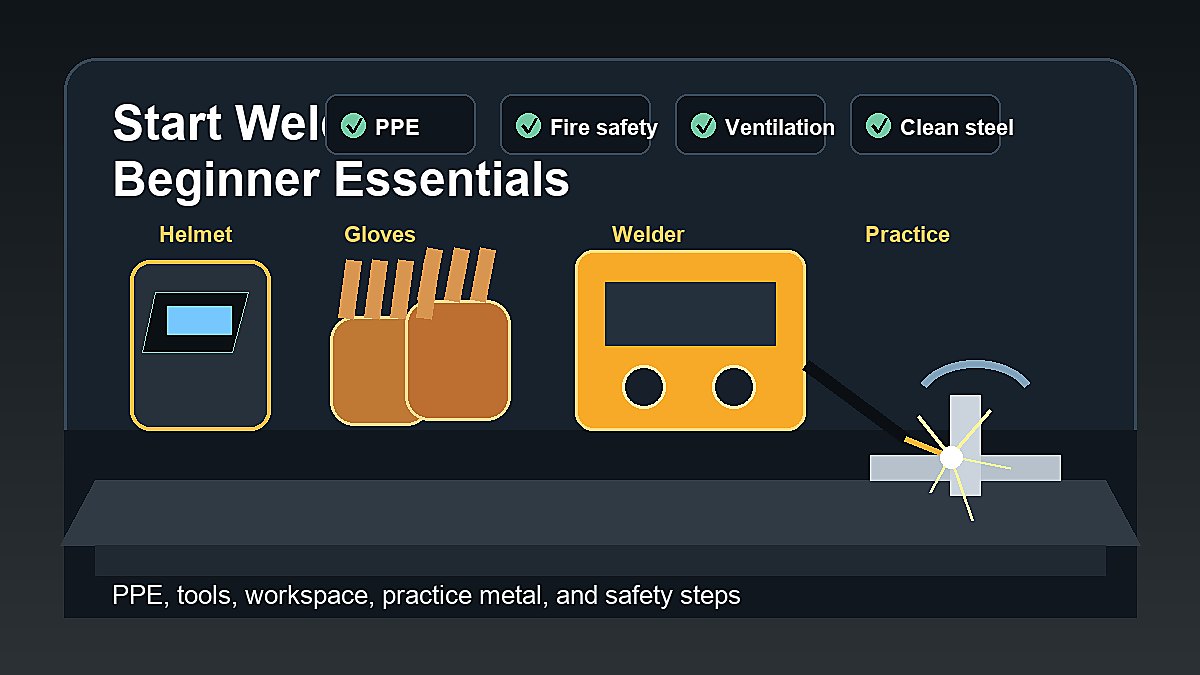
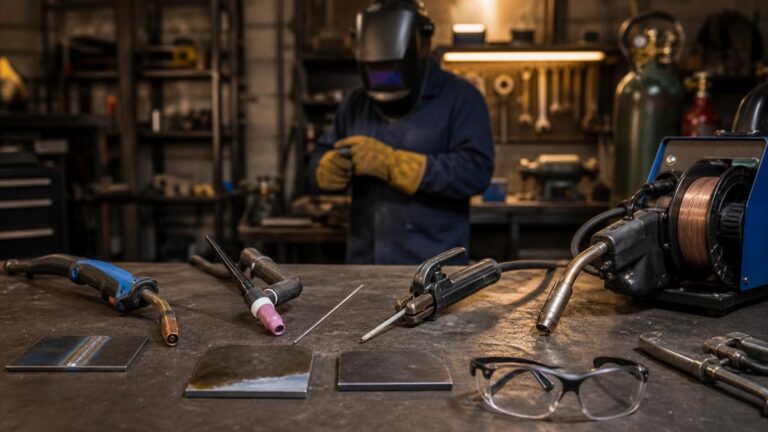
What do beginners need to start welding? At minimum, a beginner needs the right safety gear, a suitable welding process, a fire-safe workspace, clean practice metal, basic hand tools, and enough instruction to avoid dangerous first projects. The machine matters, but it is not the first thing to buy.
Welding combines heat, electricity, sparks, fumes, ultraviolet light, hot metal, and fire risk. A good starter setup is not just a welder in a box. It is a controlled place to practice, protective equipment that fits, simple materials, and a plan for learning one process at a time.
Mark Dawson beginner note: your first goal is not to build a trailer, fix a vehicle, or weld anything that could hurt someone if it fails. Your first goal is to learn safe setup, run repeatable beads on scrap, and recognize when a weld is not good enough.
Quick Answer
A beginner needs PPE, a beginner-friendly welding machine, clean mild steel practice pieces, a stable work surface, clamps, a grinder or wire brush, ventilation, fire control, and basic knowledge of the chosen process. Most home learners start with MIG or flux core because wire-feed welding is easier to control than TIG or stick for many first-time welders.
| Starter Need | Why It Matters | Beginner Tip |
|---|---|---|
| Helmet | Protects eyes and face from arc light | Use the correct shade and fit |
| Gloves and clothing | Protects skin from heat, sparks, and UV | Choose flame-resistant materials |
| Welder | Creates the arc or heat | Match process to projects |
| Workspace | Controls fire, fumes, and movement | Clear flammables first |
| Practice metal | Lets you learn without risking real parts | Start with clean mild steel |
Start With Safety Gear
Safety gear comes before the machine. A welding helmet protects your eyes and face from arc radiation, sparks, and hot particles. Auto-darkening helmets can be convenient, but the shade range, reaction, fit, and reliability matter more than appearance.
Welding gloves protect your hands from heat and spatter. MIG and stick gloves are usually heavier, while TIG gloves are often thinner for dexterity. Beginners should also wear flame-resistant sleeves or a jacket, cotton or FR pants, leather boots, and safety glasses for grinding and chipping.
Synthetic clothing can melt against skin. Avoid nylon, polyester, loose hoodie strings, open pockets, and shoes that catch sparks. For a dedicated safety overview, read Welding Safety and Protective Equipment Essentials for the Beginner Welder.
Choose One Welding Process First
Beginners do not need to learn every process at once. Choose one process that matches your workspace, power supply, budget, and practice goals. For many home users, the first choice is MIG welding or self-shielded flux core welding. Both use a wire-feed gun, so the learning curve is often smoother than stick or TIG.
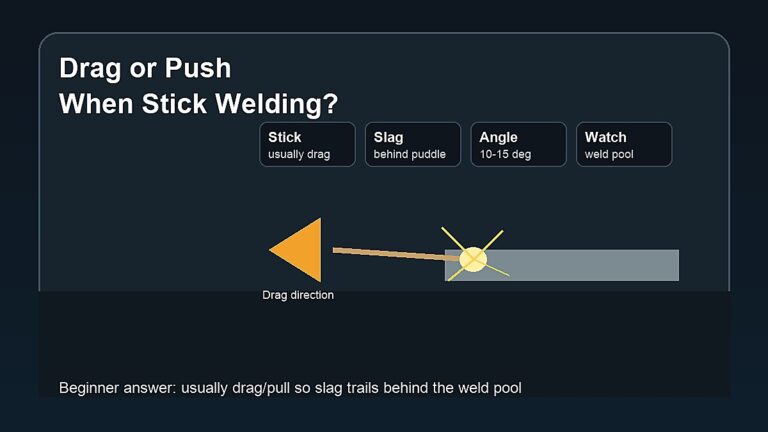
MIG welding usually uses shielding gas and works best indoors or in sheltered areas. Flux core can work better outdoors because self-shielded wire does not need an external gas bottle. Stick welding is useful for outdoor repair and thicker steel, but arc starts and rod control take patience. TIG offers excellent control, yet it is usually harder for a beginner.
For process comparison, start with Types of Welding Explained, then use MIG Welding Techniques for Beginners or How to MIG Weld Flux Core for Beginners when you pick your first path.
Pick a Machine That Matches Real Practice
A beginner machine should be simple enough to use often. Check input power, amperage range, duty cycle, supported wire or rods, polarity requirements, and material thickness. A small 120V wire-feed welder can be fine for practice and light projects, but it may not handle thick steel well.
Do not buy only by maximum amp number. A clear manual, stable wire feed, available consumables, safe power requirements, and realistic thickness chart matter more for learning. If a machine is hard to set up or does not match your outlet, it can slow your progress.
Also budget for consumables. MIG and flux core need wire, contact tips, nozzles, drive rolls, and sometimes gas. Stick welding needs rods. TIG needs tungsten, cups, filler rods, and gas. The machine is only one part of the setup.
Check Power, Outlets, and Extension Cords
Before buying a welder, check what power you can safely use. Many small beginner machines run on 120V household power, but that does not mean every outlet is suitable. The circuit, breaker, cord length, plug type, and machine requirements all matter.
Undersized extension cords can overheat or cause voltage drop. Long cords can make a small welder run poorly. Follow the welder manual for cord gauge, circuit size, and input requirements. If you need a 240V outlet, use a qualified electrician instead of improvising.
Beginners often think only about amperage at the torch. The safer question is whether the whole electrical setup is appropriate from wall outlet to machine to work clamp. Dry conditions, intact insulation, tight connections, and proper grounding all matter.
Build a Fire-Safe Workspace
A safe workspace needs a stable surface, clear floor, dry footing, and enough room to move without dragging leads through clutter. Remove cardboard, paper, sawdust, rags, gasoline, solvents, aerosols, dry leaves, plastic containers, and anything else that can ignite.
Use a steel table or another suitable fire-resistant work surface. Wood benches, plastic sawhorses, and painted surfaces create fire and fume problems. Keep a fire extinguisher nearby and check the area again after welding because sparks can smolder where you do not notice them at first.
Ventilation matters too. Welding fumes depend on the process, metal, coating, filler, and workspace. Outdoor air is not a complete safety plan, and indoor practice needs fresh air without blowing shielding gas away from the weld. Review OSHA welding hazards guidance and OSHA welding fume guidance.
Gas Cylinders and Storage Basics
If you choose gas MIG or TIG, you also need to think about cylinders. A gas cylinder is not just another accessory. It must be secured upright, protected from damage, moved carefully, and used with the correct regulator and hose setup.
Beginners who do not want to manage a cylinder often start with self-shielded flux core wire. That can simplify outdoor practice, but it adds slag, smoke, and cleanup. There is no free shortcut; each process trades one kind of setup work for another.
If you use shielding gas, learn how to check for leaks, open valves correctly, protect hoses from sparks, and close the cylinder when finished. Keep cylinders away from heat and secure them so they cannot fall.
Get Basic Tools Before Fancy Accessories
Beginner welding tools should help you clean, hold, measure, tack, and inspect the work. You do not need a huge fabrication shop. You do need enough simple tools to make the practice repeatable.
- Wire brush for cleaning steel and removing slag.
- Chipping hammer if using stick or flux core.
- Angle grinder with suitable wheels.
- Clamps, magnets, or fixtures to hold parts securely.
- Tape measure, marker, square, and soapstone.
- Pliers or welding pliers for wire-feed work.
- Fire extinguisher and metal container for hot scrap.
- Spare contact tips, rods, wire, or other consumables for your process.
Clamping is especially important. Beginners often struggle because parts move during tacking, gaps open, or the joint is poorly supported. Better fit-up makes welding easier and safer.
How Much Should Beginners Spend?
There is no single correct starter budget. The better question is what must be included. A cheap welder without safe PPE, clamps, grinder, consumables, and practice steel is not a complete starter setup. A more expensive welder does not help if you cannot practice safely.
Put money into protection first: helmet, gloves, clothing, safety glasses, and fire control. Next, buy the machine and consumables that match one process. After that, add tools that improve practice quality, such as clamps, a better work surface, and cleaning tools.
Avoid buying every accessory before you know what problems you actually have. Practice will show whether you need more clamps, better lighting, extra tips, a different wire size, or a more stable work table.
Start With the Right Practice Metal
Clean mild steel is the best practice material for most beginners. It is easier to learn on than aluminum, stainless steel, cast iron, very thin sheet, or unknown scrap. Start with pieces thick enough that you do not instantly burn through but not so thick that your machine cannot fuse them.
Avoid painted, galvanized, oily, rusty, plated, or mystery metal while learning. Coatings can create fumes and contamination. Rust and paint can cause porosity and weak welds. If you do not know what the metal is, do not use it for beginner practice.
Cut small coupons, clean the surface, clamp them flat, and run straight beads before trying joints. After beads look consistent, move to lap joints, T-joints, and butt joints. For mistake diagnosis, use the Welding Defects hub.
Learn Machine Settings Slowly
Every beginner needs a way to choose starting settings. Use the chart inside the welder door, the machine manual, or a reliable settings guide for your process, wire, rod, gas, and metal thickness. Then test on scrap before welding the actual part.
Adjust one thing at a time. If you change voltage, wire speed, travel speed, angle, and stickout all together, you will not know what fixed or worsened the bead. Keep short notes while practicing so the machine starts to make sense.
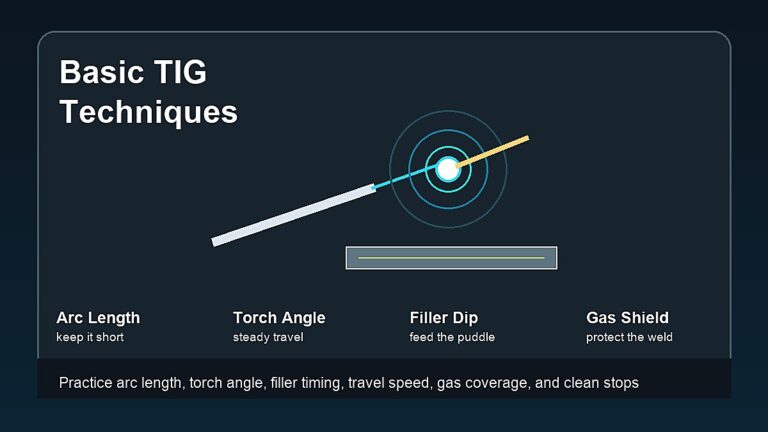
For wire-feed work, learn stickout, travel angle, work angle, wire speed, voltage, and sound. For stick welding, learn amperage, rod angle, arc length, travel speed, and slag cleanup. For TIG, learn tungsten prep, gas coverage, puddle control, filler timing, and heat control.
What Beginners Should Not Weld Yet
Some beginner projects are fine for practice. Others are not. Avoid vehicle frames, trailers, suspension parts, lifting points, pressure vessels, structural supports, gas tanks, fuel containers, and anything that could injure someone if the weld fails.
Also avoid sealed containers, unknown tanks, and anything that held fuel, oil, chemicals, or flammable material. Those jobs can be deadly without proper preparation and training. If the project matters for safety, get qualified instruction and inspection.
Beginner Practice Plan
- Read your welder manual and safety instructions.
- Set up PPE, ventilation, fire control, and a dry workspace.
- Choose one process and one material thickness.
- Clean mild steel coupons and clamp them securely.
- Run straight beads without trying to build anything.
- Clean and inspect each bead.
- Practice lap joints and T-joints on scrap.
- Study defects and adjust one variable at a time.
- Move to simple non-critical projects only after repeatable practice.
Good beginner projects include practice coupons, a small bracket for the shop, a simple welding cart practice frame, or a non-critical table accessory. Keep the early projects small enough that mistakes are easy to see and fix.
How to Inspect Early Practice Welds
After each practice weld, clean it before judging it. Slag, soot, and spatter can hide what the bead actually did. Look for even width, consistent tie-in at both edges, no obvious pinholes, no deep undercut, and no big cold lap sitting on top of the metal.
Cutting, bending, or breaking practice coupons can teach more than looking at the top of the bead. A weld can look acceptable and still have poor fusion underneath. Beginners should learn to be curious about the result instead of trying to make every bead look pretty immediately.
Take photos of practice beads and write down settings. Over time, you will see patterns: moving too fast makes narrow beads, too much heat can undercut edges, dirty metal can create porosity, and poor fit-up makes everything harder.
First-Week Practice Schedule
A simple practice schedule keeps the learning path from turning into random sparks. On day one, set up the workspace, read the manual, and practice dry positioning without striking an arc. On day two, run short straight beads on clean scrap and focus only on travel speed.
On day three, repeat the same bead while changing one machine setting at a time. On day four, practice tacks and simple lap joints. On day five, clean and inspect every weld, then compare the best and worst beads. That slow approach builds control faster than jumping into a complicated project.
After the first week, choose one small non-critical project that uses the same material thickness you practiced on. If the project requires a different process, thicker metal, thin sheet, aluminum, cast iron, or outdoor conditions, treat it as a new learning step rather than the same skill.
Common Beginner Buying Mistakes
- Buying a welder before choosing a process and workspace.
- Spending on accessories before buying proper PPE.
- Choosing a machine that needs an outlet you do not have.
- Ignoring consumable cost and availability.
- Trying to weld dirty scrap because it was free.
- Assuming a bigger machine makes better welds automatically.
- Skipping training because practice beads seem easy.
A better approach is boring but effective: safety first, one process, clean practice metal, simple settings, repeated inspection, and gradual progress. That foundation will help more than a random pile of tools.
Trusted Safety References
Before striking an arc, review official safety resources. OSHA covers welding hazards, fire, fumes, and protective controls. The American Welding Society also provides safety and education resources for welders. Start with AWS free resources along with the OSHA links above.
FAQ
What is the first thing a beginner welder should buy?
Buy proper PPE first, especially a welding helmet, gloves, flame-resistant clothing, and safety glasses. A welding machine should come after you know your process, workspace, and power supply.
What type of welding should a beginner start with?
Many beginners start with MIG or flux core because wire-feed welding is easier to control than TIG or stick. The best choice still depends on your workspace and projects.
Can I learn welding at home?
You can practice basic beads at home if you have safe equipment, ventilation, fire control, and suitable space. Formal training is strongly recommended before doing important repairs.
What metal should beginners weld first?
Clean mild steel is usually best. Avoid aluminum, stainless, cast iron, galvanized, painted, or unknown scrap until you understand the process and safety issues.
How much does it cost to start welding?
The cost depends on process, machine, PPE, workspace, tools, gas, wire, rods, and practice metal. Beginners should budget for safety gear and consumables, not only the welder.
Final Advice
Beginners need a safe setup more than a perfect machine. Start with PPE, clean mild steel, a fire-safe workspace, one welding process, and a simple practice plan. Once your beads become consistent and you can identify common defects, move slowly into small non-critical projects and keep safety as the habit that guides every weld.