TIG Welding Tips and Techniques
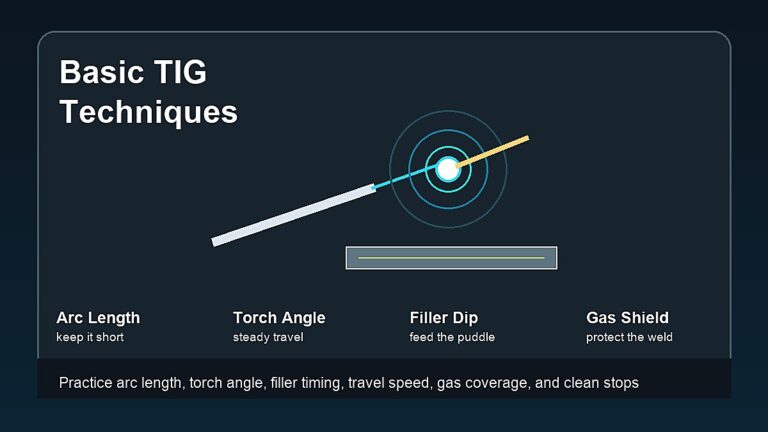
TIG practice becomes more useful when torch control, filler timing and cleanliness are treated as separate skills. A contaminated tungsten or unstable hand position can make good settings look wrong. Stop and identify the problem before increasing current.
Rehearse before lighting the arc
With the equipment made safe, move along the joint and check whether your wrist, torch lead or filler hand will catch. Support your arms without placing them where hot material or electrical hazards can reach them. Arrange the work so you can see the pool throughout the run.
Three focused drills
| Drill | Concentrate on | Stop when |
|---|---|---|
| Torch movement on a marked practice line | Stable angle and working distance | Your position forces an awkward reach |
| Short puddle-control runs on suitable scrap | Watching the pool rather than chasing a pattern | The tungsten touches metal |
| Controlled filler additions | Repeatable timing with clean filler | The filler or tungsten becomes contaminated |
Use current, tungsten and shielding suitable to the material and machine. These drills are not a substitute for the manufacturer's process setup. Keep a simple log so a change in tungsten preparation is not confused with a change in gas coverage.
Diagnose contamination promptly
If tungsten touches the puddle or filler, stop and prepare it correctly before continuing. Check gas delivery, leaks, cup condition, drafts and cleanliness when oxidation or erratic behavior appears. More gas flow is not always better; disturbed coverage can introduce problems of its own.
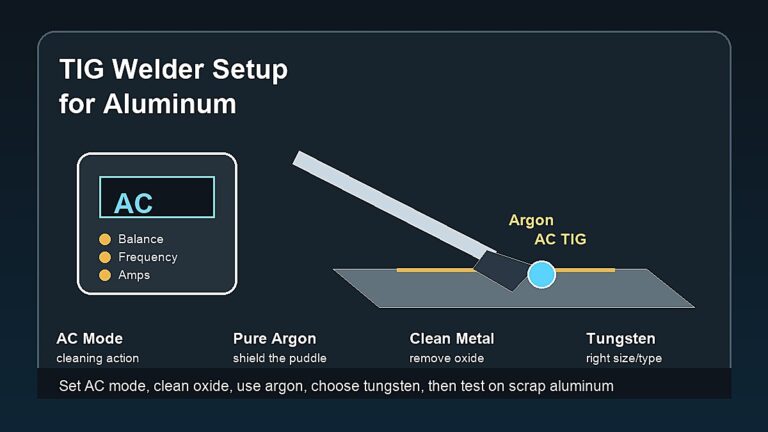
Do not judge stainless shielding solely by a colored surface, and do not copy aluminum settings into a steel job. Material, thickness, joint and the machine's AC/DC capability change the setup.
Should I keep welding after dipping the tungsten?
Stop and correct the contamination. Continuing can make it harder to distinguish a technique problem from an electrode problem.
Is a uniform ripple pattern proof of a sound TIG weld?
No. Regular appearance does not establish fusion, root quality or material suitability. Use appropriate training and inspection before doing critical work.
Continue learning
Sources and limits
This is an educational reference. Follow the exact equipment and consumable instructions; safety-critical welding needs appropriate qualifications, procedures and inspection.