Advantages and Disadvantages of TIG Welding
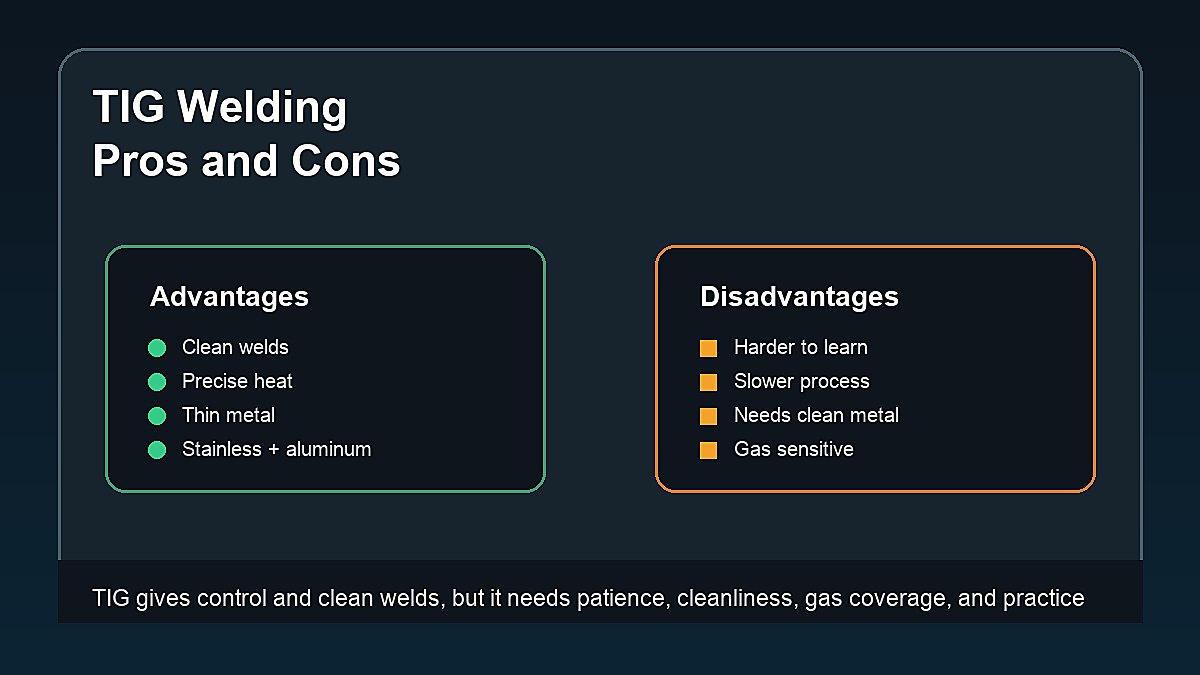
The advantages and disadvantages of TIG welding matter because TIG is one of the cleanest and most controlled welding processes, but it is not the easiest or fastest choice for every job. TIG can make precise welds on thin metal, stainless steel, aluminum, and visible fabrication work. It also requires clean material, shielding gas, hand coordination, and patience.
TIG stands for tungsten inert gas, and the technical process name is gas tungsten arc welding, or GTAW. It uses a non-consumable tungsten electrode to create the arc while inert shielding gas protects the weld pool. Filler rod is often added by hand.
Mark Dawson beginner note: TIG is not automatically better than MIG, stick, or flux core. It is better when the job needs its strengths: control, cleanliness, thin-material work, and careful heat input.
Quick Answer
The main advantages of TIG welding are clean welds, excellent heat control, low spatter, strong precision on thin metal, and usefulness on stainless steel and aluminum. The main disadvantages are slower speed, harder learning curve, higher setup cost, strict cleaning needs, shielding gas sensitivity, and lower productivity for heavy or rough repair work.
| Side | Point | Beginner Meaning |
|---|---|---|
| Advantage | Precise heat control | Good for thin and visible work |
| Advantage | Clean welds | Less spatter and cleanup |
| Advantage | Works on many metals | Useful for stainless and aluminum |
| Disadvantage | Harder to learn | Needs torch, filler, and heat coordination |
| Disadvantage | Slower process | Not ideal for every production job |
| Disadvantage | Needs clean metal and gas | Drafts and dirt cause defects quickly |
Advantage: Excellent Weld Control
TIG gives the welder strong control over heat, arc length, filler metal, travel speed, and puddle size. The tungsten creates the arc, while filler rod is separate. That separation lets you add metal only when the joint needs it.
This control is useful on thin sheet, tubing, stainless work, small brackets, visible joints, and projects where overheating would cause distortion. A foot pedal or torch control can make heat adjustments even more precise.
The same control also means the welder has more to manage. Beginners must learn to watch the puddle, keep the tungsten clean, feed filler smoothly, and avoid losing gas coverage. For the foundation, read TIG Welding for Beginners.
Advantage: Clean Weld Appearance
TIG can produce neat, smooth welds with little spatter when the setup is correct. Because the filler rod is added separately and the shielding gas protects the weld area, TIG often leaves less cleanup than stick or flux core welding.
This is one reason TIG is popular for visible stainless steel, exhaust work, custom fabrication, decorative parts, and projects where bead appearance matters. It can create clean weld profiles when the joint fit-up and technique are good.
Appearance is not proof of strength by itself. A shiny TIG weld can still be weak if there is poor fusion, contamination, wrong filler, or bad joint design. Clean-looking welds still need proper technique and inspection for important work.
Advantage: Good for Thin Metal
TIG is excellent for thin metal because heat can be controlled carefully. The arc can be focused, filler can be added in small amounts, and travel speed can be adjusted to avoid burn-through. This makes TIG useful for sheet metal, tubing, small parts, and precise repairs.
Thin metal still takes practice. Too much heat can warp the part or melt through the edge. Too little heat can leave a cold weld that sits on top instead of tying in. TIG gives control, but the operator still has to use it well.
Beginners should practice on scrap before working on thin real parts. Practice short beads, pauses, tack spacing, and heat control rather than trying to weld a full thin joint in one long pass.
Advantage: Stainless Steel and Aluminum Capability
TIG is widely used for stainless steel and aluminum. Stainless benefits from precise heat control and clean shielding. Aluminum often uses AC TIG with proper cleaning, tungsten, shielding gas, and machine settings.
This flexibility makes TIG attractive to beginners who want to grow into more advanced materials. One TIG machine may support mild steel, stainless, and aluminum if it has the right current type and features.
Do not start with aluminum if you are completely new. Aluminum is heat-sensitive, oxidizes quickly, and can be frustrating before you understand basic puddle control. Learn steel TIG first, then move up.
Advantage: Low Spatter and Less Slag
TIG does not use a flux-coated rod or flux-filled wire for ordinary manual welding, so it does not leave slag like stick or self-shielded flux core. Spatter is also usually low when the arc, gas, and filler technique are right.
Less slag and spatter can mean less cleanup, less grinding, and a cleaner work area. This is useful for thin parts, visible welds, sanitary-looking fabrication, and jobs where heavy grinding would damage the part.
Low spatter does not mean no hazards. TIG still creates UV radiation, hot metal, shielding gas risks, electrical hazards, and possible fumes depending on the material. PPE is still required.
Disadvantage: Harder to Learn
TIG is harder for many beginners because it requires coordination. You may control the torch with one hand, feed filler with the other, and adjust amperage with a foot pedal or torch control. At the same time, you must keep the arc short and avoid dipping the tungsten.
Small mistakes show quickly. A dirty tungsten, long arc, draft, contaminated filler rod, or poor torch angle can ruin the weld. MIG and flux core are often easier first processes because the machine feeds the wire.
The learning curve is not a reason to avoid TIG. It simply means beginners should practice in steps: puddle control first, filler timing second, joints after that, and difficult materials later.
Disadvantage: Slower Welding Speed
TIG is usually slower than MIG or flux core for many jobs. The welder often adds filler by hand, controls the puddle carefully, and moves at a pace that protects the weld quality. That precision costs time.
For production brackets, long seams, heavy fabrication, and rough repair, faster processes may be more practical. TIG shines when control matters more than speed, not when every inch of weld needs to be deposited as fast as possible.
Beginners should not judge TIG by speed during early practice. The first goal is clean setup and controlled beads. Speed improves after consistency.
Disadvantage: Cleanliness Is Strict
TIG is sensitive to contamination. Rust, oil, paint, moisture, mill scale, oxide, dirty filler, and contaminated tungsten can cause porosity, discoloration, unstable arc behavior, and weak welds.
This means prep work matters. You may need to clean, brush, grind, wipe, or regrind tungsten before welding. Stainless steel and aluminum also need material-specific cleaning habits to avoid contamination.
Some beginners see this as annoying. A better way to think about it: TIG teaches discipline. Clean prep gives cleaner feedback, and cleaner feedback makes learning easier.
Disadvantage: Shielding Gas Sensitivity
TIG depends on shielding gas. Drafts, wind, wrong flow, leaks, poor cup choice, too much tungsten stickout, or too much torch angle can expose the weld pool to air. The result can be porosity, dull color, oxidation, or contamination.
This makes TIG less convenient outdoors than stick welding or self-shielded flux core. You can TIG outside in controlled conditions, but wind and drafts are real problems.
Gas also adds cost and setup steps. You need a cylinder, regulator or flowmeter, hose, leak checks, and safe cylinder handling. For shop organization, see Welding Cart for Beginners.
Disadvantage: Higher Setup Cost
A TIG setup can cost more than a basic flux core or stick setup. Beyond the machine, you may need a torch, cups, collets, tungsten, filler rods, argon cylinder, regulator, foot pedal, PPE, and cleaning tools.
AC/DC TIG machines for aluminum usually cost more than simple DC-only machines. Water-cooled torches and advanced pulse features add even more cost, though many beginners do not need those at first.
Cost should match the goal. If you mainly need outdoor repair on thick steel, TIG may not be the best first investment. If your goal is stainless, aluminum, thin metal, or precise fabrication, TIG may be worth the slower start.
When TIG Welding Is a Good Choice
- Thin metal needs careful heat control.
- Stainless steel or aluminum is part of the plan.
- Weld appearance matters.
- Low spatter and minimal cleanup are important.
- The workspace is clean and shielded from drafts.
- The operator has time to practice coordination.
- Precision matters more than welding speed.
When TIG Welding Is Not the Best Choice
- Outdoor wind makes gas shielding unreliable.
- The job is rough repair on dirty metal.
- High deposition speed matters more than appearance.
- The material is thick and needs faster fill.
- The budget only supports a very basic first welder.
- The beginner needs the easiest process to start with.
- The work is safety-critical and the welder is not trained.
TIG Compared With MIG, Stick, and Flux Core
Compared with MIG, TIG is cleaner and more precise, but MIG is usually faster and easier for general mild steel projects. MIG also feeds filler wire automatically, which removes one coordination step for beginners. TIG asks the welder to control filler by hand.
Compared with stick welding, TIG is cleaner and more controlled, but stick is better for many outdoor repair jobs, thicker steel, and rougher conditions. Stick does not need a shielding gas cylinder, while TIG depends on gas coverage.
Compared with self-shielded flux core, TIG is much cleaner but less convenient outdoors. Flux core can handle wind and less-than-perfect metal better than TIG. TIG is the better choice when the job needs clean fit-up, visible weld quality, and precise heat.
If you are choosing a first process, compare your workspace and projects before buying. For beginner process selection, read What Is Easier to Learn: MIG or TIG Welding?.
Best Beginner Use Cases for TIG
TIG makes the most sense when you can work indoors or in a protected shop, clean the material properly, and spend time practicing. It is a strong option for small stainless brackets, thin mild steel practice pieces, aluminum learning projects, visible welds, and fabrication where fit-up is accurate.
It is less attractive when the metal is rusty, painted, oily, thick, awkward, or outdoors in wind. A process can be excellent and still be wrong for the job. TIG rewards a controlled environment.
For a beginner, the best TIG project is usually not a real repair. Start with clean coupons and simple joints. Once the puddle and filler timing become predictable, move into small non-critical projects where appearance and precision matter.
Cost and Time Tradeoff
TIG can save cleanup time because it produces little spatter and no slag in normal manual use. That benefit can disappear if the setup is wrong and the weld becomes contaminated. Bad TIG welds can take a long time to grind out and redo.
The real cost is not only the machine. Argon refills, tungsten, cups, collets, gas lenses, filler rods, PPE, and cleaning supplies add up. Practice time is also part of the cost because TIG skill develops slowly.
For some people, that tradeoff is worth it. For others, a MIG or stick setup will produce useful work sooner. The right choice depends on whether you want precision and material flexibility or fast, practical joining on common steel projects.
How to Reduce TIG Disadvantages
- Start on clean mild steel before aluminum.
- Use simple joints and short practice beads.
- Keep tungsten clean and regrind after contamination.
- Protect the weld from drafts and wind.
- Use comfortable torch position and table height.
- Store filler rods clean and dry.
- Practice filler timing separately from travel speed.
- Use the machine manual before copying random settings.
These habits do not make TIG easy, but they remove avoidable frustration. Many beginner TIG problems come from dirt, gas coverage, and body position rather than the machine itself.
Safety Notes
TIG looks cleaner than some welding processes, but it still involves UV radiation, hot metal, electric shock risk, shielding gas hazards, fumes, burns, and fire risk. Use a proper helmet, TIG gloves, flame-resistant clothing, safety glasses, boots, ventilation, and fire-safe work area.
Review OSHA welding hazards guidance, OSHA welding, cutting, and brazing requirements, and AWS safety resources. For fume planning, read Welding Respirator for Beginners.
FAQ
What is the biggest advantage of TIG welding?
The biggest advantage is control. TIG lets the welder control heat, filler metal, arc length, and puddle movement very precisely.
What is the biggest disadvantage of TIG welding?
The biggest disadvantage for beginners is the learning curve. TIG requires torch control, filler timing, shielding gas control, and sometimes amperage control at the same time.
Is TIG better than MIG?
TIG is better for precision, thin metal, and clean visible welds. MIG is often faster and easier for general fabrication. The better process depends on the job.
Why is TIG welding so slow?
TIG is slow because filler is often added by hand and the weld pool is controlled carefully. The process favors precision over deposition speed.
Is TIG welding worth learning?
Yes, if you want clean, controlled welds on thin metal, stainless steel, aluminum, or visible fabrication work. It takes practice, but the skill is valuable.
Final Advice
TIG welding is worth learning when control and weld quality matter more than speed. Its biggest strengths are clean welds, precise heat control, and flexibility on stainless and aluminum. Its biggest tradeoffs are difficulty, slower speed, gas sensitivity, strict cleaning, and higher setup cost.