MIG Welding for Beginners
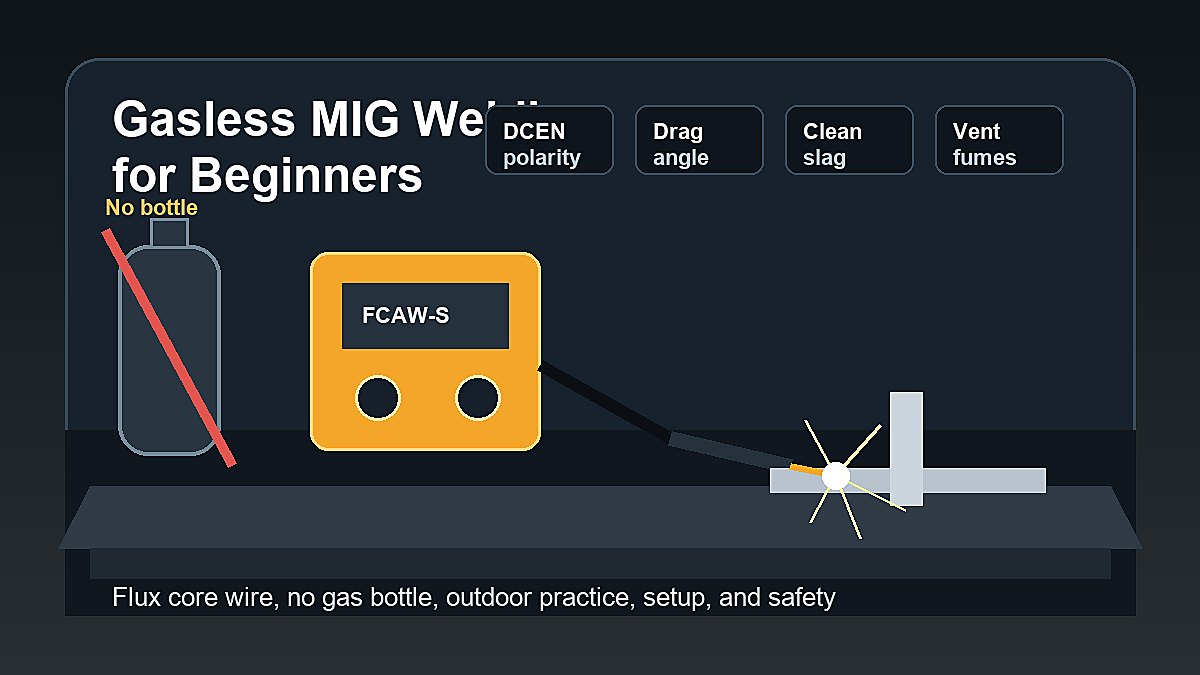
For beginner practice on clean mild steel, MIG welding means feeding solid wire through a gun while an external shielding gas protects the weld. It is different from self-shielded flux-core welding, even when the same machine can run both. Check the selected process before loading wire or copying settings.
Build a setup that matches the consumables
Choose wire, tip, drive roll and liner sizes that work together. Set polarity and gas according to the wire and machine instructions. Secure the cylinder upright and inspect its regulator and hoses. The welder's input circuit must meet the manual; a convenient socket is not proof that the supply is suitable.
Make the first practice joint from identified, clean mild-steel scrap. Avoid painted, plated or unknown material. Clean the joint and provide a sound work-clamp connection. Position extraction so it controls fumes without disrupting shielding.
Your first three practice tasks
| Task | What to concentrate on | What to record |
|---|---|---|
| Straight bead on a coupon | Steady distance and a clear view of the puddle | Wire, gas, thickness and machine settings |
| Lap joint on matching scrap | Directing the arc into both pieces | Fit-up, angle and edge fusion |
| Small practice fillet | Keeping the joint visible while moving | Bead shape and visible defects |
Start with the machine chart, then compare one adjustment at a time. Do not add weaving just to create a patterned surface. A repeatable straight bead teaches more about setup than a decorative motion hiding an unstable arc.
Read problems before turning controls
A tall bead that sits on the surface calls for examination of heat, travel and fusion. Visible pores call for a shielding and cleanliness check. Repeated wire stubbing can involve feed, voltage or a worn tip. Keep the gun cable reasonably straight and inspect feeding before chasing settings.
Can I weld outside with MIG?
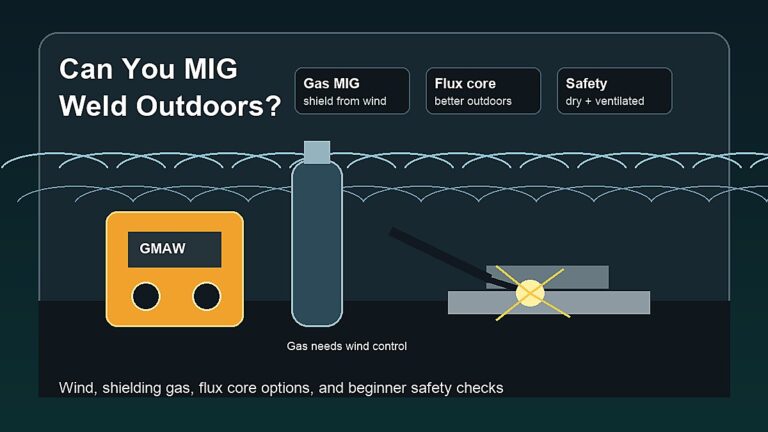
Shielding gas can be disrupted by wind. Do not assume turning up the regulator solves it. Use an appropriate protected setup or a process selected for the conditions.
When am I ready for a real project?
Begin with noncritical work after repeatable practice and competent feedback. A neat surface cannot verify a trailer, lifting point, vehicle repair or structural weld. Those require an appropriate procedure and inspection.
Continue learning
- MIG Welding Settings Chart for Beginners
- MIG Welding Tips for Cleaner Welds
- Flux Core vs MIG Welding: Which Should You Use?
Sources and limits
This is an educational reference. Follow the exact equipment and consumable instructions; safety-critical welding needs appropriate qualifications, procedures and inspection.