
Flux core welding is a wire-feed arc welding process that uses tubular wire containing flux. For many beginners, self-shielded flux core offers a practical way to weld mild steel outdoors without carrying a shielding-gas cylinder. It also produces fumes, spatter and slag that require suitable controls and cleanup.
This pillar page organizes setup, wire selection, technique, troubleshooting and safety into one learning path. Start with welding fundamentals and the main welding process comparison if terms such as electrode, polarity, weld pool and shielding are still new.
How Flux Core Welding Works
The machine feeds consumable wire through the gun. An arc between the wire and workpiece melts the wire and base metal to form the weld pool. Flux ingredients help protect the molten metal and usually leave slag over the bead. After the weld cools sufficiently, the slag must be removed as required before inspection or another pass.
Self-shielded and gas-shielded flux core
Self-shielded flux-cored wire creates its shielding from the wire and is the type most beginners mean by gasless welding. Gas-shielded FCAW also uses external shielding gas and is common in heavier fabrication. Do not assume the two use the same polarity, equipment or technique. Follow the wire classification, data sheet and machine manual.
The phrase “gasless MIG” is common, but self-shielded flux core is FCAW rather than gas metal arc welding with solid wire. The Gasless MIG guide and MIG without gas explanation clarify this naming difference.
Beginner Flux Core Setup
1. Confirm the machine and power supply
Check input voltage, circuit requirements, output range and duty cycle. Confirm that the machine supports the selected wire diameter and polarity. The home welding setup guide covers power, workspace, work surface, ventilation and fire control.
2. Match the wire, drive roll and contact tip
Use wire approved for the material and intended application. Install the drive-roll groove and contact tip specified for the wire size. Too little drive tension can cause slipping; too much can deform the wire or contribute to feeding trouble. Keep wire dry and clean according to manufacturer instructions.
3. Verify polarity
Many beginner self-shielded wires require direct-current electrode-negative polarity, but this is not a universal rule. Read the label and data sheet. Incorrect polarity can produce excessive spatter, an unstable arc and poor weld behavior even when the voltage and wire speed appear reasonable.
4. Prepare and clamp the work
Identify the base metal, remove unsuitable coatings and contamination, prepare the joint and secure fit-up. Flux core may tolerate some surface condition better than gas MIG, but that does not make unknown, wet, oily or heavily coated metal safe or suitable to weld.
5. Start from documented settings
Use the machine chart, wire data or manual as the baseline for measured material thickness. Test on comparable scrap, then adjust one variable at a time. The Welding Calculators hub explains why online settings are estimates rather than approval for a finished weld.
Basic Flux Core Technique
Maintain a consistent work angle, travel angle and contact-tip-to-work distance. Many self-shielded wires are used with a drag technique, but follow the wire manufacturer’s directions. Watch the leading edge of the weld pool and keep travel steady. Moving too fast can reduce tie-in; moving too slowly can create excessive buildup or heat.
Allow slag to solidify, then remove it safely with appropriate eye protection and tools. Clean between passes so slag is not trapped in the joint. Practice beads and simple joints before attempting repairs. Use the beginner mistakes guide to plan controlled practice.
Flux Core Compared With Gas MIG
Self-shielded flux core is useful outdoors because it does not depend on an external shielding-gas envelope. Gas MIG usually produces less slag and smoke and can be easier to clean on suitable indoor work. Material thickness, appearance, wind, power, portability and cleanup all affect the choice. Visit the MIG Welding hub before selecting a machine solely from one feature.
Common Flux Core Problems
- Excessive spatter: check polarity, settings, stickout, travel and contamination.
- Porosity: check moisture, contamination, arc length and wire condition.
- Slag inclusion: clean between passes and review angle, access, heat and bead placement.
- Burn-through: verify thickness, fit-up, output and travel speed before continuing.
- Poor wire feeding: inspect the spool path, tension, liner, drive roll and contact tip.
Use the Welding Defects hub to troubleshoot systematically. A bead’s appearance alone cannot prove fusion, strength or compliance with an applicable standard.
Flux Core Safety
Flux core welding can create intense arc radiation, hot metal, sparks, slag, electric-shock risk and substantial fumes. Wear suitable PPE, control fire hazards and use ventilation or fume extraction appropriate for the material and process. Never weld unknown containers or coatings, and do not rely on outdoor air movement as a complete fume-control plan.
Review OSHA welding hazards and solutions and the American Welding Society safety resources. Structural, vehicle, trailer, pressure, lifting and other safety-critical welding requires qualified training, an appropriate procedure and required inspection.
Latest Flux Core Welding Guides
-
Flux Core vs MIG Welding: Which Should You Use?
For a beginner choosing between solid-wire MIG and self-shielded flux core, start with the workspace and material. MIG is often convenient for clean steel…
-
Flux Core Welding for Beginners
Self-shielded flux-core welding uses tubular wire whose flux provides shielding. It does not require an external gas cylinder, but it still creates fumes, spatter…
-
Flux Core Welding Settings for Beginners
A beginner guide to flux core welding settings, including voltage, wire speed, polarity, stickout, drag angle, travel speed, test beads, and safety checks.
-
Flux Core Welding Tips for Beginners
Beginner flux core welding tips for setup, polarity, wire speed, stickout, travel angle, slag cleanup, safety, and better practice welds.
-
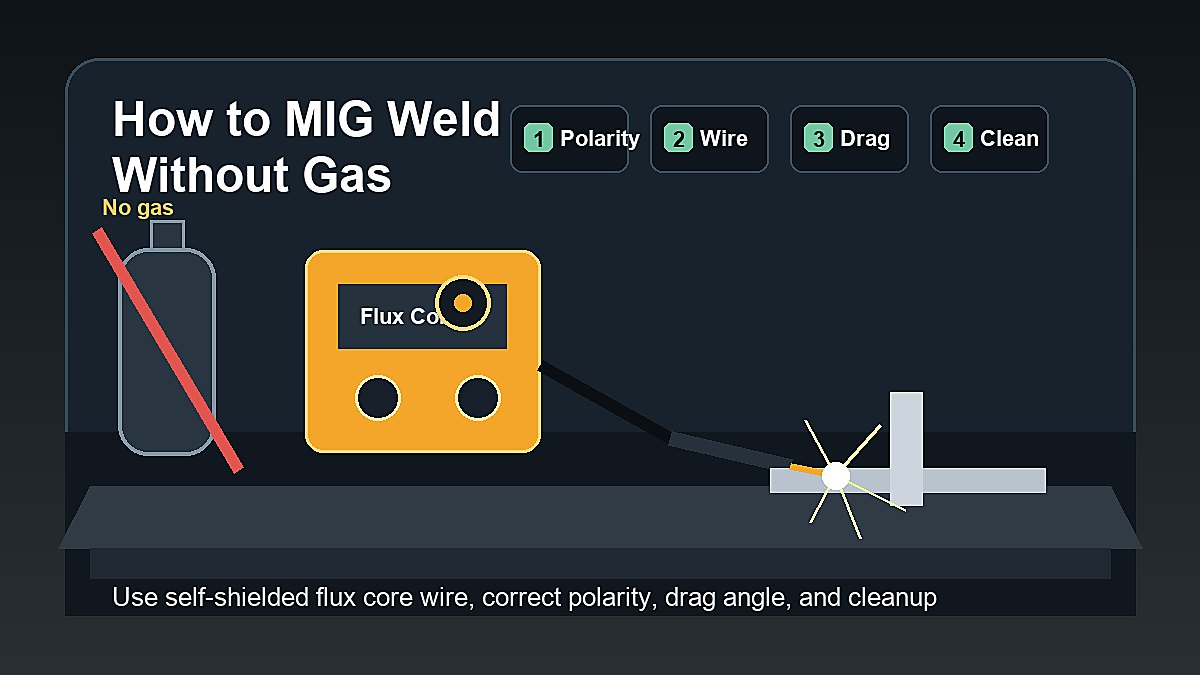
How to MIG Weld Without Gas for Beginners
Step-by-step beginner guide to MIG welding without gas using self-shielded flux core wire, with setup, polarity, technique, troubleshooting, and safety tips.
-
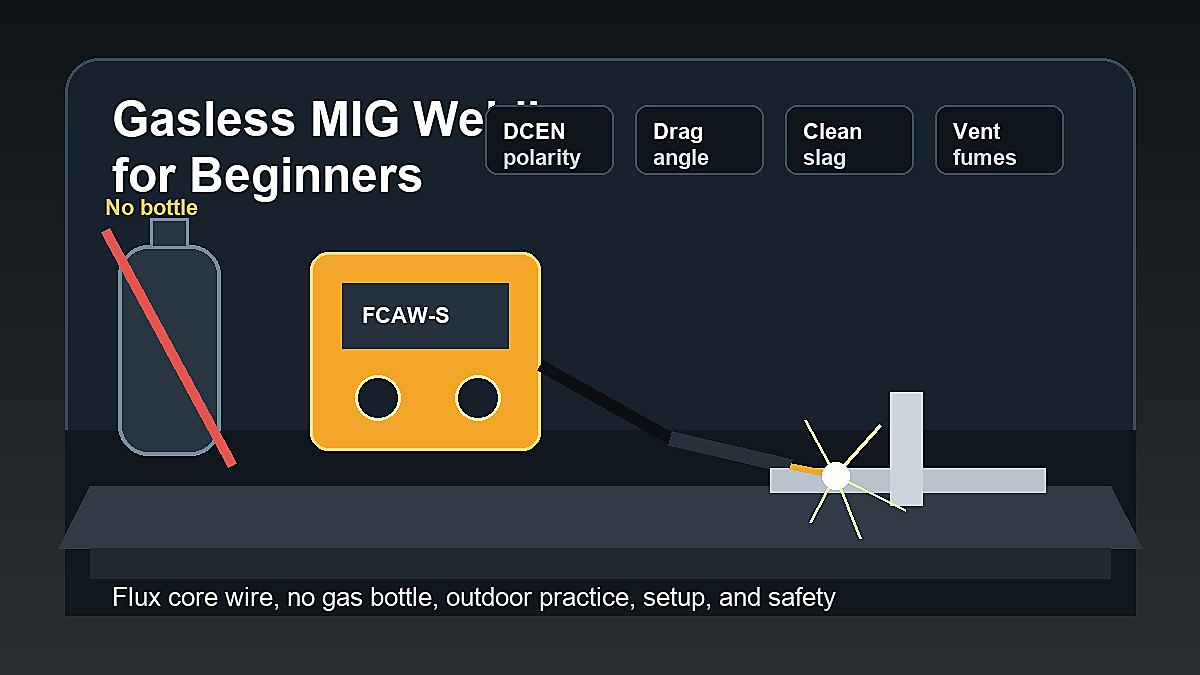
Gasless MIG Welding for Beginners
A beginner guide to gasless MIG welding with flux core wire, covering setup, polarity, wire speed, stickout, drag angle, slag cleanup, safety, and first…
Flux Core Welding FAQ
Is flux core welding good for beginners?
Yes, self-shielded flux core can be practical for beginners who need outdoor portability. Expect more slag, smoke and spatter than clean gas MIG work, and learn safety before practice.
Does flux core welding need shielding gas?
Self-shielded flux-cored wire does not need an external gas cylinder. Gas-shielded flux-cored wire does. Confirm the exact wire classification and manufacturer instructions.
Do you push or drag flux core wire?
Many self-shielded wires are used with a drag technique, but the correct method depends on the wire and application. Follow the manufacturer’s data rather than a universal slogan.
Can flux core weld thin sheet metal?
Some machines and wires can weld thin steel, but burn-through and distortion become harder to control. Confirm the machine’s range and practice on comparable scrap first.