MIG Welding Tips for Cleaner Welds
Cleaner MIG welds begin with stable wire delivery, correct shielding and a repeatable hand position. Spatter is a symptom to investigate, not a reason to change voltage, feed and gas flow simultaneously.
Use a fault-isolation routine
| Symptom | Inspect before adjusting |
|---|---|
| Wire stops or pulses | Tip, liner, drive-roll setup, spool drag and cable routing |
| Pores in the bead | Gas delivery, drafts, leaks and contamination |
| Wire pushes the gun back | Feed/voltage relationship and contact-tip condition |
| Edge melts away | Fit-up, travel and heat accumulation |
| Tall bead with poor edge tie-in | Parameters, travel and joint access |
The table narrows the investigation; it cannot diagnose a weld from a photograph. Stop and inspect the setup instead of covering a defective bead with more metal.
Separate machine trouble from hand movement
Make a short run on clean, matching scrap with your arms supported. Watch the leading part of the pool and both joint edges. Keep the gun position consistent enough that a settings change can be compared fairly. If the cable catches on the bench midway through the run, fix that first.
Use the door chart as the baseline for your exact wire and shielding gas. Record the displayed units: inches per minute and metres per minute are different scales. Numbered speed knobs are not automatically either unit.
Reduce cleanup by correcting the cause
Clean the joint before welding. Check tip wear and spatter buildup in the nozzle according to the manual. A dirty nozzle can interfere with shielding, while worn feeding components can make a once-good setting behave inconsistently. Turn off and isolate equipment as directed before servicing it.
Should I push or pull the gun?
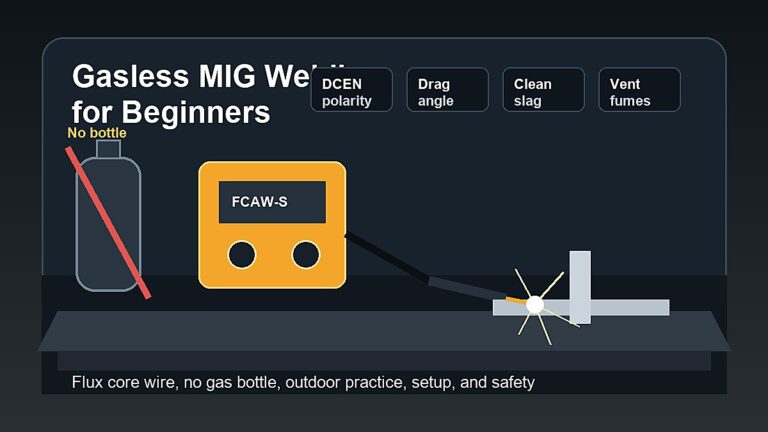
Use the technique appropriate to the selected wire and joint. A solid-wire MIG habit is not a universal rule for slag-forming flux-cored wire. Keep angle and distance repeatable while learning.
Can a hotter second pass repair porosity?
Do not assume it will. Identify the cause and remove or repair defects under an appropriate procedure. Critical joints need qualified assessment, not cosmetic coverage.
Continue learning
- MIG Welding Settings Chart for Beginners
- MIG Welding for Beginners
- Flux Core vs MIG Welding: Which Should You Use?
Sources and limits
This is an educational reference. Follow the exact equipment and consumable instructions; safety-critical welding needs appropriate qualifications, procedures and inspection.