MIG Welding History: From Early GMAW to Modern Control
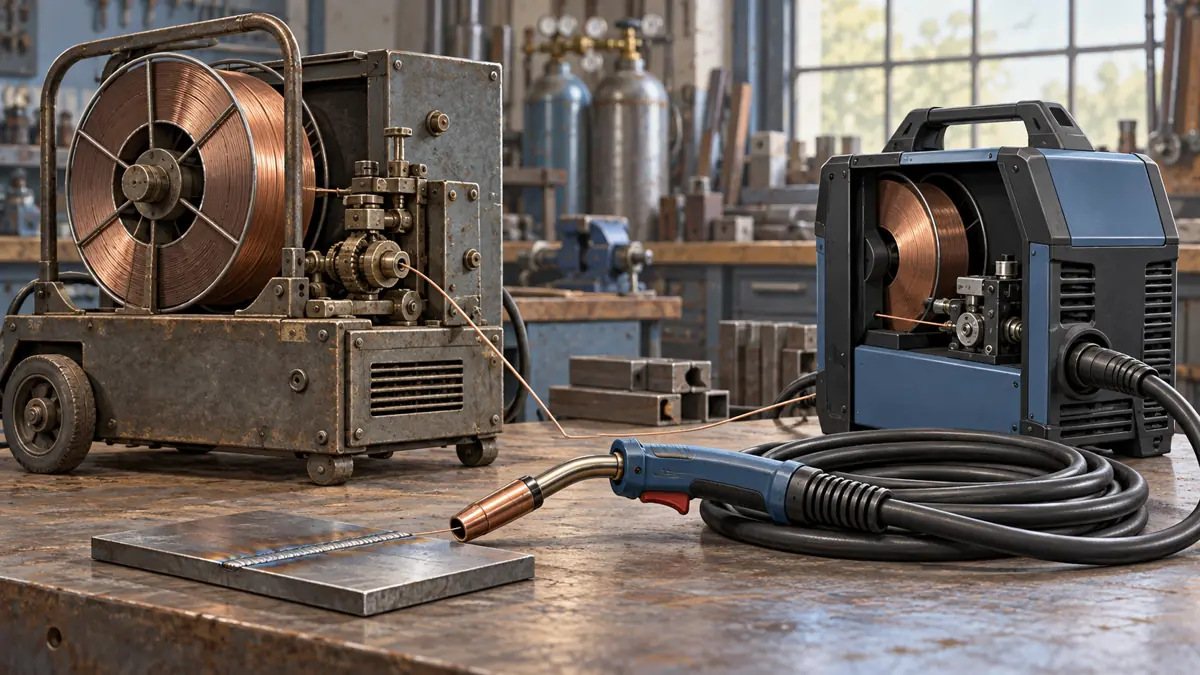
MIG welding’s industrial breakthrough dates to 1948, when the Battelle Memorial Institute developed gas metal arc welding under Air Reduction Company sponsorship. It began with nonferrous metals and grew into a wider family of wire-fed processes as shielding gases, power sources and metal-transfer control improved.
The history is easier to follow when you separate three questions: when an idea was demonstrated, when it was patented, and when it became practical for a particular job. Those events do not always share a date. An aluminum development and a later steel-production application can both be important without being the same “invention.”
A short MIG welding timeline
| Period | Development | What changed |
|---|---|---|
| 1920s | Experiments with gas protection and wire delivery | Earlier ideas supplied parts of the later process. |
| 1948 | Battelle’s GMAW development with Air Reduction sponsorship | Gas shielding and a continuously fed consumable electrode became an industrial process. |
| 1949 | Aluminum-welding patent milestone described by TWI | A patent date appears alongside the earlier development date in historical accounts. |
| 1950s | CO₂ shielding and later short-circuit transfer | Steel economics and thin-material applications expanded. |
| Early 1960s onward | Pulsed spray and improved power-source control | More deliberate control over how metal crosses the arc. |
| Later developments | Electronic waveform control and specialized variants | Manufacturers refined particular operating stages for particular applications. |
The early chronology is documented in TWI’s welding history; the transfer-control developments are also discussed in Lincoln Electric’s GMAW guide. Treat this as a timeline of useful milestones rather than an exhaustive patent history.
The idea combined wire feeding with gas protection
In MIG, the electrode is continuously supplied as wire and is consumed into the weld. Shielding gas protects the arc region and molten metal. That combination distinguishes the process from manually feeding a separate rod into a TIG puddle.
Earlier research mattered because wire delivery and protection from the atmosphere were separate technical problems. TWI describes Hobart and Devers experimenting with argon and helium protection in the 1920s, including nozzle arrangements that anticipated later gas-metal-arc work.
It is therefore misleading to picture the whole modern system appearing in one workshop on one day. A useful historical account follows the combination of ideas into equipment that could be used reliably, then follows improvements that made it suitable for more materials.
1948: an industrial breakthrough, initially for nonferrous work
Miller’s historical account identifies the Battelle/Air Reduction development in 1948. Early GMAW was introduced for nonferrous metals, including aluminum. The continuously fed electrode offered a route to greater deposition, but the cost of inert shielding gas limited its initial appeal for steel.
That economic detail explains why invention and widespread use are different milestones. A process can work technically yet remain unattractive when the consumables or operating requirements cost too much for the job. Later improvements addressed that barrier rather than simply making the same machine smaller.
Why some histories also mention 1949
TWI’s MIG process account describes a US patent for aluminum welding in 1949. Read alongside the 1948 development milestone, these dates refer to different stages. They should not be silently substituted for each other.
For a concise answer, identify which event you mean. “Developed in 1948” answers a different question from “patented for aluminum welding in 1949.” Naming the milestone also makes a timeline easier to check against its source.
This article summarizes the engineering histories linked here. It does not attempt to resolve the legal priority or scope of individual patent claims.
CO₂ shielding opened a more economical route for steel
Miller records Lyubavskii and Novoshilov announcing consumable-electrode welding in a carbon-dioxide atmosphere in 1953. It used equipment related to the inert-gas process while making steel welding more economical. Refinements in wire diameter and power supplies helped extend its usefulness.
The gas change also explains terminology that still confuses beginners. Strictly, MIG means metal inert gas; MAG means metal active gas. CO₂ and argon/CO₂ mixtures belong to the active-gas category. GMAW, or gas metal arc welding, is the broader name. TWI’s process guide makes this distinction.
In everyday conversation, “MIG” is often used more loosely. When selecting equipment or following a procedure, identify the actual wire, shielding gas and process requirements instead of relying on the casual label. Our flux-core versus MIG comparison helps separate another common wire-welding mix-up.
Short-circuit transfer expanded thin-sheet possibilities
Lincoln’s GMAW guide places the practical development of short-circuit transfer in the late 1950s. Improved power sources and smaller-diameter electrodes allowed lower-heat-input work on thin sections and opportunities for welding in different positions.
This was a change in how the electrode metal transferred to the work, not merely a new name for the shielding gas. In short-circuit transfer, the wire repeatedly contacts the pool or work as part of the operating cycle. Other transfer modes behave differently.
That distinction remains useful when reading an old article or a modern machine description. Knowing only that a weld is “MIG” does not tell you its transfer mode. Our beginner MIG techniques guide introduces practical control without treating every setup as identical.
Pulsed spray made current control a central part of development
Lincoln describes pulsed-spray development in the early 1960s, followed by further power-source advances in the 1970s. Switching between a higher peak and lower background current offered another way to manage transfer and average current.
The historical significance is the shift toward controlling the electrical cycle more deliberately. For a learner, the practical consequence is modest: a pulse-capable process has its own operating requirements. Its existence is not evidence that every pulse setting improves every joint.
Modern variants refine the cycle rather than replace the principle
Later development continued within the wire-electrode and gas-shielding framework. Fronius dates the introduction of Cold Metal Transfer, or CMT, to 2005. It is a manufacturer-specific development, not the invention date of MIG welding itself.
Another example is Miller’s Regulated Metal Deposition, a modified short-circuit process that controls metal transfer more precisely. These examples show why a modern history includes process control as well as the original feed mechanism.
Keep manufacturer claims attached to their particular process and application. A specialized variant’s capabilities should not be assigned to every machine sold with a MIG label.
What this history helps a beginner understand
WeldingPilot reading note: ask what problem each development solved. Early work combined continuous filler delivery and shielding; later changes addressed cost, material range, heat input and transfer control. That is more useful than memorizing a list of dates without the reasons behind them.
When comparing two machines or procedures, write down the material, wire, gas, transfer mode and required result. History explains why those variables exist; it does not supply settings or establish whether a particular weld is acceptable.
Frequently asked questions
Who invented MIG welding?
The industrial milestone is associated with Battelle Memorial Institute working under Air Reduction Company sponsorship. Earlier gas-shielding and wire-feed work also contributed, so naming one person without explaining the stage can oversimplify the history.
Was MIG welding invented for cars?
The early industrial development focused on nonferrous welding, including aluminum. Automotive sheet-metal work is one application that later equipment and process developments helped serve.
Are MIG, MAG and GMAW three unrelated inventions?
No. The names distinguish gas characteristics and the broader process family. Read them together with the actual shielding gas and transfer mode rather than treating the labels as interchangeable settings.