Welding Respirator for Beginners
A welding respirator for beginners can help reduce exposure to welding fumes, grinding dust, and some airborne particles when it is selected correctly, fitted properly, and used with ventilation. A respirator is not magic protection. It is one layer in a safety setup that should also include clean material prep, local exhaust when needed, and keeping your head out of the fume plume.
Welding fumes depend on the process, base metal, filler metal, coatings, cleaning chemicals, shielding gas, airflow, and work position. Mild steel practice in a ventilated garage is not the same as stainless steel, galvanized material, painted metal, confined-space work, or industrial repair.
Mark Dawson beginner note: do not use a respirator as permission to weld unknown or coated metal. If you do not know what the material is, what coating is on it, or whether the space has enough oxygen and ventilation, stop and verify before welding.
Quick Answer
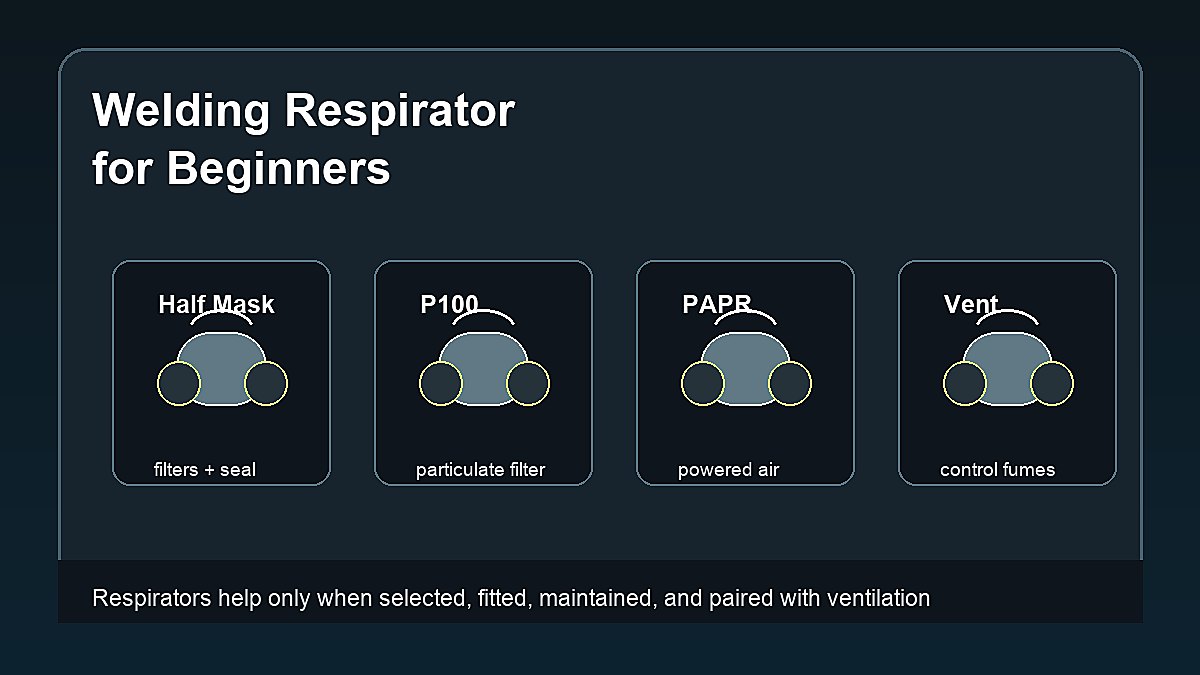
Most beginners who need respiratory protection for welding start by learning about half-mask elastomeric respirators with particulate filters such as P100 filters, but the correct respirator depends on the hazard. Respirators must fit your face, seal correctly, work under your helmet, use the right filters or cartridges, and never replace proper ventilation or qualified safety guidance for hazardous materials.
| Option | Best For | Beginner Note |
|---|---|---|
| Disposable respirator | Some dust and particulate tasks | Fit and approval still matter |
| Half-mask respirator | Reusable welding fume protection | Needs correct filters and seal |
| P100 filters | High-efficiency particulate filtration | Does not solve all gas or vapor hazards |
| Organic vapor cartridges | Some solvent or vapor hazards | Must match the contaminant |
| PAPR system | Higher-comfort powered protection | More expensive and training-sensitive |
What Welding Fumes Are
Welding fumes are tiny particles and gases created when metal, filler, flux, coatings, and contaminants are heated. The plume above the arc can include metal oxides and other byproducts. Grinding and cutting can add dust and particles before or after welding.
The exact hazard changes by job. Stick welding, flux core welding, MIG welding, TIG welding, plasma cutting, and grinding can all create different exposures. Stainless steel, galvanized steel, painted steel, plated parts, oily material, and unknown scrap require extra caution.
Good fume control starts before choosing a respirator. Clean the material, avoid welding through coatings, position your head away from the plume, and use ventilation or local exhaust when needed. For the full PPE picture, read Welding Safety Equipment for Beginners.
Respirator vs Ventilation
A respirator protects the person wearing it. Ventilation helps control the air around the work. Beginners sometimes treat these as interchangeable, but they are not. If fumes collect in the workspace, other people may still be exposed, visibility may suffer, and the work area can become unsafe.
Local exhaust ventilation, fume extraction, open airflow, and work positioning can reduce exposure before the air reaches your breathing zone. A respirator may still be needed, but it should support fume control rather than replace it.
Never use an air-purifying respirator in an oxygen-deficient or unknown atmosphere. Confined spaces, tanks, pits, and enclosed repairs require qualified procedures, monitoring, and training. A beginner should not guess in those conditions.
Half-Mask Welding Respirators
A reusable half-mask respirator covers the nose and mouth and uses replaceable filters or cartridges. Many welders use low-profile half masks that fit under a welding helmet. This style can be useful for particulate welding fumes when paired with appropriate filters.
The mask must seal to your face. Facial hair, wrong size, poor strap adjustment, dirty seal surfaces, or the wrong mask shape can cause leaks. If contaminated air leaks around the mask, the filter cannot do its job.
Check that the respirator fits with your helmet, safety glasses, and head position. If the helmet pushes the respirator out of place, the setup is not working. For helmet choices, read Types of Welding Helmets for Beginners.
P100 Filters and Cartridges
P100 filters are commonly discussed for welding because they are high-efficiency particulate filters. They can help with many particle hazards, including welding fume particles, when the respirator is approved, fitted, and used correctly.
Particulate filters are not the same as gas or vapor cartridges. If the hazard includes solvent vapors, paint fumes, gases, or chemical byproducts, the cartridge must match the contaminant. This is where guessing becomes risky. The filter label, manufacturer instructions, and safety data sheets matter.
Filters and cartridges do not last forever. Replace them when breathing resistance increases, when they are damaged, when the manufacturer schedule says to replace them, or when a qualified respiratory protection program requires it. Organic vapor cartridges need a change-out schedule; smell alone is not a safe warning system.
Disposable Respirators
Disposable filtering facepiece respirators may help with some particulate exposures, but they must be approved, fit correctly, and match the task. Ear-loop dust masks and nuisance masks should not be treated as welding respirators.
Disposable respirators can be harder to seal under some helmets and with facial hair. They also become dirty, crushed, wet, or difficult to breathe through. If a disposable respirator does not seal, it should not be trusted.
For many beginners who weld regularly, a properly fitted reusable half-mask with correct filters is more practical than relying on random disposable masks. The right answer still depends on the hazard.
PAPR Welding Helmets
A powered air-purifying respirator, or PAPR, uses a blower, filters, and a hood or helmet to provide filtered air. Some welding helmets are designed as PAPR systems. They can improve comfort and reduce breathing resistance, especially for longer work.
PAPR systems cost more and require correct setup, filter selection, battery care, airflow checks, and maintenance. They are not a shortcut around identifying the hazard. They also do not make oxygen-deficient or unknown atmospheres safe.
Beginners usually start with basic ventilation habits and properly selected PPE before considering a PAPR system. If fumes are a regular issue, especially in occupational work, get qualified safety guidance instead of improvising.
Fit, Seal Checks, and Facial Hair
A respirator only works when it seals. Facial hair under the seal area can prevent a tight fit. So can scars, face shape mismatch, poor strap tension, sweat, dust, or damaged mask edges. Beginners should learn the manufacturer’s seal-check steps before welding.
A user seal check is not the same as a formal fit test, but it is still an important habit. Adjust the respirator or stop using it when air leaks during the check. In workplaces where respirators are required, OSHA respiratory protection rules apply.
Do not loosen straps because the mask feels annoying. If the respirator is uncomfortable, try a different size or design. A loose respirator can feel easier to breathe through because it is leaking.
Materials That Need Extra Caution
- Galvanized steel and zinc-coated material.
- Stainless steel and high-alloy metals.
- Painted, plated, oily, or solvent-cleaned parts.
- Unknown scrap metal.
- Brake, vehicle, trailer, tank, or pressure-related parts.
- Confined spaces or enclosed repair areas.
- Any material with missing safety data or unknown coating.
These situations may require more than a beginner respirator choice. They may need coating removal, ventilation, exposure evaluation, specific cartridges, supplied air, professional procedures, or avoiding the job entirely until trained.
Beginner Buying Checklist
- Choose a respirator approved for the type of protection needed.
- Make sure it fits under your welding helmet.
- Confirm the filters or cartridges match the hazard.
- Check that the mask seals on your face.
- Keep replacement filters available.
- Read the respirator and welder manuals.
- Use ventilation and safe head position even with a respirator.
- Do not weld unknown or coated materials without proper guidance.
How to Match Filters to the Job
Filter matching is where many beginners get confused. Welding fume particles are not the same as solvent vapors, paint fumes, shielding gas problems, or oxygen deficiency. A particulate filter may help with particles, but it does not automatically protect against every gas or vapor created by coatings, cleaners, or heated chemicals.
Start by identifying the material and what is on it. Clean mild steel is simpler than painted steel, galvanized steel, stainless steel, plated parts, or unknown scrap. If the material has a coating or chemical residue, read the safety data sheet and avoid welding until the hazard is understood.
Do not mix random cartridges and masks from different systems unless the manufacturer says they are compatible. Respirator parts are designed as systems. A filter that fits poorly or is not approved for the facepiece can leak or fail.
Using a Respirator Under a Welding Helmet
A respirator must fit under the welding helmet without breaking the face seal. Low-profile half masks are common because they leave room for the helmet shell and lens. Larger masks can push against the helmet, shift when you nod, or interfere with looking down at the weld joint.
Test the setup before welding. Put on the respirator, do the seal check, add safety glasses if you wear them, lower the helmet, and move your head like you would during the weld. A shifting mask or poorly seated helmet means the combination needs to change.
Comfort also matters. If the respirator presses painfully under the helmet, you may loosen it without thinking. A loose mask can leak. A better-fitting respirator or helmet can be safer than forcing a bad combination to work.
Simple Ventilation Setup for Practice
For beginner practice, airflow should move fumes away from your breathing zone without blowing shielding gas away from the weld. This is a balance. A strong fan pointed directly at a MIG weld can disturb shielding gas and create porosity, but no airflow can let fumes collect around your face.
A better habit is to position your head to the side of the plume and use general airflow or local extraction to pull fumes away from you. Keep the work at a height where you do not need to hover directly over the arc. Good posture helps both weld quality and breathing-zone control.
Outdoor welding can still create fume exposure, especially if wind pushes the plume toward your face. Wind also affects shielding gas for MIG and TIG. Adjust position instead of assuming outdoors means automatic safety.
When to Replace Filters or Cartridges
Replace particulate filters when breathing becomes harder, when filters are damaged, wet, dirty, or loaded with dust, or when the manufacturer instructions say to replace them. Do not knock filters against the bench to clean them. That can damage the filter and send dust back into the air.
Gas and vapor cartridges are more complicated because they can become used up before you notice a smell. Workplaces use change-out schedules for this reason. Beginners should avoid jobs that require unknown cartridge life decisions unless qualified help is available.
Date new cartridges when opened and store them sealed as recommended by the manufacturer. Leaving cartridges exposed in the shop can shorten their useful life, especially around solvents, fuel, paint, or chemicals.
Respirator Limits Beginners Should Respect
A respirator cannot make every welding job beginner-safe. It does not identify unknown metal, remove fire risk, supply oxygen, or make confined spaces safe. It also does not protect helpers, visitors, or other people nearby unless they have their own correct protection.
If you feel dizzy, short of breath, irritated, sick, or unusually fatigued while welding, stop. Move to fresh air, shut down safely, and reassess the work. Do not keep welding because the respirator is on your face.
Respiratory protection is a serious safety area. For workplace use, required respirators involve medical evaluation, fit testing, training, and a written program under OSHA rules. Home users should still treat selection and fit with respect, even outside a formal workplace.
Care and Storage
Respirators need maintenance. Wipe the face seal, inspect straps, check valves, and replace filters as needed. Store the respirator in a clean bag or container away from welding dust, grinding grit, solvents, and direct damage.
Do not leave filters open on a dirty bench beside grinding dust or solvent containers. Do not share a dirty facepiece. Replace a cracked, warped, incomplete, or hard-to-seal mask.
Respirator care should become part of the same routine as checking gloves, boots, lenses, and clothing. For related PPE, see Types of Welding Gloves for Beginners and Welding Boots for Beginners.
Common Beginner Mistakes
- Using a dust mask as if it were a welding respirator.
- Buying filters without matching them to the hazard.
- Welding coated or unknown metal because a respirator is available.
- Ignoring ventilation and keeping the head in the fume plume.
- Using a mask that does not fit under the helmet.
- Wearing a respirator over facial hair that breaks the seal.
- Keeping old cartridges with no change-out plan.
- Using air-purifying respirators in confined or unknown atmospheres.
Safety Notes
Respirators can reduce exposure only when selected, fitted, used, and maintained correctly. They do not replace ventilation, material identification, safe procedures, or professional safety guidance. Welding fumes can be hazardous, and some materials require controls beyond beginner PPE.
Review OSHA respiratory protection, OSHA welding hazards guidance, NIOSH respirator approval information, and AWS safety resources.
FAQ
Do beginners need a respirator for welding?
Some beginners may need one depending on the material, process, ventilation, and fume exposure. Even with a respirator, use ventilation and keep your head out of the plume.
Is a P100 filter good for welding fumes?
P100 filters can help with particulate welding fumes when used on an approved, properly fitted respirator. They do not solve every gas, vapor, coating, or oxygen-deficiency hazard.
Can I use a regular dust mask for welding?
A regular dust mask should not be treated as a welding respirator. Respiratory protection must be approved, fitted, and matched to the hazard.
Can I weld galvanized metal with a respirator?
Do not rely on a respirator alone for galvanized metal. Zinc-coated material can create serious fume hazards and requires proper controls, ventilation, coating removal where appropriate, and qualified guidance.
Does a respirator replace ventilation?
No. Ventilation controls fumes in the work area. A respirator protects only the wearer when it is selected and fitted correctly. Use both when the hazard calls for it.
Final Advice
For beginners, a welding respirator should be chosen by hazard, fit, filter type, and compatibility with the helmet. Start with clean material, good airflow, and safe head position. Use a properly selected respirator when needed, and get qualified help for coated metals, confined spaces, stainless, galvanized material, or unknown hazards.