Welding Rod Numbers Explained
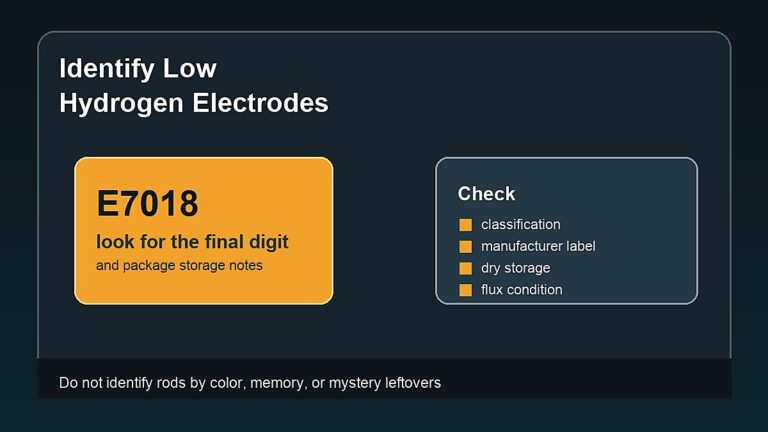
A stick electrode label such as E7018 describes the electrode classification. It does not give you the rod diameter or a universal amperage setting. Read the number first, then check the exact product label for current, polarity and storage instructions.
Read E7018 from left to right
| Marking | Meaning | What it does not tell you |
|---|---|---|
| E | Electrode | Whether your machine can run it well |
| 70 | Minimum tensile-strength classification of deposited weld metal: 70,000 psi | The load capacity of your finished joint |
| 1 | All-position classification, subject to product and procedure restrictions | Permission to weld in any direction with any technique |
| 18 | Coating/current classification read as a pair | A stand-alone amperage setting |
Treat the last two digits together when choosing current and coating characteristics. Additional suffixes carry more information. For example, the Lincoln Excalibur E7018-1 H4R datasheet lists toughness and hydrogen/moisture-related classifications as well as operating ranges. Those suffixes are not decoration.
Compare common numbers before buying
6010, 6011, 6013 and 7018 are different electrode families, not a ladder from bad to good. A higher strength number does not automatically improve a joint made with incompatible filler or poor fusion. Choose a classification specified for the base metal, machine and application; choose diameter separately.
For a concrete example, a 1/8-inch 7018 and a 3/32-inch 7018 share a classification but require different operating ranges. Conversely, two 1/8-inch rods with different classifications can need different current and handling. Photograph the package label before throwing it away so you can identify both variables later.
A label-reading exercise
Take one unopened packet. Write down the classification, diameter, permitted polarity and manufacturer current range. Look up its datasheet and compare those details with your welder manual. If the packet is unmarked or the coating is damaged, set it aside rather than identifying it by color alone.
Does 7018 mean a weld will hold 70,000 pounds?
No. Tensile strength is a stress classification, not a total weight rating. Joint geometry, material, defects and inspection determine whether a weld is suitable for service. Structural and other safety-critical welding needs a qualified procedure and inspection.
Can I select amperage from the rod number alone?
No. You also need diameter, exact product, polarity and welding position. Use the manufacturer's range as your starting reference.
Continue learning
Sources and limits
This is an educational reference. Follow the exact equipment and consumable instructions; safety-critical welding needs appropriate qualifications, procedures and inspection.