Best Welding Helmet for Glasses: Fit Before Brand
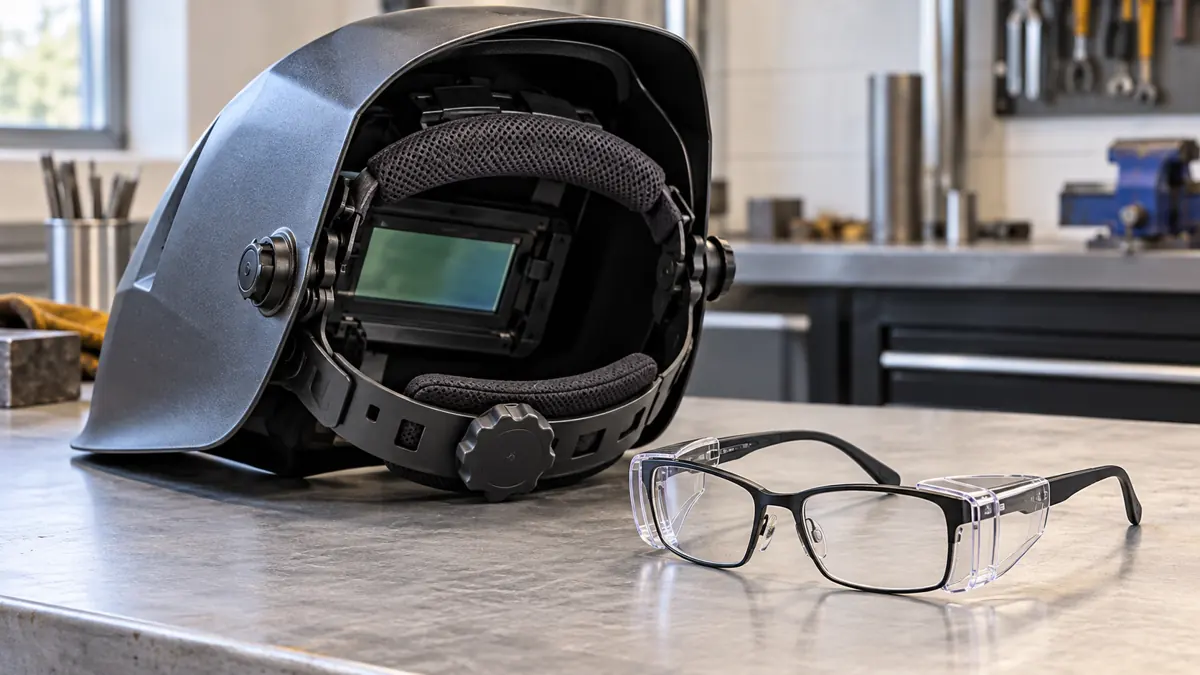
The best welding helmet for glasses is one that accommodates your required protective eyewear without pushing it out of position. Start with adjustable headgear, usable clearance around the frame, and a clear view of your normal joint. A large viewing window alone does not tell you whether your glasses will fit.
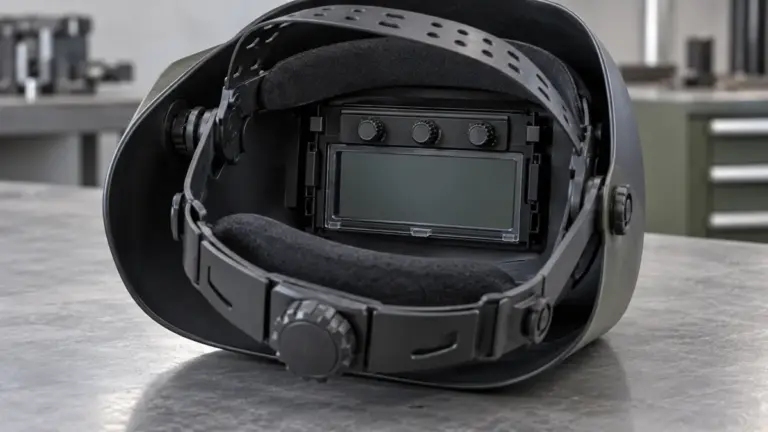
Two models worth trying are the Miller Digital Performance Black 296757 with Legacy headgear and the Lincoln VIKING 2450 ADV Black K3028-5 with X6 headgear. Their documented adjustment features give you something specific to evaluate. Neither is guaranteed to fit every face, prescription frame or over-glasses protector.
Research note: manufacturer information and occupational eye-protection guidance checked October 15, 2026. WeldingPilot has not worn these helmets with different glasses or measured internal clearances. This guide offers a conditional shortlist and a fit-check process, not a universal product winner.
Start with the eyewear you actually need
Ordinary prescription glasses provide vision correction; do not assume that makes them industrial eye protection. NIOSH’s guidance on selecting eye protection distinguishes regular ophthalmic eyewear from industrial protective eyewear and explains that frames and lenses must meet the relevant protective requirements.
For workers who wear prescription lenses, OSHA 1910.133(a)(3) requires suitable eye protection incorporating the prescription or protection worn over prescription lenses without disturbing either pair’s proper position. The standard also addresses side protection against flying objects.
That means the fitting task may involve prescription safety glasses, or regular prescription glasses plus a suitable over-glasses protector. Try the helmet with the complete arrangement you will use, rather than testing it over a smaller everyday frame and assuming the result transfers.
Two helmets to try, with specific questions
| Candidate | Documented feature | What to check with your glasses |
|---|---|---|
| Miller Digital Performance Black 296757 | Legacy headgear; the Legacy product page lists tilt, angle and depth adjustments | Can you position the window naturally without pressure on the frame or displaced eyewear? |
| Lincoln VIKING 2450 ADV Black K3028-5 | X6 headgear with forward/backward and other fit adjustments | Can the supported adjustment range provide clearance while keeping the helmet stable and properly positioned? |
The table does not rank measured glasses clearance. Ask a supplier for a fitting opportunity or suitable return terms, and confirm the headgear fitted to the exact supplied revision.
Miller Digital Performance: evaluate the Legacy adjustment
Miller’s page for Black 296757 identifies Legacy headgear. The separate Legacy 290460 product page lists tilt, angle and depth adjustment. Those are useful features to investigate when a fixed helmet position presses on your glasses or misaligns your view.
Try the approved adjustments while wearing the actual protective eyewear. Check both the lowered and raised positions: lifting the helmet should not drag the glasses off your nose or catch the temples. Confirm the result while looking down at a typical bench joint.
Choose only if the complete combination works for you and the filter suits your welding. These headgear features do not establish compatibility with a particular prescription frame. See Miller’s Digital Performance listing.
Lincoln 2450 ADV: evaluate fore-and-aft positioning
The 2450 ADV brochure identifies Black K3028-5 and X6 headgear with forward/backward adjustment, adjustable top support and other fit controls. This makes it a candidate to compare when the face-to-filter position is part of your problem.
Use the actual instructions for the supplied helmet. Adjust within the intended range, then check stability, coverage and eyewear position together. Moving a helmet farther from your face is not a successful solution if it leaves the equipment poorly positioned or unstable.
The ADV name also covers features unrelated to glasses clearance. Separate those from the fit decision. Digital controls or a task light cannot make a frame fit beneath a shell that contacts it in your normal posture.
A practical fit check with the welding equipment off
- Put on the full eyewear arrangement. Include required side protection or an over-glasses protector, plus other PPE normally worn at the task.
- Adjust the suspension. Follow the manual for depth, tightness, angle and any distance adjustment. The helmet should stay in position without forcing your eyewear to move.
- Lower and raise the helmet. Watch for contact at the bridge, temples, lenses and upper frame. Check that lifting it does not pull the glasses forward.
- Look at a normal joint. Use your usual working distance and posture. Check whether you can locate the joint without pushing the glasses up or tilting the helmet out of position.
- Move as the task requires. Look down and turn your head. Check that the arrangement remains stable rather than judging only a straight-ahead pose.
- Evaluate other PPE together. If equipment interferes, seek a compatible combination. Do not remove required protection or modify a shell to make room.
This is a practical purchasing check, not a certification test or a replacement for the manufacturer’s pre-use checks. It should be done without an arc. A supplier demonstration must follow the equipment instructions and appropriate protective procedures.
Separate poor clearance from poor visibility
Glasses touching the helmet, scratched cover plates, a poorly lit joint and an unsuitable viewing position are different problems. Identify which one you have before buying a more expensive helmet.
Miller’s helmet-selection guidance discusses viewing area, light state and the need for safety glasses underneath. Those viewing features can matter, but they do not replace a physical fit check.
If a surface is fogged, stop in a safe condition and restore a clear view using care methods approved for that surface. Prescription coatings, protective eyewear and helmet cover plates can have different cleaning requirements. Do not apply an unapproved household coating or keep welding through a poor view.
If the prescription or eyewear fit itself needs attention, have that reviewed by the appropriate eye-care professional. A different helmet does not establish that the correction is suitable for your working distance.
Do not use a lighter welding shade to solve blur
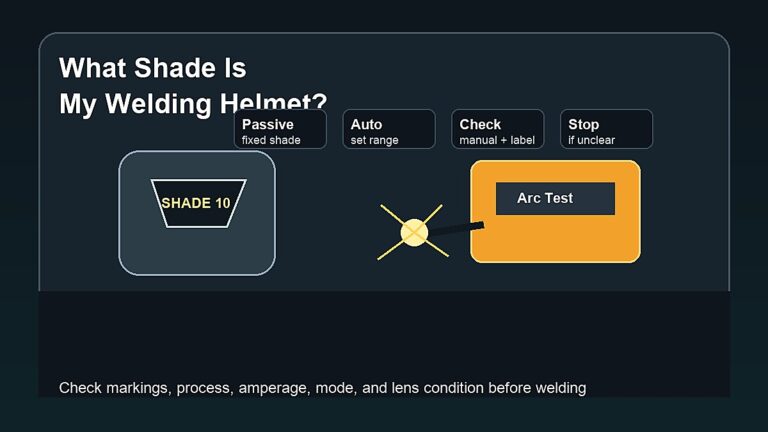
Choose the protective filter for the operation, current and applicable instructions. First check clear covers, lighting, position and eyewear condition if the joint is difficult to see. Do not reduce protection below the required level to compensate for a fit or vision problem.
A magnifying insert is also separate from protective eyewear and the welding filter. Confirm the approved insert and holder if you use one; do not treat it as permission to discard required prescription safety eyewear. Our welding lens shade chart explains the protective-shade decision.
For a broader starting point, see our beginner helmet selection guide. The right purchase combines suitability, stable fit and a usable view, rather than one feature advertised as glasses-friendly.
Common glasses and helmet questions
Will any large-view helmet fit over glasses?
No. Viewing area describes the window. It does not specify the space around the frame, nose or temples. Try the exact helmet with your complete eyewear arrangement.
Can I wear ordinary prescription glasses under a helmet?
You still need the eye protection appropriate to the hazards. Ordinary prescription glasses alone should not be assumed to meet that requirement. Use suitable prescription protective eyewear or a compatible over-glasses solution as required.
Should I buy prescription safety glasses before the helmet?
Establish the required protective-eyewear arrangement first, then fit the helmet with it. If both purchases are new, coordinate them rather than assuming either will accommodate the other.
Is either shortlisted model guaranteed to work for me?
No. The adjustment features justify a fitting trial; they do not prove universal clearance. Keep the final decision conditional on fit, protective requirements and the exact supplied version.