Best Budget Welding Helmets Under $100: 3 Options
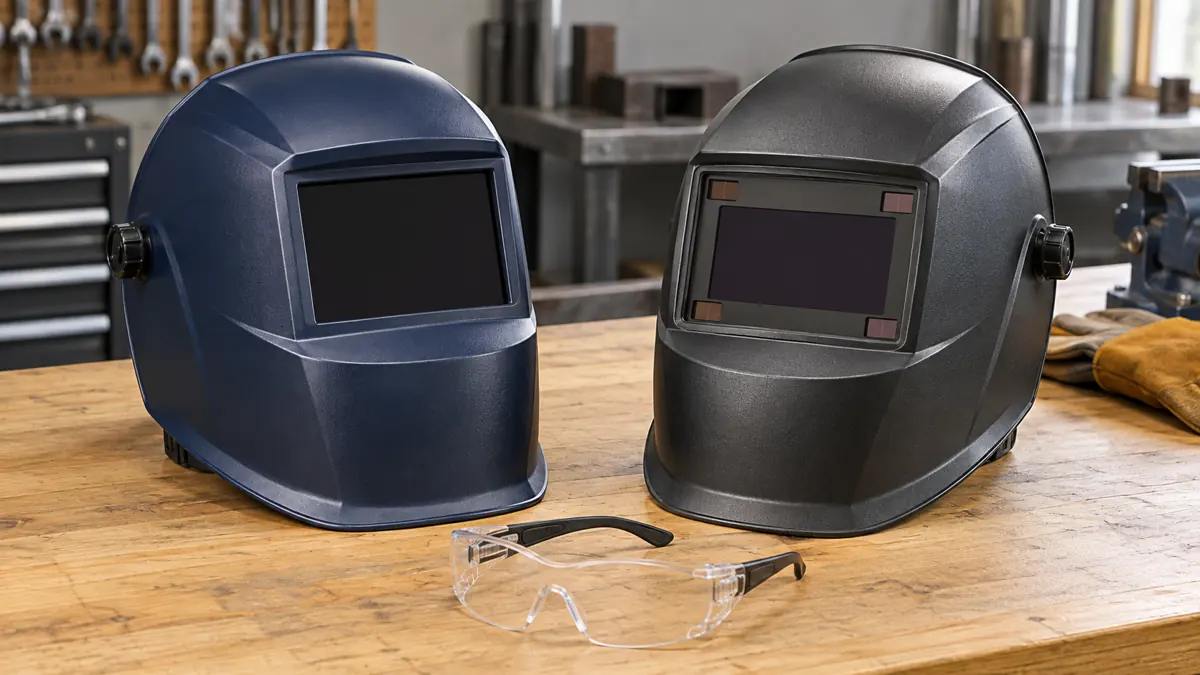
A useful shortlist of budget welding helmets under $100 starts with three different choices: the Hobart Pillar 770860 for fixed-shade auto-darkening, the TITANIUM 58059 for a larger variable-shade option, and the Hobart passive 770264 for a lower-cost fixed lens. They do not offer the same functions, and the TITANIUM needs an extra check because its current product page and one linked manual disagree on several specifications.
If your work calls for shade 10, compare the Pillar and passive Hobart by fit and the way you prefer to position the helmet. If you need selectable shades, investigate the TITANIUM’s exact supplied revision before choosing. A helmet that cannot meet your task requirements is not a bargain, even when the price fits.
Research note: US advertised prices and primary manufacturer information checked October 15, 2026. This is a specification-based buying guide. WeldingPilot has not tested these helmets’ optical quality, comfort, triggering performance or durability.
Three under-$100 options, with different limits
| Exact product | Advertised item price | Type | Main buying limit |
|---|---|---|---|
| Hobart Pillar Black 770860 | $85.06, Hobart Weld Shop | Auto-darkening to fixed shade 10 | No variable welding shade or grind mode |
| TITANIUM 9.3 sq. in., item 58059 / TI-TCWH9 | $99.99, Harbor Freight | Variable-shade auto-darkening | Confirm exact UPC and matching specifications; virtually no checkout-budget margin |
| Hobart passive fixed-front 770264 | $35.20, Hobart Weld Shop | Passive fixed-shade helmet, supplied with shade 10 | No automatic light-to-dark change |
These are item prices before applicable tax, delivery and extras. They are not a promise of a complete delivered purchase below $100. Price sources: Pillar offer, TITANIUM offer, and passive Hobart offer. Recheck the exact item and checkout total before ordering.
Hobart Pillar: auto-darkening without a selectable welding shade
The Pillar 770860 changes from its light state to shade 10 when activated. Hobart lists a 6.2-square-inch viewing field, two arc sensors and a weld-only operating mode. It is an auto-darkening helmet even though you cannot select a different welding shade.
This distinction matters. “Auto-darkening” describes the lens changing state; “variable shade” describes the ability to choose the dark setting. The Pillar gives you the first function, not the second. It also has no grind mode, so do not buy it expecting the task-switching functions found on more adjustable models.
Shortlist it when the exact instructions and your task’s shade selection support shade 10. Do not treat shade 10 as a universal MIG, stick or TIG setting. Check Hobart’s Pillar technical sheet and the instructions for the supplied helmet.
TITANIUM 58059: more adjustment, but verify the revision
Harbor Freight advertises a 9.3-square-inch viewing area, four sensors, digital adjustments and grind mode for item 58059. At $99.99, it sits just one cent below the item-price limit.
There is a specification conflict worth resolving before purchase. The product page lists TIG at 10+ amps. The linked 2026 manual for UPC 193175583338 lists TIG at 2+ amps and also differs on shade details. The same manual excludes oxyacetylene welding/cutting, although the product-page application list includes it.
Do not combine the more favorable claims into a single recommendation. Ask Harbor Freight which UPC is being supplied and obtain its matching instructions. In particular, this guide does not recommend the item for low-current TIG or oxyfuel work while that question remains unresolved. The 2026 UPC-specific manual shows why a shared SKU is not enough to identify every operating limit.
It remains a candidate to investigate for selectable-shade arc-welding work. Confirm the actual range and suitability first, then compare fit and usable controls. Window size and sensor count alone do not settle either question.
Hobart 770264: the passive alternative
The 770264 is a fixed-front passive helmet supplied with a shade-10 lens and adjustable headgear. It has no automatic light-to-dark transition. Hobart’s Passive Series technical sheet identifies it separately from the flip-front models and lists specified replacement lenses and covers.
Consider it if a suitable fixed lens matches your work and you are comfortable positioning with a passive helmet. The lower item price leaves more room for the rest of the required equipment. It does not establish that the helmet is more protective or a better fit than an auto-darkening model.
Before choosing, practise lowering it with the welding equipment off. Check whether you can maintain your position without exposing your face or losing the intended start point. If the supplied shade is unsuitable, verify the exact approved replacement rather than improvising a lens assembly.
Make the $100 limit mean the right thing
Decide whether $100 means the helmet alone or the complete purchase. The distinction changes this shortlist: the TITANIUM leaves $0.01, the Pillar leaves $14.94, and the passive Hobart leaves $64.80 before reaching $100. Those amounts still have to accommodate any tax, shipping and immediately needed extras.
Use the actual checkout total. Include the correct clear covers and any other required PPE you do not already own. Do not rely on an expired coupon or assume that a member-only offer applies to you. Store pickup may change delivery cost, but it does not remove applicable tax.
If the hard limit buys a helmet that lacks the required shade or application capability, change the purchase plan. Ask an instructor or workplace equipment provider about suitable options. Do not try to make incompatible protective equipment acceptable through a different technique.
Five checks before buying a budget helmet
- Identify the task. Record process, current range and the appropriate protective shade before comparing prices. Use our welding lens shade chart as a starting reference alongside the exact equipment instructions.
- Confirm the exact version. Match model, item number, UPC where relevant, included filter and manual. Product-family names are not enough when revisions differ.
- Check fit without an arc. Wear the required eye protection, adjust the headgear, look at a normal joint and bend as you would at the bench. Check for slipping or contact with glasses.
- Find the service parts. Ask for the correct clear covers, lens holder and headgear. For an electronic model, check its specified power arrangement and replacement procedure.
- Read return and support terms. Know how to address an incorrect version, damaged component or fault before your first use. A customer rating is not a protective specification.
Use the helmet within its documented limits
OSHA’s eye and face protection standard calls for a filter shade appropriate to the work. It also addresses flying-object protection and compatibility with prescription eyewear. Price and automatic darkening do not replace those requirements.
Use appropriate primary eye protection with the helmet, as described in OSHA’s eye-protection guidance. Follow the model’s inspection and function-check instructions. Stop using equipment that is damaged, incorrectly assembled or behaving inconsistently; do not expose your eyes to an arc to investigate a doubtful filter.
Where a model has grind mode, confirm welding mode before the next arc. Where it does not, arrange the appropriate grinding protection separately. Our helmet-use guide covers the broader preparation routine. A standard welding helmet alone does not provide respiratory protection.
Common budget questions
Which one should a beginner compare first?
For work that appropriately uses shade 10, compare the Pillar’s auto-darkening operation with the passive Hobart’s fixed lens. If the work needs selectable shades, investigate the TITANIUM revision and its limits before buying. Fit and documented suitability decide the final choice.
Is a fixed-shade auto-darkening helmet the same as a passive helmet?
No. A fixed-shade auto-darkening lens changes between light and one dark setting. A passive lens remains at its selected dark shade. Neither description tells you whether that shade suits your particular task.
Can a $99.99 helmet satisfy a $100 total budget?
Only if the final payable amount remains within the limit. Any additional charge greater than one cent takes that purchase above $100.
Should I buy only by the largest window?
No. Establish the required operating range, reliable documented configuration and fit first. Then compare the view. A large window cannot compensate for unsuitable protective settings.