Projection Welding Parameters Chart: Weld-Nut Examples
A projection welding parameters chart is useful only when its fastener, sheet and equipment conditions match the job. Current, weld time and electrode force work together; thread size alone does not define a weld schedule. Start with the fastener supplier’s information, then establish and verify a suitable schedule on the actual assembly.
The chart below is a clearly scoped published weld-nut example. It is followed by the checks needed to read it correctly, record a trial and avoid confusing a destructive-test value with an installation torque.
Example chart: square weld nuts on 1 mm sheet
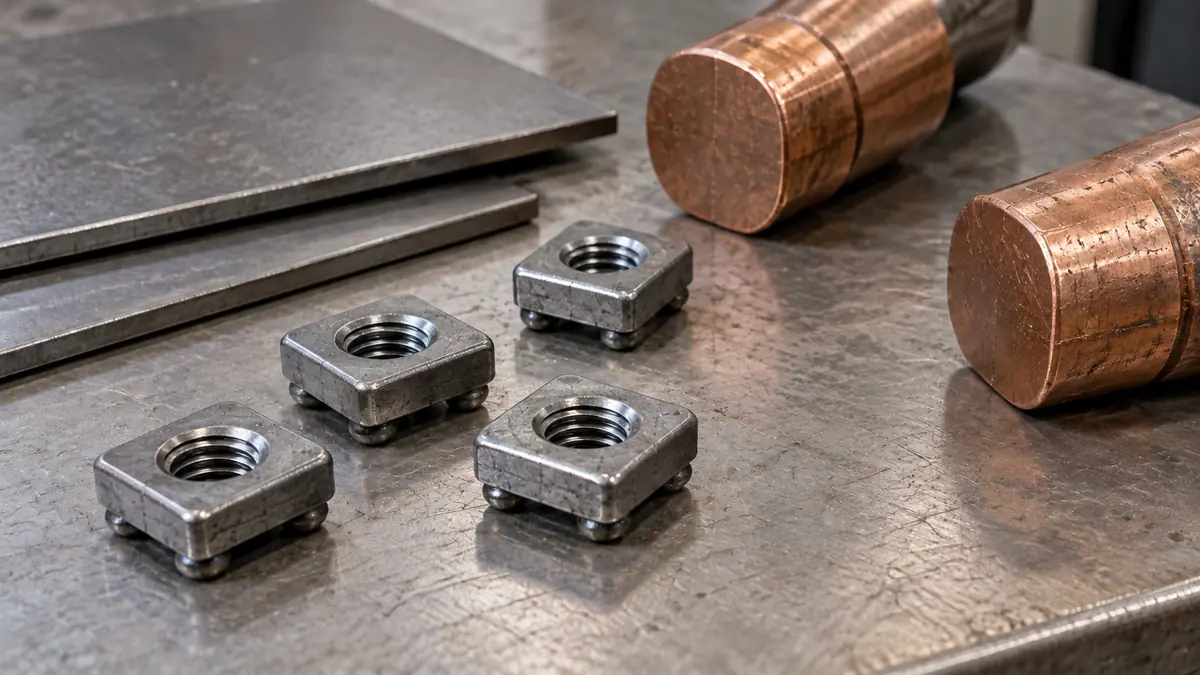
TWI provides these setup examples for square nuts to BS 7670 joined to 1 mm sheet. Preserve that scope when using the numbers. They are not a universal table for every M5, M6 or M8 nut, sheet coating or welding power source.
| Nut size | Electrode force (kN) | Weld duration (cycles) | Approximate current (kA) | Typical minimum torque to failure (N·m) |
|---|---|---|---|---|
| M5 | 3.6 | 5 | 9 | 12 |
| M6 | 4.2 | 6 | 10.5 | 20 |
| M8 | 4.9 | 9 | 17 | 50 |
Read before entering values: the cited page does not state the sheet grade, coating or timing frequency alongside this table. Keep those omissions visible. Obtain the missing application details before turning an example into a machine program.
The last column describes a destructive-test benchmark in that example. It is not a bolt-tightening torque for the finished product. TWI also calls for supporting destructive assessment of the individual projection welds rather than relying on torque alone.
Why another M6 chart can give different numbers
Compare the part, not just its thread. PennEngineering’s WN-M6-0CU product page lists installation information for its own self-locating projection-weld nut. Its cold-rolled-steel installation row lists 2,440–2,670 N ram force, 20,000 A secondary current with a stated ±500 A heading, and 10 cycles / 0.17 seconds.
Those values should not replace the TWI row or be averaged with it. They describe a different identified fastener and supplier setup. The product page separates installation rows from performance-test rows; preserve those distinctions when collecting data.
This comparison is useful precisely because it prevents a false shortcut. “M6” identifies the thread, but does not establish projection geometry, contact conditions, sheet details or the machine arrangement.
What the main schedule fields mean
In resistance projection welding, the projection localizes contact and helps concentrate the joining action. Geometry matters: an annular projection is not simply several nut projections joined into a ring. TWI’s annular-projection guidance explains the importance of the localized contact area and projection design.
| Field | What to establish |
|---|---|
| Welding current | Actual specified current and measurement basis, rather than an assumed equivalent percentage. |
| Weld time | Duration and timing units for each current pulse or stage. |
| Electrode force | Required force at the work and how the machine verifies it. |
| Squeeze time | Time for contact and force to establish before current begins. |
| Hold time | Time the electrodes remain in contact after the weld-current interval. |
| Additional stages | Any impulses, cooling intervals or force changes required by the approved schedule. |
The ENTRON EN1000/EN1001 manual distinguishes squeeze, weld/heat, hold and other timed functions. These are separate parts of a sequence. Extending squeeze time does not mean that welding current flows for longer.
The same manual describes a percentage-current control in terms of conduction time and discusses separate constant-current operation. A percentage shown on one control is therefore not a portable kA value that can be copied to another machine without verification.
Keep cycles, milliseconds and force units separate
If a timing value means complete line-frequency cycles, the conversion is:
Time in milliseconds = cycles × 1,000 ÷ frequency in hertz.
As arithmetic examples, six complete cycles equal 120 ms at 50 Hz and 100 ms at 60 Hz. These examples do not establish the frequency behind the TWI chart. Some equipment uses different timing conventions, so read the particular controller instructions before converting.
Similarly, 1 kA equals 1,000 A and 1 kN equals 1,000 N. Air-pressure units and electrode-force units describe different quantities. Use the machine’s specified force-setting or verification method rather than treating a pressure gauge as a direct force reading.
A useful transcription check is to read each recorded value aloud with its unit: “ten point five kiloamps,” not “ten point five.” It makes a missing unit easier to catch before someone uses the sheet.
Check head movement as well as static settings
The weld head must respond as the joint changes during welding. A force setting on a stationary assembly does not describe every part of its dynamic behavior. AMADA WELD TECH’s SL-300A manual discusses follow-up performance and how head force and moving mass affect the ability to follow material deformation.
For nut welding, have the equipment and tooling assessed for the actual application. Check alignment, locating arrangements, electrode condition, cooling and repeatable seating using the supplier’s instructions. Do not compensate for an unstable arrangement by changing current until one sample happens to pass.
Build a trial record that another person can reproduce
WeldingPilot setup note: keep the source example and the trial results in different columns. A published starting value should not quietly become labeled “approved” simply because it has been copied into a spreadsheet.
Record these items before comparing trials:
- Fastener manufacturer, part number, revision and projection configuration.
- Sheet grade, thickness, coating and surface condition.
- Machine, power-source type, controller, program and electrode/tooling identity.
- Force, current, timing units, pulse sequence and relevant measured results.
- Sample identity, test method, acceptance requirement, observations and reviewer.
Make controlled comparisons under an appropriate development plan. A published study of M6 square nuts on 1.5 mm pickled hot-rolled steel investigated the interaction of current, time and force against pull-out load. Its deliberately identified materials illustrate why a result is tied to a particular experiment; its model is not automatically your production schedule.
Verify the joint rather than its appearance
Set the required test and acceptance criteria before trials. Torque, push-off, peel and other assessments answer different questions and must follow the applicable method. A nut that resists hand movement is not evidence that every projection produced an acceptable weld.
Use the component supplier’s and product’s requirements to determine the tests, sample plan and release decision. Keep destructive samples traceable. For a process comparison, our spot-welding introduction explains the related resistance process without treating its settings as a nut-welding chart.
Resistance welding also creates mechanical, electrical, hot-metal and expulsion hazards. Use the machine’s guarding and isolation procedures, keep hands out of the electrode closing area and obtain appropriate training. OSHA’s resistance-welding requirements address equipment protection and guarding.
Frequently asked questions
Can I use the M6 row for any six-millimeter weld nut?
No. Identify the fastener and projection design, sheet and equipment conditions first. The two published examples above show why the thread designation does not define one schedule.
Is torque to failure the assembly tightening torque?
No. Destructive testing of the weld and tightening a service bolt are different tasks. Obtain the correct fastening requirement for the finished assembly.
Can I convert an AC chart directly into an MFDC program?
Do not assume equivalence from matching displayed numbers. The power source and control conventions must be accounted for, and the resulting schedule requires appropriate development and verification.